Category Archives: hoops

Tuesday Truths: “On the shoulders of giants” edition

DES

(newsobserver.com)

It may have been pure chance that the genius who invented the very idea of advanced stats also happened to be: a) the most successful college basketball coach not named “John Wooden” up to his time; and b) one of the finest and most praiseworthy people you would ever wish to encounter. His idea’s sheer power was such that it would have made basketball divulge its secrets even if the man who first conceived of it had been an imperious egoist with a losing record. However the fact that the man was none of those things would prove convenient for me personally on more than one occasion.

Whenever those of us who were following gratefully in these footsteps were told that what we were doing was somehow threatening or peripheral, contrived or irrelevant, abstruse or faddish, the plain truth always sufficed as a response. Always.

Read more about a brilliant man who was doing this stuff when Bill James was still in grade school. And at at the other end of the timeline, the story on the college basketball side from Dean Oliver through 2013 has also been summed up nimbly.
Continue reading

Tuesday Truths: “Undivided attention” edition

Caption.

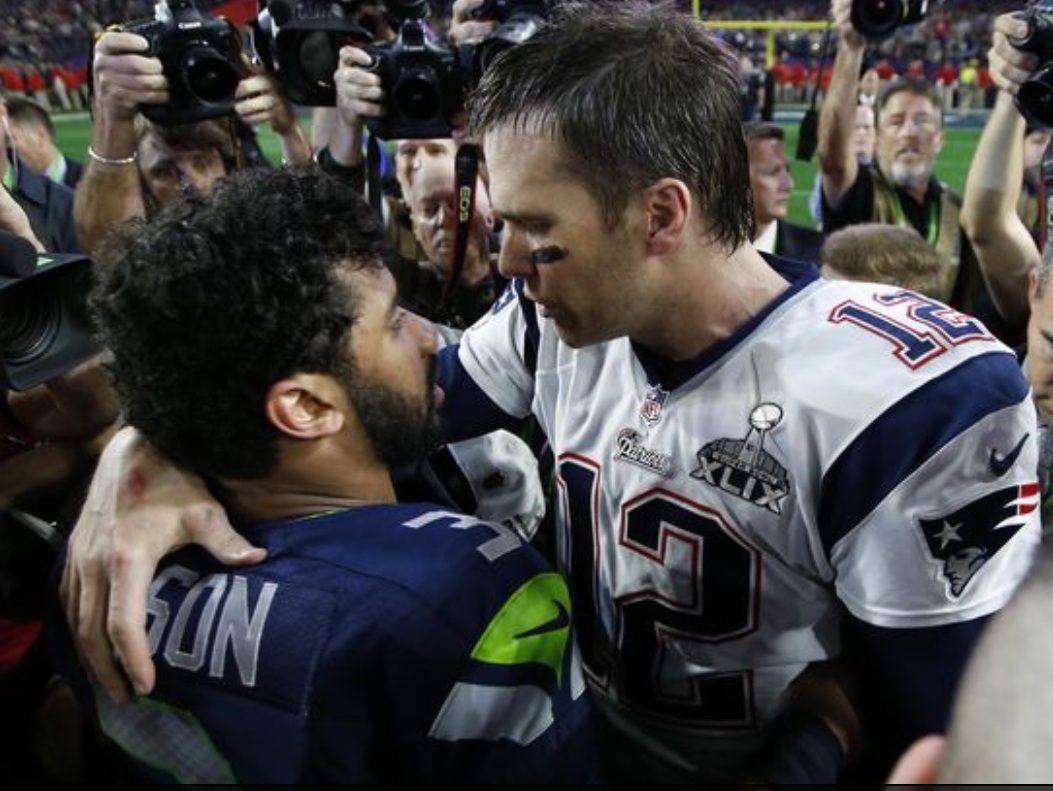
“Good game. You’re shorter than you look on TV.” (USA Today)

Welcome, casual fan. Some play call, huh? Turning to what truly matters, here’s a 60-word synopsis of the college hoops season so far:

Kentucky is good. So are Gonzaga and Virginia. Duke is likely overrated at the moment, and Arizona is probably underrated. Scoring is down, but not as much as you’ll hear and not at all uniformly. Scoring is actually up in ACC play, but good luck finding a pundit to throw that confetti. (Though I guess I kind of just did.)

Good stuff, right? It’s a fine sport, truly. Read on….

Welcome to Tuesday Truths, where I look at how well 131 teams in the nation’s top 11 conferences are doing against their league opponents on a per-possession basis.

The unusually adequate Notre Dame defense
Through games of February 2, conference games only
Pace: possessions per 40 minutes
PPP: points per possession   Opp. PPP: opponent PPP
EM: efficiency margin (PPP – Opp. PPP)

ACC                       W-L   Pace    PPP   Opp. PPP    EM
1.  Virginia              8-1   57.2    1.11    0.92    +0.19
2.  Louisville            6-2   65.2    1.10    1.01    +0.09
3.  Notre Dame            8-2   61.9    1.16    1.07    +0.09
4.  North Carolina        7-3   67.8    1.10    1.03    +0.07
5.  Duke                  5-3   66.4    1.11    1.06    +0.05
6.  NC State              5-5   64.3    1.08    1.05    +0.03
7.  Syracuse              5-3   65.4    1.01    1.01     0.00
8.  Miami                 4-4   62.2    1.04    1.05    -0.01
9.  Clemson               5-4   60.0    0.98    0.99    -0.01
10. Florida State         4-5   62.6    1.04    1.10    -0.06
11. Georgia Tech          1-8   60.7    0.97    1.03    -0.06
12. Pitt                  4-5   60.3    1.06    1.13    -0.07
13. Wake Forest           2-7   67.5    1.01    1.09    -0.08
14. Virginia Tech         1-7   63.0    0.98    1.12    -0.14
15. Boston College        1-7   60.5    0.97    1.12    -0.15

AVG.                            63.0    1.05

Notre Dame was just upset by an opponent that hadn’t previously done much of anything, so this is perhaps a good non-bandwagon moment to make an affirming point: Mike Brey likely has one of the best teams he’s ever had in South Bend. Continue reading

Tuesday Truths: “Statistically extreme” edition

A low-fumble group.

A low-fumble group.

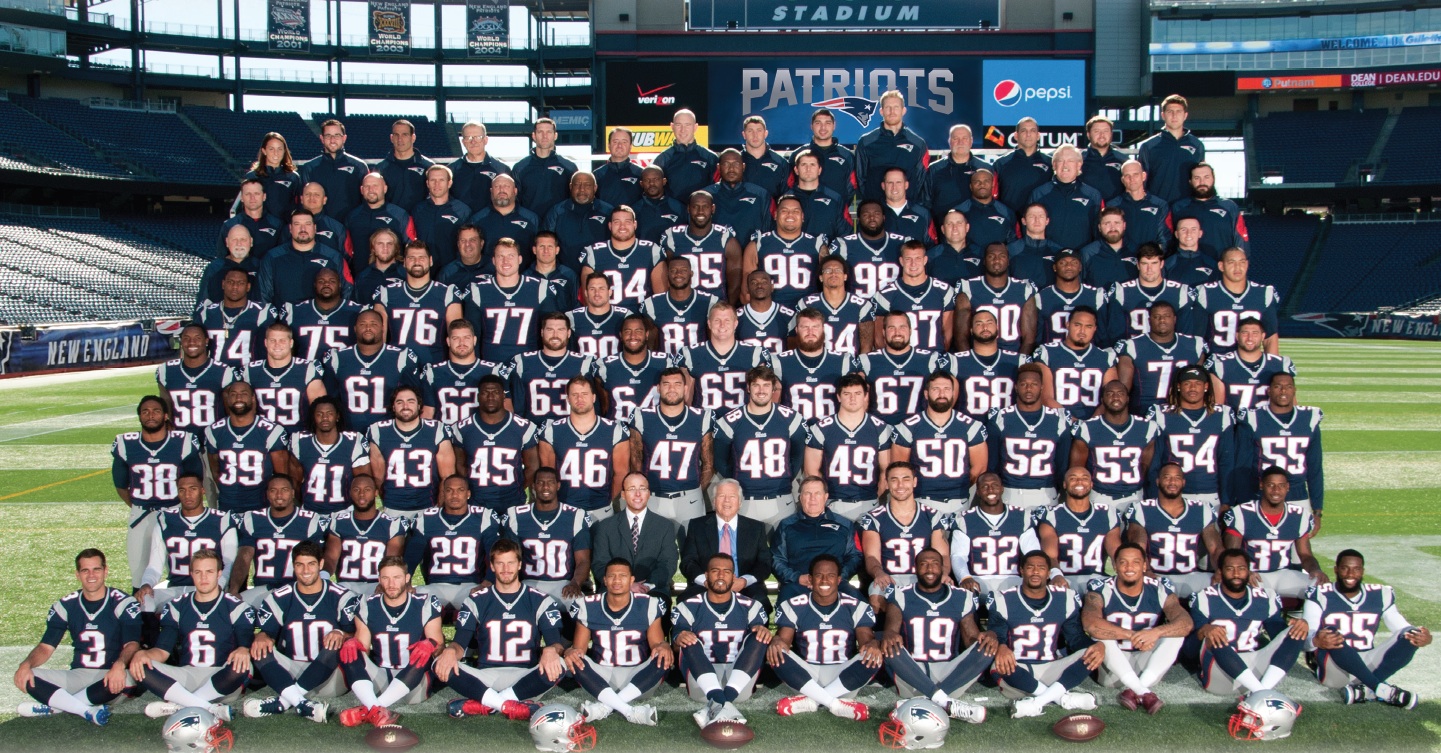
Warren Sharp’s analysis of the low fumble rates recorded by New England since 2007 immediately made me wonder how unusual the Patriots’ numbers really are. And by “really,” I of course mean “in college basketball terms.”

Using our old friend Mr. Standard Deviation, let’s frame this question in a way that anyone who follows our nation’s True Greatest Sport can understand. Here are a few of the more statistically aberrant team-based behaviors currently occurring in college hoops:

                                  SD's better/worse (-)
                                       than mean
Utah efficiency margin                    1.95
Richmond offensive rebound %             -2.31
Arizona defensive rebound %               2.34
Kentucky defense                          2.44
Wisconsin turnover %                      2.46
Kentucky efficiency margin                2.53
San Diego opp. turnover %                 2.54
Wichita State turnover %                  2.59
San Jose State offense                   -2.61
Virginia defense                          2.62
Wisconsin offense                         2.63

Patriot fumble rate, 2010-14              3.83

Basketball stats: Relative to respective conference means, conference games only
Football stat: Relative to NFL mean (offensive plays per fumble lost, all games) 

“Tuesday Truths” has been one of our country’s most cherished traditions since the Taft administration, and in that time I’ve never seen a team statistic vary from its league mean by three standard deviations, much less close to four. I don’t suppose there’s a single correct conclusion to be drawn from that observation — mundane circumstances produce statistically zany outcomes once in a great while. But put me down as one vote for “the most statistically extreme thing I’ve yet run across.”

Continue reading

Tuesday Truths: “Red velour” edition

The Mayor is so excited about early-season per-possession stats he borrowed an outfit from the Sonic red velvet cake ad.

The Mayor is so excited about early-season per-possession stats he borrowed an outfit from the Sonic red velvet cake ad.

Hoiberg even kind of looks like the Sonic guy.

Welcome to Tuesday Truths, where I look at how well 131 teams in the nation’s top 11 conferences are doing against their league opponents on a per-possession basis.

ACC: Reveal thyself, North Carolina!
Through games of January 19, conference games only
Pace: possessions per 40 minutes
PPP: points per possession   Opp. PPP: opponent PPP
EM: efficiency margin (PPP – Opp. PPP)

                          W-L   Pace    PPP   Opp. PPP    EM
1.  Virginia              5-0   56.4    1.16    0.95    +0.21
2.  North Carolina        4-1   65.3    1.12    0.99    +0.13
3.  NC State              4-2   65.4    1.11    1.01    +0.10
4.  Notre Dame            5-1   60.5    1.14    1.06    +0.08
5.  Duke                  4-2   67.3    1.11    1.04    +0.07
6.  Louisville            3-2   64.2    1.07    1.02    +0.05
7.  Miami                 2-2   63.6    1.11    1.09    +0.02
8.  Syracuse              4-1   62.9    1.00    0.98    +0.02
9.  Pitt                  3-3   59.4    1.05    1.12    -0.07
10. Georgia Tech          0-5   61.2    0.98    1.05    -0.07
11. Wake Forest           1-4   70.2    1.01    1.09    -0.08
12. Florida State         2-4   64.1    1.02    1.11    -0.09
13. Clemson               2-4   58.8    0.95    1.05    -0.10
14. Virginia Tech         0-4   65.6    0.98    1.14    -0.16
15. Boston College        0-4   58.7    0.95    1.12    -0.17

AVG.                            62.9    1.05

On paper the Tar Heels are egregiously underrated, but I can at least see where the pollsters are coming from. The beautiful efficiency margin you see here was achieved entirely at the expense of Clemson (albeit at Clemson) and Virginia Tech (in Chapel Hill). Throw in three coin-flip games (one-point loss at home to Notre Dame, one-point win at home against Louisville, two-point win at NC State) and you have UNC’s conference season to date.
Continue reading

Tuesday Truths: “Way too early” edition

Scarily Intense LSU Woman says it's never too early for Tuesday Truths.

Scarily Intense LSU Woman says it’s never too early for Tuesday Truths.

Welcome to the season’s first installment of Tuesday Truths, where I look at how well 131 teams in the nation’s top 11 conferences are doing against their league opponents on a per-possession basis.

This year I decided to do something a little different with the season’s first Truths. Ordinarily in mid-January I shield your tender sensibilities from conferences that haven’t played very many games.

But for 2015 I’m just flinging them all at you right from the start. Who cares if Kansas has played just two Big 12 games? In future years archivists will treasure this comprehensive week-by-week look at the entirety of the conference season.

(Hello, archivists! Do people still recline on airplanes?)

ACC: A theory of Virginia
Through games of January 12, conference games only
Pace: possessions per 40 minutes
PPP: points per possession   Opp. PPP: opponent PPP
EM: efficiency margin (PPP – Opp. PPP)

                          W-L   Pace    PPP   Opp. PPP    EM
1.  Virginia              3-0   58.2    1.12    0.99    +0.13
2.  North Carolina        2-1   63.2    1.14    1.01    +0.13
3.  NC State              3-1   64.9    1.09    0.97    +0.12
4.  Duke                  2-1   69.2    1.12    1.03    +0.09
5.  Syracuse              3-0   62.8    1.08    1.00    +0.08
6.  Louisville            2-1   66.3    1.08    1.00    +0.08
7.  Notre Dame            3-1   60.8    1.13    1.05    +0.08
8.  Miami                 1-1   59.2    1.05    1.09    -0.04
9.  Georgia Tech          0-3   62.6    0.93    1.01    -0.08
10. Wake Forest           1-3   71.2    0.99    1.07    -0.08
11. Virginia Tech         0-2   66.0    1.07    1.17    -0.10
12. Florida State         1-2   65.9    1.04    1.15    -0.11
13. Clemson               1-2   59.6    0.97    1.08    -0.11
14. Pitt                  1-2   57.3    0.97    1.11    -0.14
15. Boston College        0-3   60.1    0.95    1.10    -0.15

AVG.                            63.2    1.04

I’m wondering if there might be three differences between what we saw from Tony Bennett’s team in the ACC last season and what’s about to transpire here in 2015. I’d venture to say those differences might be as follows: Continue reading

Why we should occasionally be less impressed by undefeated records

If a team's still undefeated at this point in the season, they will almost invariably be ranked or very close to it. Is that a correct assessment? Good question.

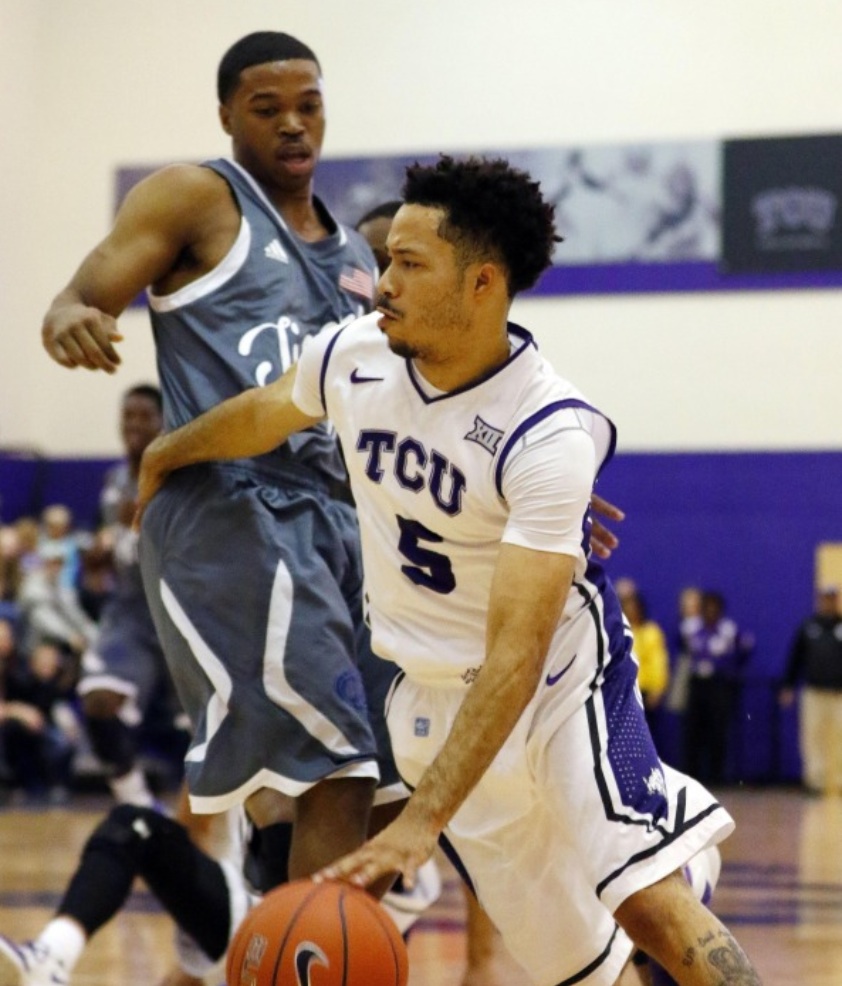
If a team’s still undefeated at this point in the season, it will as a matter of custom be ranked or very close to it. Is that a correct assessment? Good question. (TCU)

TCU and Colorado State have posted identical 13-0 records to start 2014-15, and I would venture to say that both the Horned Frogs and the Rams are indeed much better than we expected them to be in the preseason. Kyan Anderson, an unfailingly aggressive sub-six-foot lead guard, really is playing the way Chris Jones probably thinks that Chris Jones plays. CSU is winning games with zero (or multiple) point guards, a very high barrage factor (many offensive boards and few turnovers), and heaping helpings of clutchy clutchness and just wanting it more in close games. Trent Johnson and Larry Eustachy, take a bow.

I’m just not sure either team is really as mighty as what’s currently being shown in the polls: Colorado State is No. 24, and TCU’s No. 1 in the “others receiving votes” small type. There’s an evaluative bonus that comes from being undefeated, and I’m not interested in lobbying against it as much as I am in defining it more precisely. Indeed I myself have been known to bestow the evaluative bonus on this or that team on occasion. If anything I was perhaps too charitable in my pre-Stony Brook ranking of Washington.  Continue reading

Putting Syracuse’s historically atrocious three-point shooting into context

He's been far and away Syracuse's most accurate three-point shooter. He's shooting 28 percent.

He’s been far and away Syracuse’s most accurate three-point shooter. He’s shooting 28 percent. (syracuse.com)

If the Unannounced Audit Panel of the US Basketball Writers Association shows up at my door later today, I think I’ll be in pretty good shape. I’ll steer them toward my pre- and early-season wariness of a North Carolina team that at the time was being ranked in the top 10 or even in the top five. I’ll trot out my hearty approval of Tony Bennett’s decision to embrace offensive rebounding last season. (Now look. The guy’s practically Tom Izzo Jr.) And I may even call attention to my canny (if entirely risk-free) decision to leave an analytic light on just in case an NJIT team returning six members from a seven-man rotation should decide to win one of its four tries against major-conference competition — despite the fact that the Highlanders entered the season 0-22 lifetime on that score.

All in all I feel like the audit will go pretty well. But then the diligent and tireless auditors will ask me about Syracuse, and that’s where things could get a little awkward. What was that I said again about the Orange being “underrated”? Just what exactly did I mean when I said “the laws of statistical gravity suggest an offense powered collectively by Trevor Cooney and players to be named later can shoot just as well as if not better than the one that last season was focused with surprising insistence on C.J. Fair”?

Since those statements were so confidently asserted Syracuse has started the season 5-3, losing two of those games by double-digit margins to unranked opponents. Furthermore Jim Boeheim’s men have reached mid-December shooting 20.8 percent on their threes. So, yeah, at that point in the audit I’ll have two options — flee or explain. And since I’ve already given the USBWA my home address, I guess I’ll have to opt for the latter.  Continue reading

Conference strength is somewhat related to results in the Iowa Caucuses of hoops

Kaminsky vs. this guy -- should be a pretty good game in Madison. (newsobserver.com)

Kaminsky vs. this guy. That should be fun. (newsobserver.com)

Tonight the ACC-Big Ten Challenge will tip off, with Florida State hosting Nebraska and Clemson playing at home against Rutgers. This will be the 16th time the conferences have squared off in this event, meaning if there had been a Lamar Hunt figure at the founding we would be referring to this as Challenge XVI.

The ACC holds a 10-3 advantage since 1999, though in truth John Swofford’s league hasn’t won the event outright since December 2008. The last two Challenges have ended in 6-6 ties. This will be the first year that 14 games are played — the ACC chose to leave Boston College at home for this one.

If the ACC leads the Challenge 10-3 all-time, that must mean it’s been the better conference over the past 15 years, right? Well, sort of. Continue reading

Seven teams account for 25 percent of all tournament wins since 2000

Two coaches, four titles.

Life is good at the top of Division I. (USA Today)

Counting NCAA tournament wins since 2000 is little more than a blinkered exercise in setting arbitrary and subjective quantitative goalposts. Much like a good portion of real life. Let’s do this.

                     NCAA tournament         National
                     wins since 2000     titles since 2000
1.   Kansas                38                    1
2.   Michigan State        36                    1
3.   Duke                  34                    2
     North Carolina        34                    2
5.   Florida               33                    2
6.   Connecticut           32                    3 (4 since 1999!)
     Kentucky              32                    1

After Connecticut and Kentucky there’s a big drop — equivalent to one national championship run — before you get down to plucky underdogs like Arizona, Louisville, Syracuse, and Wisconsin. No other program has won more than 25 games. (Full team list at the bottom of this post. Limber up your scrolling finger.)  Continue reading

Why be bad at part of a sport you’re trying to be good at?

Alex Olah seems somewhat skeptical of his coach's ban on offensive boards. (Chicago Tribune photo.)

Alex Olah is very excited about his coach’s decision to forego offensive rebounds. But has a team ever succeeded because of bad offensive rebounding and not merely in spite of it? (Chicago Tribune)

Offensive rebounding is one of the few antecedents of scoring in sports that a significant minority of coaches consciously and indeed insistently tries to do very badly.

That fact alone doesn’t mean those coaches are wrong — sometimes the smart play is to miss a free throw or let the opponent score — but it sure is interesting. This season a handful of coaches with realistic chances at an NCAA tournament bid will seek to win that reward, in part, by avoiding offensive rebounds.

Stats will be brought into this discussion momentarily, don’t you fret, but at the outset I trust plain old words can do justice to a rather remarkable state of affairs. First let us note that there’s nothing intrinsically special or magical about offensive rebounds — or, conversely, about transition defense. Continue reading