Category Archives: wednesday wonderings

Are the committee’s selections slowly getting better or just easier to predict?

2007

The 65-team field was statistically puzzling in 2007. Things have been more predictable lately, though the courts are less distinctive visually.

One way to think of the NCAA tournament is as the most popular nightclub in town. The men’s basketball committee is the bouncer, of course, stationed outside the club and working the rope line. There are 351 teams queued up hoping to get in, and the bouncer gives familiar and knowing nods to the first 20 or so teams as they breeze in. It’s pretty much the same group every year.

Next, after the usual teams have been waved through, there is always the same number of unfamiliar and oddly attired out-of-towners who show up. Once they explain that they’ve won the conference tournaments in their one-bid leagues, however, these teams are also let in.

Lastly, there are the toughest decisions of all. These are the final at-larges, and up until a few years ago the best way to get in was to engage in some form of the following conversation. For example this particular discussion took place in 2012:

SOUTHERN MISS: Uh, hi, I’m Southern Miss. I think I’m on your list for 2012.

BOUNCER (suspicious, checks clipboard). Nope, sorry, pal. Don’t see you. Wait behind the rope, please.

SOUTHERN MISS: I think there must be some mistake. I’m pretty sure I’m supposed to be on the list. My RPI is 21.

BOUNCER: Right this way.

Continue reading

How to succeed on offense without really making shots

UNC

If you’re waiting for UNC’s love of two-point jumpers to doom its offense, well, keep waiting.

This season North Carolina is rather rudely meddling with the primal forces of analytic nature, ranking near the top of Division I in offensive efficiency at kenpom.com yet doing so by shooting more two-point jumpers than any team in the country. The sport as a whole is moving emphatically toward the threes-and-dunks approach on shot selection, yet here are the Tar Heels still firing away on low-efficiency jumpers inside the arc like it’s 1986.

Then again Roy Williams may not be as antiquarian as that sounds. In recent years Carolina has copped a page from Bo Ryan, and this season the team’s posting its lowest turnover percentage (15.5) ever in ACC play under Williams. That plus garden-variety beastly offensive rebounding — par for the course in Chapel Hill — means the Heels attempt a tremendous number of shots (which, indeed, tend to be of the two-point jumper variety). Continue reading

Twos are dying

ML

“Let’s dispel once and for all with this fiction that Buddy Hield is the only player who’s making about half his threes while attempting about eight of them a game. I’m Max Landis, and I approved this message. No, not that Max Landis.”

So far in 2015-16, attempts from inside the arc have comprised just 64.8 percent of all shots in Division I. True, 64.8 percent of anything is a fair share. Nevertheless, that figure does represent an all-time low. To quote a movie, at this rate twos will disappear entirely in another 27 years.

It is therefore fair to say that a three-point revolution is at hand. Being the helpful, proactive, and modest sort, I’ve prepared a brief précis to help you safely navigate this bold new era’s tumbrils and barricades. Enjoy.

There’s a reason it may seem like you’re not really seeing a revolution
Strictly speaking threes are at an all-time high across the breadth of D-I, but, as always when the subject is college basketball, this is somewhat misleading. No human being watches all of D-I, and the numbers that emerge from this vast unseen monolith are driven by a bulky majority of programs that even most professional college basketball writers never once glimpse during a given season. For example the most perimeter-oriented leagues in the nation are currently the SoCon, the Big South, and the MAAC. Conversely, the teams that more fans and writers do tend to watch are, rather ironically, the exceptions to the revolutionary rule.
Continue reading

Buddy Hield’s season is impossible

BB

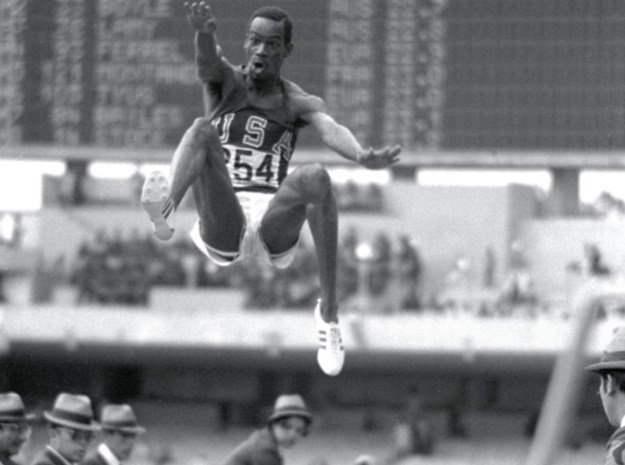
What we’re seeing is Beamon-esque.

This season I’ve adopted a new morning ritual. I check the previous evening’s scores, glance at the headlines, and then I devote a minute or two exclusively to Buddy Hield.

If by chance Oklahoma has played the previous evening, I’ll watch those highlights. Or if the Sooners are between games, I might find myself gazing upon Hield’s body of numerical work and trying, once again, to take the true measure of what I’m seeing….

It’s good to know my need to try to situate Hield within some kind of rational framework is a shared affliction. Last week I realized that Luke Winn, Kevin Pelton, and I were all simultaneously running Hield-triggered searches on 22 years’ worth of Division I basketball at sports-reference.com. Luke heralded Hield’s membership in the 50-50-90 club. Kevin wants to gently dissuade NBA general managers from thinking this remarkable Hield of Dreams thing can possibly continue at the next level. Continue reading

Why are there so many exceptionally challenged teams in 2016?

PR

“Highlights”?

This week John Beilein was asked about his team’s next opponent, and he came up with a small masterpiece of backhanded complimenting.


Beilein’s brand of faint praise reminded me of how former Illinois coach Lou Henson used to respond in similar situations. When I was a kid my brother and I had a running joke involving Henson’s preferred verbal tic, “super ball club.” We’d take turns inserting the most absurd opponent imaginable and mimicking Henson’s flat New Mexican twang: “Well, Jim, Immaculate Heart of Mary is just a super ball club, and we’re going to have to play our best game to win.”

Still, Beilein’s ringing endorsement of his next opponent’s Division I status weirdly paralleled some thoughts I’ve had regarding exceptionally challenged teams. For starters I’ve often wondered how ECT’s happen at all. It seems like if you squint hard enough and keep things good and abstract, such teams should be all but impossible. Continue reading

Continuing coverage from the offensive rebound’s deathbed

Van

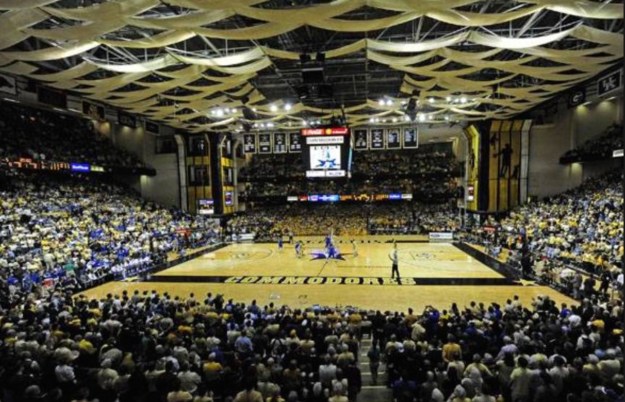
Offensive boards have disappeared at Vanderbilt. Will they ever come back?

It’s no secret that the offensive rebound is dying, both at the professional and collegiate levels. Barring a seismic turnaround, the offensive rebound rate in major-conference play this season will come in under 31 percent for the first time since I started doing things like tracking the offensive rebound rate in major-conference play.

This process has been in motion for years, and “inexorable” is probably not too strong a word to describe it. I’ll restate at the top what regular readers already know: I’m unpersuaded as to the wisdom of giving up on offensive rebounds. Be that as it may, it’s happening and, as the major-conference rate threatens to dip below 30 some season (very) soon, the disappearance of offensive boards is offering up some really interesting  vignettes. Continue reading

Welcome to 2016’s egalitarian and accelerated showcase for veterans

JH

The nation’s leading scorer is Howard’s James Daniel, a seasoned junior who plays for a fast-paced team that isn’t great. How emblematic of him.

Today I’m officially removing the disclaimer “It’s early” from my 2015-16 lexicon. It’s not early anymore.

Most of the teams we spend our time talking about have now played 15 or so games, and even the conference seasons are at last well underway. We’ve now seen 20 percent of all the major-conference games we’re going to get in 2016, so forgive me if I feel like I have a pretty good — albeit still adjustable — understanding of where the season’s headed on January 13.

To my eyes these are the four factors (if you will) driving this unique season, in order of importance….

1. No great teams (hereafter NGT)
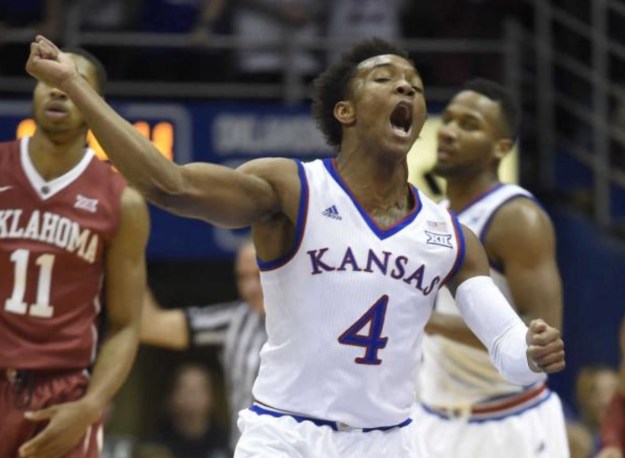
Kansas, Oklahoma, North Carolina, Michigan State, et al., are all fine teams that nevertheless would be ground into a fine neutral-floor powder by the Duke, Wisconsin, Kentucky, and Arizona teams we saw last season. Last year was unusually strong at the top. This year is unusually weak. I trust this isn’t merely Grandpa Simpson-variety carping on my part; ideally it is instead something I looked into and wondered about before the start of the season. More importantly a diagnosis of no great teams doesn’t have to be a dyspeptic lament. Continue reading

The new clock’s making conference games faster and therefore higher-scoring

KU.jpg

A triple-overtime game with 102 possessions and 215 total points? That’ll do. (Mike Gunnoe, Topeka Capital-Journal)

In the offseason the NCAA introduced a whole host of rule changes and/or “no, this time we really mean it” reemphases. Most prominent among the new measures was the 30-second shot clock, and coming into the season it was natural to think of the clock as purely a tempo-reform measure while pretty much everything else was either efficiency- or justice-related.

As always with such offseason discussions, the potential impact of the new rules and new clock were considered at length because it was hot outside and we had no games to talk about. Then, once the season started, we properly moved on to more pressing concerns such as who’s going to win the national title. As chance would have it I’m still interested in who’s going to win the national championship, but today I want to pause briefly to consider how the major conferences are faring in terms of tempo, efficiency, and scoring.

I realize that on January 6 it may seem rather early to look at the shot clock’s effect on conference play. Well, it is early. Still, 69 major-conference games have already been played, and that’s 10.2 percent of the eventual total right there. Think of it as the same number of games that, say, the Big 12 or Big East will have played in-conference by late February.  Continue reading

Why Bo Ryan was the most influential coach of his era

Ryan

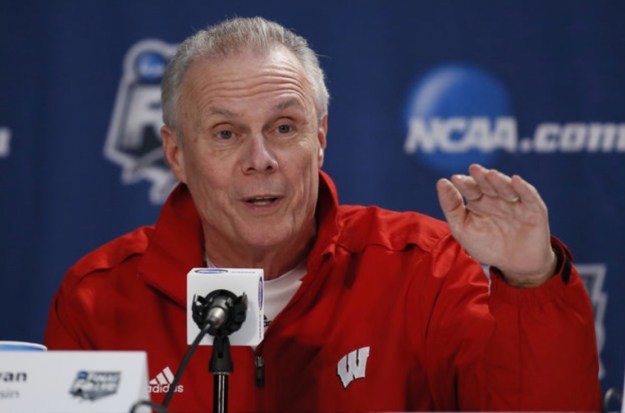
Ryan addresses the media at the 2015 Final Four. (Reuters)

In the spring of 2001 when Pat Richter placed a call to Wisconsin Milwaukee head coach Bo Ryan, the Wisconsin athletic director had been through a challenging few months. Fresh off a surprising run to the 2000 Final Four as a No. 8 seed, the Badgers lost their coach when Dick Bennett decided to retire just two games into the 2000-01 season. Brad Soderberg coached the team the rest of the way that year, but it was widely assumed in basketball circles that the man that Richter — and the entire state of Wisconsin — really wanted for the job was Utah head coach Rick Majerus.

Only now, as Richter made his call to Ryan, the Utes’ coach had pulled his name from consideration for the post in Madison. The Badgers needed a Plan B immediately, and Richter had just one question for the man on the other end of the line:

“Bo, are you ready?”

“Pat, I’ve been ready.” Continue reading

The college basketball implications of Stephen Curry

Curry

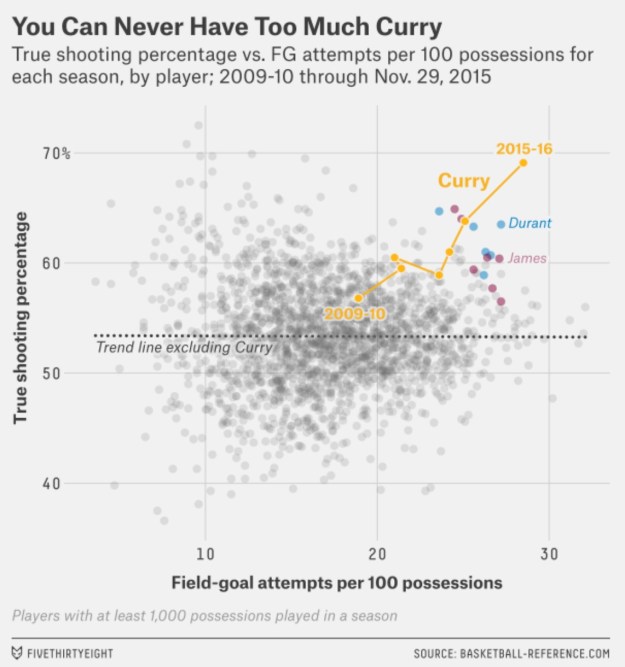
If it turns out the usage-efficiency tradeoff doesn’t apply to one player, what does that say about how the game should be played by every other player? (fivethirtyeight.com)

As an incorrigibly casual and contentedly sporadic NBA fan, I really enjoyed Benjamin Morris’s piece on what precisely Stephen Curry hath wrought in our game. Previously I had struggled to piece together a coherent awe from the stray random shouts I caught from trusted and unmistakably thunderstruck colleagues on Twitter. But after stumbling across Morris and his arresting visuals, I get it. A player who is (apparently) “virtually immune to burden” reorders the hoops universe.

So now what? As an incorrigibly dedicated and contentedly constant fan of the college game, I have some questions.

Should Curry change what college coaches do?
If nothing else Curry has erected a tower so that first-grade math can shine forth like a beacon and claim its due deference. Three is greater than two, and one possibility Curry raises is that, purely in the abstract sense, the first option for any basketball possession should be an open three-point attempt.  Continue reading