Category Archives: in many ways the work of a critic is easy

Tuesday Truths for an accelerated world

cal

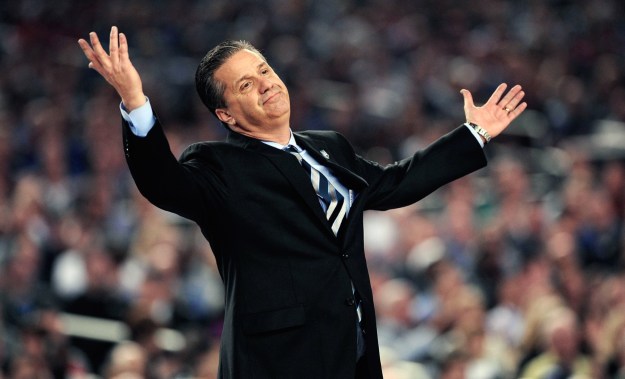
His team is playing much faster this season, a bit like Division I since 2015.

Next week on a day that I trust requires no further specification here, Tuesday Truths will return for an eighth season.

This rite of the bleak midwinter has now appeared at three different sites and been situated amidst wildly varying levels of graphic support. Yet here it is, still standing. It is the Tubby Smith and/or Lon Kruger of college basketball features.

For 2017, Tuesday Truths will track every possession in conference play for the ACC, Big 12, Big East, Big Ten, Pac-12, SEC, American, Atlantic 10, Missouri Valley, and WCC. This is more or less the top third of Division I, and the idea is to cast a net large enough to either: a) spot a nascent national champion early; or b) offer grounds for proper and informed surprise when a dark horse shocks the world come April.

College basketball is strange in leaving approximately 35 percent of a team’s schedule purely to its coach’s discretion. I certainly don’t ignore that 35 percent — I’ve written lots of words from November up to now — but I have found in addition that there’s much to be gained from looking at the 1200 or so possessions that a team records in conference play. Continue reading

Grayson Allen seems sincere, and maybe that’s the problem

havanicetrip

Adrenaline is not Grayson Allen’s friend. It’s not Fran McCaffery’s friend either, of course, but at least the Iowa head coach didn’t give North Dakota’s Brian Jones a leg-sweep in the handshake line on Tuesday night.

Instead, McCaffery petulantly walked off the floor rather than shake hands. Dumb move from a guy old enough to know better, certainly (McCaffery apologized almost immediately), but one that can be classed as the standard-issue wreckage caused by male adrenaline.

What’s strange about Allen (who also apologized almost immediately) is that his adrenaline swells so unerringly and with such velocity in his right foot, of all places. I’ve played and watched basketball for a really long time, and I’ve seen every kind of scuffle and altercation imaginable. Scuffles and altercations are endemic to hoops, truly.

But I can honestly say I’ve never seen a player trip an opponent intentionally twice, much less three times. The particular form that Allen’s on-floor stupidity takes is sui generis. I have no idea where it comes from. This will be for a biographer to figure out, and if Allen indeed turns out to be a seven-time NBA all-star and/or wins a presidential election someday (don’t laugh), we may get answers. Continue reading

Your category 5 update for 2016-17

rosterdurham

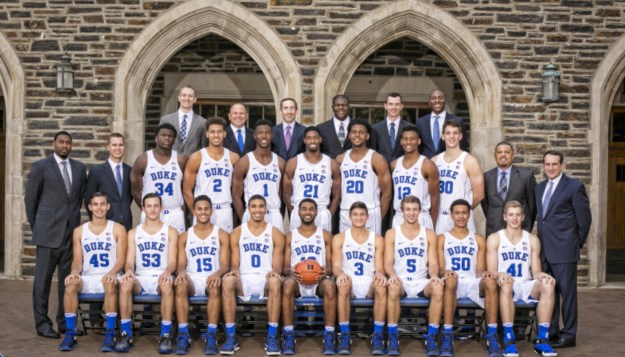
Not counting the 10 suits, a group like this only happens in Division I once every 1.8 years.

Now that Duke is rounding into form health-wise, this may be an appropriate moment to revisit the idea of the category 5 roster. With Mike Krzyzewski giving serious minutes to Jayson Tatum and the coach also saying that Harry Giles may play before Christmas, this epochal-roster-strength stuff is no longer a conceptual exercise where the Blue Devils are concerned. The speculative “when Duke gets healthy” dream pieces have been retired, and unalloyed present-tense adulation (heresy just two weeks ago) has begun in earnest.

A category 5 roster is one that returns at least 40 percent of its possession-minutes from the previous season, and adds a freshman class that rates out at 25 recruiting points or better based on Drew Cannon’s canonical front-loaded evaluative curve.

Duke has the nation’s only category 5 roster for 2016-17. Here’s how the Blue Devils and Kentucky fare on the metrics in question this season:

                           Recruiting
                %RPMs        points
Duke              56          36.6
Kentucky          26          35.4    

Continue reading

What injury-ravaged Duke might tell us about basketball

ravages

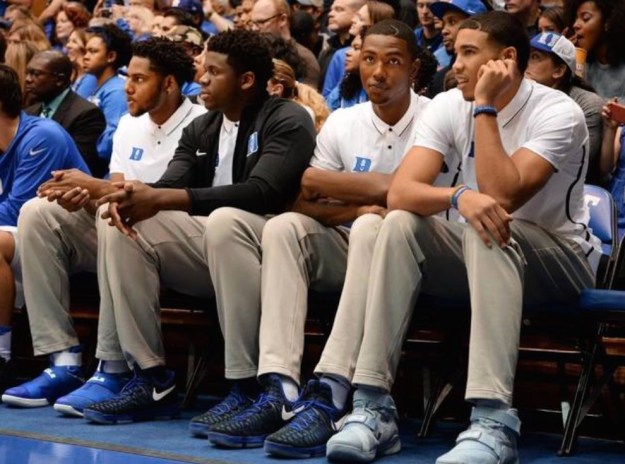
Marques Bolden, Sean Obi, Harry Giles, and Jayson Tatum sit and watch. (Charlotte Observer)

Duke entered 2016-17 ranked a resounding No. 1 in the nation, capturing 58 of a possible 65 first-place votes in the preseason AP poll. Alas, Mike Krzyzewski’s charges have turned out to be a rather insistently gimpy resounding No. 1.

Freshmen Harry Giles, Jayson Tatum, and Marques Bolden are all yet to appear on the floor this season. Grayson Allen’s been limping noticeably, and both Chase Jeter and Amile Jefferson have been reported as being banged up as well.

Do the math and you’re left with just three current Blue Devil starters who’ve been vouchsafed as possessing more or less normal stores of health and soundness: Matt Jones, Luke Kennard, and Frank Jackson. The descriptive modifier of choice with this team so far on the young season is “injury-ravaged.”

The modifier’s accurate, surely, yet I’ve been moved to wonder whether in this case accuracy can’t additionally be somewhat misleading. If so, it’s possible this particular brand of confusion might be able to tell us an instructive thing or two about the sport. Continue reading

Notes for a lively five-month Markelle Fultz discussion

fultz

This season Markelle Fultz will turn out to be brilliant, disappointing or something in between, and of course Washington either will or will not make the NCAA tournament. But I for one promise not to brand Fultz as a disappointment simply because the Huskies don’t receive a bid. In fact, I think it rather likely that Fultz will live up to the hype, and that Lorenzo Romar’s guys will not go dancing. There may be far less friction between these two scenarios than we’re inclined to assume.

In the one-and-done era, there is precious little precedent for a freshman single-handedly and dramatically altering the trajectory of his non-blue-chip program’s season. Yet for some reason, a decade in, we’re still talking like this should indeed happen simply as a matter of course.

We talked like that last year with Ben Simmons despite a preseason chorus of smug pre-Trump laptops saying that LSU, even with the best freshman in the country, was likely to be a bubble team. We may talk like that again with Fultz this season (though yesterday’s loss at home to Yale certainly won’t get any bandwagons rolling).

This gap between the observed performances of the past and our expectations for the near-future has come to constitute something of an esteem tariff that a coach like Romar chooses to pay when signing a one-and-done-track player like Fultz. What a terrible coach, we say. He can’t even do what’s hardly ever been done by anyone else before. It’s a vein of criticism that dates from the widespread disbelief that Kevin Durant could end his freshman season anywhere except the Final Four. It’s been a hearty perennial ever since. Continue reading

College basketball’s unabated evaluative love of the unseen

uk

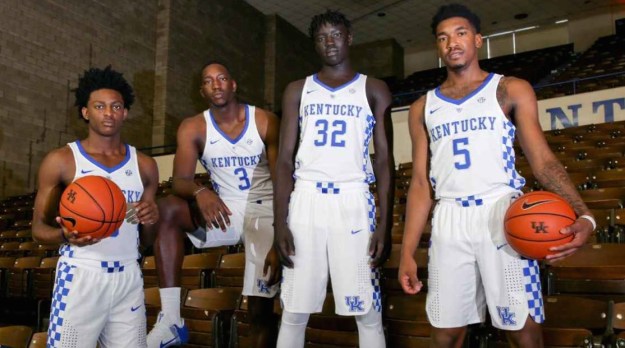
How many games will they win this season? What seed will they get in the tournament? Who among them will go pro next summer? Good questions. (Mark Zerof, USA Today)

I may be exhibiting the slightest degree of occupational bias, but it is my considered opinion that predicting future events in college basketball represents the most difficult forecasting gig there is, period. Please consider this post a tribute, then, to Ken Pomeroy, Dan Hanner, David Hess, and all of my intrepid colleagues who are engaged in this inherently hazardous line of work. It’s brutal out here.

If there’s a similarly daunting predictive challenge, I’m yet to find it. Other sports? Football introduces some interesting randomness, what with the microscopic number of games, alpha-and-omega nature of the quarterback position and win-probability-shattering pick-sixes. Yet somehow even the gridiron can’t give us anything to compare with Middle Tennessee State on March 18, 2016. (Spoken like a repentant forecaster.) At the end of the day pro sports and college football alike bequeath upon their predictors the cardinal blessing of year-to-year carryover in elite personnel. In college hoops, conversely, the best players by definition (almost) always leave. Continue reading

The political economy of college sports is infuriating, profitable, and remarkably resistant to asteroids

Paige

The viewership for this game was, comparatively speaking, terrible. Why didn’t that matter to advertisers? (USA Today)

This week USA Today followed in Kyle Whelliston’s venerable footsteps and termed college sports a “bubble” that’s sure to pop sooner or later. Something strange happened in between the piece’s inception and publication, however, because the final product turns out to consist of a labored and rather convoluted lede placed atop the latest iteration of what has long been an excellent and even invaluable set of data.

For starters the nominal news hook presented by the numbers — most athletic departments operate at what they are pleased to term deficits — would seem to be something of an awkward fit for our traditional stock of “bubble” iconography. Maybe it’s me, but I always assumed that tulip merchants in 1637, the South Sea Company in 1720, Webvan.com in 1999, and subprime lenders in 2006 instead showed astronomic operating surpluses. In fact I rather thought this was precisely the red flag in those cases.

Nor is it clear why a bubble would aptly describe a revenue model now entering its sixth decade of “Seriously! Any day now!” impending legal doom. Finally, fretting about those darned young people and their cord-cutting in a piece based in no small measure on a brand new TV deal whose lead signatory is a legacy broadcaster founded in 1927 qualifies as still another curious ratiocinative choice, surely.

Far from being an “unstable situation,” college sports in general, college basketball more especially, and the NCAA tournament in particular instead present a series of successively smaller and progressively more advantageously situated concentric circles characterized by an unusual degree of hardiness solely as media properties. There are variables in play, naturally, and it’s not too much to term the threat of legal exposure “existential” — with regard to the NCAA. I don’t know who or what will be governing the sport in 2032, and I do trust that by then the players will have long since been receiving their fair share of the resulting revenues.

But if we view the essentials of the tournament as nothing more or less than 68 college teams playing 67 games of win-or-go-home basketball over three weeks from mid-March to early April, I’m yet to see anything even remotely persuasive in the way of a Book of Revelation. The essentials are eyeballs and basketballs, and if a tournament that earned record-setting revenues for a decade before, during and after the largest economic calamity since the Great Depression constitutes a bubble, well, put me down as bullish on this particular bubble.  Continue reading

The season in exceptionally brief review

Kris

(USA Today)

If we turned back the clock five months, here are the events that would have surprised me….

Things I missed badly on:
–Michigan State losing in the round of 64. I had the Spartans lasting a few games longer than that.

–Davidson being meh. I thought the Wildcats would be significantly better (like, NCAA tournament bid-worthy).

Things I didn’t even think to have an opinion on because I didn’t see them coming at all:
–Bo Ryan retiring in-season.

–Jamie Dixon to TCU.

–Kevin Stallings to Pitt.

–Monmouth garnering more coverage than the two 2011 national championship game participants combined. Continue reading

Advance scouting an extreme Final Four

Boeheim

Is this man a defensive mastermind? Lucky that so few teams use his defense? A little of both? (USAT)

In keeping with my decade-old tradition of very late Final Four previews, here are some thoughts I’ve been mulling this week.

Is the Syracuse zone’s effectiveness scheme-blind and a simple matter of novelty? 
The funny thing about the Syracuse reign of defensive terror in this bracket is that — unlike a similar episode in 2013 — this season the Orange defense wasn’t very good.

During the regular season the ACC made 52 percent of its 2s against this D. In the tournament, however, this number has dropped all the way down to a rather ridiculous 36 percent. Are tournament opponents (ACC member Virginia notwithstanding) failing against this defense because it’s so strange and alien to them? Hard to say, but the history here is pretty interesting.

As it happens this season’s 16-percentage-point improvement in interior defense is by far the most extreme manifestation of what was nevertheless a preexisting historical pattern. Starting with Carmelo Anthony’s national championship team of 2003 and running through Sunday evening, the Syracuse defense has been exactly four percentage points better at forcing missed twos in the tournament than it’s been in conference play. (To keep the “novelty” hypothesis clean and tidy I threw out this weekend’s tournament win against league foe UVA, as well as the tournament loss against league foe Marquette in 2011.) That’s a big difference, and the sample sizes here are comforting: Syracuse has played 32 tournament games over that span.

I’ve never really looked at tournament vs. regular-season two-point defense over a decade-plus before, so just to be sure Syracuse really is weird I ran the same numbers for four other national champions of the period: Duke, North Carolina, Kansas and UConn. It turns out Syracuse really is weird. The Blue Devils have also played better interior D in the tournament than they have against the ACC, but the difference is smaller (two percentage points) and, anyway, Duke’s played weaker teams in its NCAA brackets than what it’s seen in conference play. Syracuse, on the other hand, has faced an almost identical strength of schedule both in the tournament and in conference play. Continue reading

An accelerated and higher-scoring version of Madness

Caruso

Are you not entertained? (Ronald Martinez/Getty)

Maybe it’s just me, but it seemed like this March there was a marked drop in the number of more-in-sorrow-than-in-anger pre-mortems for college basketball. True, there was one such foray that I know of, and, to be sure, there could be more to come. The week before the Final Four’s a five-day blank canvass for eager coroners of the sport. Perhaps I’m a little too eager to be the coroner of coroners. We’ll see.

Still, it’s possible that the sudden downturn in doomsaying so far can be traced to a realization that is both quantitative and rooted in that proverbial gut we’re always consulting so assiduously. Even back in the bad old days of the Scoring Crisis and a 35-second clock, the NCAA tournament was still rather entertaining. Now the event is a faster-paced and higher-scoring version of its usual rollicking self. That plus a charitably selective memory (we’ll look past Wisconsin-Pitt and remember Wisconsin-Xavier) makes for a media property worth billions.

Continue reading