Category Archives: hoops

Notes for a lively five-month Markelle Fultz discussion

fultz

This season Markelle Fultz will turn out to be brilliant, disappointing or something in between, and of course Washington either will or will not make the NCAA tournament. But I for one promise not to brand Fultz as a disappointment simply because the Huskies don’t receive a bid. In fact, I think it rather likely that Fultz will live up to the hype, and that Lorenzo Romar’s guys will not go dancing. There may be far less friction between these two scenarios than we’re inclined to assume.

In the one-and-done era, there is precious little precedent for a freshman single-handedly and dramatically altering the trajectory of his non-blue-chip program’s season. Yet for some reason, a decade in, we’re still talking like this should indeed happen simply as a matter of course.

We talked like that last year with Ben Simmons despite a preseason chorus of smug pre-Trump laptops saying that LSU, even with the best freshman in the country, was likely to be a bubble team. We may talk like that again with Fultz this season (though yesterday’s loss at home to Yale certainly won’t get any bandwagons rolling).

This gap between the observed performances of the past and our expectations for the near-future has come to constitute something of an esteem tariff that a coach like Romar chooses to pay when signing a one-and-done-track player like Fultz. What a terrible coach, we say. He can’t even do what’s hardly ever been done by anyone else before. It’s a vein of criticism that dates from the widespread disbelief that Kevin Durant could end his freshman season anywhere except the Final Four. It’s been a hearty perennial ever since. Continue reading
College basketball’s unabated evaluative love of the unseen

uk

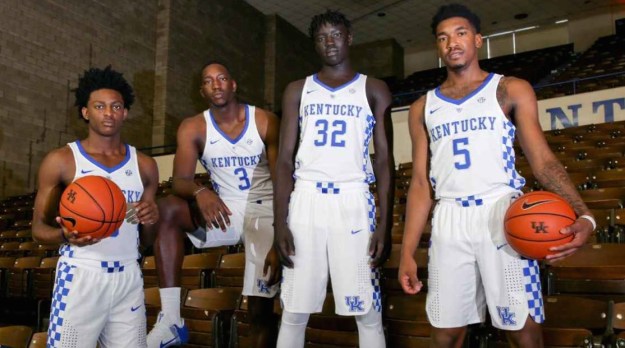
How many games will they win this season? What seed will they get in the tournament? Who among them will go pro next summer? Good questions. (Mark Zerof, USA Today)

I may be exhibiting the slightest degree of occupational bias, but it is my considered opinion that predicting future events in college basketball represents the most difficult forecasting gig there is, period. Please consider this post a tribute, then, to Ken Pomeroy, Dan Hanner, David Hess, and all of my intrepid colleagues who are engaged in this inherently hazardous line of work. It’s brutal out here.

If there’s a similarly daunting predictive challenge, I’m yet to find it. Other sports? Football introduces some interesting randomness, what with the microscopic number of games, alpha-and-omega nature of the quarterback position and win-probability-shattering pick-sixes. Yet somehow even the gridiron can’t give us anything to compare with Middle Tennessee State on March 18, 2016. (Spoken like a repentant forecaster.) At the end of the day pro sports and college football alike bequeath upon their predictors the cardinal blessing of year-to-year carryover in elite personnel. In college hoops, conversely, the best players by definition (almost) always leave. Continue reading

Great offense is an outcome, great shooting is an event

Walkup

If Thomas Walkup bumps into any Villanova players, he can set them straight on which team really had the most remarkable shooting performance of 2015-16.

Watching Villanova do amazing NCAA tournament things in terms of scoring against Miami and in terms of shooting against Oklahoma made me realize I didn’t really have good information close at hand to describe just how amazing this was. I resolved to be better prepared the next time a once-in-a-generation feat takes place.

In the offseason I’ve compiled a quick and dirty record book of the best scoring and shooting performances in the seven thousand major-conference games that have been played since 2006. Last week I rolled out part one of this data, the 10 best scoring games we’ve seen in major-conference play in the last decade. One takeaway here was that if you want to see historically insane scoring, your chances are increased dramatically by attending a Big Ten game on senior day-slash-night.

Now I want to look at shooting. If you’re wondering how impressed you should have been by the 82.7 effective field goal percentage that Jay Wright’s team posted against the Sooners, the answer there is “extremely.” Out of seven thousand games (6,996, if you must know), I’ve only seen that mark bettered twice. In fact teams record an eFG north of 80 percent, on average, less than once a year.

                           opponent      H/A   eFG    PPP   PF  PA  MOV
1.  Clemson 12-Jan-11      Georgia Tech   H    83.3  1.31   87  62   25
2.  Ohio St. 6-Mar-11      Wisconsin      H    83.0  1.61   93  65   28
3.  Providence 23-Feb-14   Butler         A    82.1  1.37   87  81    6
4.  Illinois 6-Jan-11      Northwestern	  H    80.7  1.20   88  63   25
5.  W. Virginia 31-Jan-07  Rutgers        A    80.4  1.48   89  83    6
6.  Illinois 29-Dec-10     Iowa           A    80.2  1.30   87  77   10
7.  Arizona 7-Mar-09       Stanford       H    80.0  1.41  101  87   14

Continue reading

The political economy of college sports is infuriating, profitable, and remarkably resistant to asteroids

Paige

The viewership for this game was, comparatively speaking, terrible. Why didn’t that matter to advertisers? (USA Today)

This week USA Today followed in Kyle Whelliston’s venerable footsteps and termed college sports a “bubble” that’s sure to pop sooner or later. Something strange happened in between the piece’s inception and publication, however, because the final product turns out to consist of a labored and rather convoluted lede placed atop the latest iteration of what has long been an excellent and even invaluable set of data.

For starters the nominal news hook presented by the numbers — most athletic departments operate at what they are pleased to term deficits — would seem to be something of an awkward fit for our traditional stock of “bubble” iconography. Maybe it’s me, but I always assumed that tulip merchants in 1637, the South Sea Company in 1720, Webvan.com in 1999, and subprime lenders in 2006 instead showed astronomic operating surpluses. In fact I rather thought this was precisely the red flag in those cases.

Nor is it clear why a bubble would aptly describe a revenue model now entering its sixth decade of “Seriously! Any day now!” impending legal doom. Finally, fretting about those darned young people and their cord-cutting in a piece based in no small measure on a brand new TV deal whose lead signatory is a legacy broadcaster founded in 1927 qualifies as still another curious ratiocinative choice, surely.

Far from being an “unstable situation,” college sports in general, college basketball more especially, and the NCAA tournament in particular instead present a series of successively smaller and progressively more advantageously situated concentric circles characterized by an unusual degree of hardiness solely as media properties. There are variables in play, naturally, and it’s not too much to term the threat of legal exposure “existential” — with regard to the NCAA. I don’t know who or what will be governing the sport in 2032, and I do trust that by then the players will have long since been receiving their fair share of the resulting revenues.

But if we view the essentials of the tournament as nothing more or less than 68 college teams playing 67 games of win-or-go-home basketball over three weeks from mid-March to early April, I’m yet to see anything even remotely persuasive in the way of a Book of Revelation. The essentials are eyeballs and basketballs, and if a tournament that earned record-setting revenues for a decade before, during and after the largest economic calamity since the Great Depression constitutes a bubble, well, put me down as bullish on this particular bubble.  Continue reading

The season in exceptionally brief review

Kris

(USA Today)

If we turned back the clock five months, here are the events that would have surprised me….

Things I missed badly on:
–Michigan State losing in the round of 64. I had the Spartans lasting a few games longer than that.

–Davidson being meh. I thought the Wildcats would be significantly better (like, NCAA tournament bid-worthy).

Things I didn’t even think to have an opinion on because I didn’t see them coming at all:
–Bo Ryan retiring in-season.

–Jamie Dixon to TCU.

–Kevin Stallings to Pitt.

–Monmouth garnering more coverage than the two 2011 national championship game participants combined. Continue reading

Meet two historically great tournament offenses

Houston

One thing that struck me about the build-up to this national championship game was that initially there seemed to be a fair degree of reticence on the question of how to talk about this national championship game.

North Carolina is favored over Villanova, but only slightly. There’s a decent chance no player in this game will be selected in the first round of the NBA draft this summer, so there’s no obvious “We must stop player X” narrative urging itself upon our consideration. (UNC’s Brice Johnson is currently showing up somewhere between the high 20s and low 30s on the mocks.)

Obviously the Tar Heels have size on their side, while the Wildcats have been shooting stupefyingly well. But with the opposing teams in question being very good but by no means legendary with respect to speed and defense, respectively, it’s tough to spin strength-on-strength yarns.

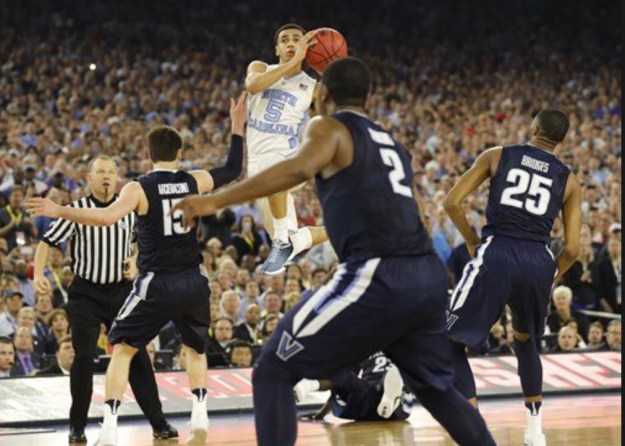
Frankly it wasn’t until I started finding incredible player stats from the past five games that I realized something very weird has been afoot here all along. With only a minor exception here and there, basically every single player in this national championship game is having a phenomenal tournament on offense. You don’t see that every year on Monday night. In fact I can’t recall ever seeing it. Continue reading

Advance scouting an extreme Final Four

Boeheim

Is this man a defensive mastermind? Lucky that so few teams use his defense? A little of both? (USAT)

In keeping with my decade-old tradition of very late Final Four previews, here are some thoughts I’ve been mulling this week.

Is the Syracuse zone’s effectiveness scheme-blind and a simple matter of novelty? 
The funny thing about the Syracuse reign of defensive terror in this bracket is that — unlike a similar episode in 2013 — this season the Orange defense wasn’t very good.

During the regular season the ACC made 52 percent of its 2s against this D. In the tournament, however, this number has dropped all the way down to a rather ridiculous 36 percent. Are tournament opponents (ACC member Virginia notwithstanding) failing against this defense because it’s so strange and alien to them? Hard to say, but the history here is pretty interesting.

As it happens this season’s 16-percentage-point improvement in interior defense is by far the most extreme manifestation of what was nevertheless a preexisting historical pattern. Starting with Carmelo Anthony’s national championship team of 2003 and running through Sunday evening, the Syracuse defense has been exactly four percentage points better at forcing missed twos in the tournament than it’s been in conference play. (To keep the “novelty” hypothesis clean and tidy I threw out this weekend’s tournament win against league foe UVA, as well as the tournament loss against league foe Marquette in 2011.) That’s a big difference, and the sample sizes here are comforting: Syracuse has played 32 tournament games over that span.

I’ve never really looked at tournament vs. regular-season two-point defense over a decade-plus before, so just to be sure Syracuse really is weird I ran the same numbers for four other national champions of the period: Duke, North Carolina, Kansas and UConn. It turns out Syracuse really is weird. The Blue Devils have also played better interior D in the tournament than they have against the ACC, but the difference is smaller (two percentage points) and, anyway, Duke’s played weaker teams in its NCAA brackets than what it’s seen in conference play. Syracuse, on the other hand, has faced an almost identical strength of schedule both in the tournament and in conference play. Continue reading

An accelerated and higher-scoring version of Madness

Caruso

Are you not entertained? (Ronald Martinez/Getty)

Maybe it’s just me, but it seemed like this March there was a marked drop in the number of more-in-sorrow-than-in-anger pre-mortems for college basketball. True, there was one such foray that I know of, and, to be sure, there could be more to come. The week before the Final Four’s a five-day blank canvass for eager coroners of the sport. Perhaps I’m a little too eager to be the coroner of coroners. We’ll see.

Still, it’s possible that the sudden downturn in doomsaying so far can be traced to a realization that is both quantitative and rooted in that proverbial gut we’re always consulting so assiduously. Even back in the bad old days of the Scoring Crisis and a 35-second clock, the NCAA tournament was still rather entertaining. Now the event is a faster-paced and higher-scoring version of its usual rollicking self. That plus a charitably selective memory (we’ll look past Wisconsin-Pitt and remember Wisconsin-Xavier) makes for a media property worth billions.

Continue reading

A selection at war with itself

spoiler

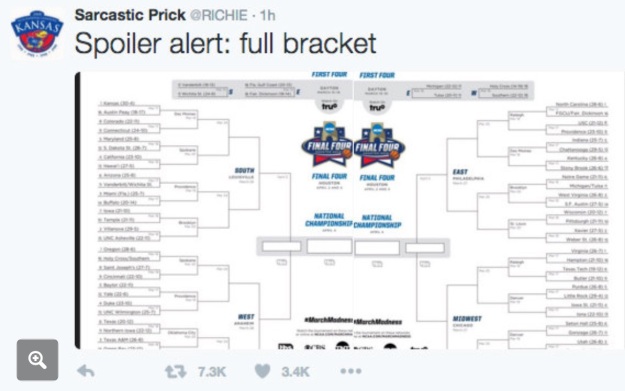
Every year a bracket comes out, and every year there’s plenty of yelling and screaming to the effect that this is the worst bracket in history and lovable mid-major X that just missed the cut has been traduced in a way no other team ever has been before. That’s what Sunday night and Monday morning are for. Then we promptly forget about the yelling and screaming and we savor the actual games.

The same sequence will play out in 2016, and that’s fine. In this brief, fleeting moment when there are no games, however, I want to hold on to this feeling of dissatisfaction for just a second and suggest that it’s the product of a selection process that’s undergoing an arduous and unavoidably public transition. If I’m right, many of the same bracket objections will be filed by we the people next year even if the committee doesn’t pull a Tulsa.

In effect the selection process is navigating three transitions at once. All three changes are difficult to navigate (or at least the NCAA’s making it look that way), and last night we saw the stormy petulance of an adolescent raging at its fate. Continue reading

How to watch Selection Sunday 2016

lounge

This is where the selection magic will happen today. (Photo: Nicole Auerbach.)

I’m hearing a good deal of talk to the effect that this is the closest or toughest selection ever. One possibility is that this sentiment is a backhanded acknowledgment that basketball-specific metrics are gaining greater acceptance in the committee room by default if not by rule. (Four years ago I dreamily envisioned such a day. Well, it’s likely here.) When you have accurate information at your elbow, you can see how excruciatingly complex that bubble you’ve been assaulting with a blunt instrument for decades really has been all that time.

Bubble
If UConn beats Memphis in the inconveniently late American title game this afternoon, what you will have is effectively eight teams chasing four bids. For the moment let’s just stick with this scenario. Here are your eight bubble aspirants, listed in rough order of Lunardi-Palm bullishness.

Just four will dance (the “UConn wins today” scenario)
Temple
Monmouth
South Carolina
San Diego State
Michigan
Syracuse
Saint Mary’s
Vanderbilt

Continue reading