Author Archives: johngasaway

The log cabin ate my homework

WHH

With apologies to Daniel Feller.

This is an essay about when and why many historians came to believe that, in the presidential election of 1840, Whigs said that their candidate, William Henry Harrison, lived in a log cabin.

The received history turns out, in this instance, to be incorrect. The Whigs did not say Harrison lived in a log cabin, so the fact that such an error occurred and indeed endured for so long (it is repeated to this day) makes for an illustrative story.

Early- and mid-20th century scholars writing about the Jacksonian era made a collective methodological misstep on this discrete question. The historians placed their faith in easily accessed reminiscences written decades after the fact instead of in more elusive yet more credible primary sources from 1840 itself.

It might be expected in the ordinary course of events that later writers would have set the record straight. Alas, presidential elections from long ago form a curious topical case, serially invoked yet seldom investigated. The locus classicus on the “log cabin and hard cider campaign” was published in 1957. And, notwithstanding Gail Collins’ deft and discerning extended essay on Harrison from 2012, the standard full-length biography of the ninth president dates from 1939.

The log cabin error was brought about originally by commission, and has remained in place ever since due to simple omission. The resulting irony, wherein 21st century writers adopt an authoritative tone of voice to lament how badly misinformed voters were in 1840, is rich, but it’s also instructive and cautionary. The secondary literature failed these writers. Perhaps it’s failing us too, on other topics and in other ways we don’t yet suspect.  Continue reading
Notes

This is an essay, etc. Phrasing inspired by James Shapiro’s Contested Will: “This is a book about when and why many people began to question whether William Shakespeare wrote the plays long attributed to him, and, if he didn’t write them, who did.”

Garrison and slaveholding gentry of Charleston, South Carolina, agreed on anti-anti-slavery bona fides of both Van Buren and Harrison. On Garrison, see the Liberator, February 7, March 13, April 3, April 24, and September 18, 1840. Choosing between the major candidates was for Garrison equivalent to making a choice “between rottenness and corruption, the plague and leprosy, Satan and Beelzebub.” On Charleston meeting, see Niles’ Register, May 30, 1840 (vol. 58), 200: “[W]e rejoice that both the candidates for the presidency are foes to the abolitionists.” Continue reading

Style, talent, and the eclipse of the chess match

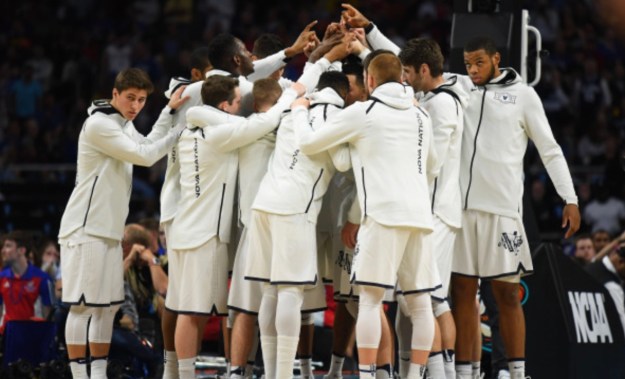
Nova

(villanova.com)

Villanova has succeeded to a degree that is seen in post-Wooden college basketball only once every decade or so, and that success, of course, comes with some very serious role-model responsibilities.

There’s just one problem. Holding up the Wildcats as a paragon of How to Win in 2018 and Beyond turns out to be more easily proclaimed than promulgated. It’s difficult if not impossible to find any discretionary schematic, stylistic, and/or demographic characteristic wherein Jay Wright’s men rate out as No. 1 the way they so clearly do in terms of bottom-line results.

Take the scheme on offense. Villanova has indeed performed remarkable feats using it, and, in the 2018 afterglow, this usage is being depicted as decade-plus-long reign of laudable (if not mandatory) NBA awareness, one dating all the way back to the four-guard Wildcat lineup that reached the 2006 Elite Eight.

Those memories aren’t incorrect so much as incomplete. For, in the early years of this decade, the Wildcats consistently ranked outside the top 100 nationally for three-point attempts and, on occasion, put paint-shooting-only 6-foot-10 and 6-foot-11 types at both the 4 and the 5 spots. All it got Nova in between 2011 and 2013 was a 54-45 record and zero NCAA tournament wins. Going small has clearly been the correct choice for Wright, but his is far from the only small-ball team in Division I. Continue reading

Rapidly improving defense is so 2018

FF

(Tom Pennington/Getty)

Defense may or may not win championships, but it is true that 75 percent of the teams in San Antonio are showing a remarkably similar performance arc on that side of the ball.

Defense, conference play vs. tournament
Opponent points per possession

                          Opp.PPP
              In-conference     Tournament
Michigan          1.02             0.89
Villanova         1.06             0.93
Kansas            1.09             1.02

Loyola Chicago, as always, is an outlier, stubbornly playing a similar level of D (albeit against better competition) as what we saw from the Ramblers in the regular season. They are bold iconoclasts, these lads from Rogers Park.

Now, why are these other three teams suddenly such world-beaters on defense? Good question. Here’s what appears to be taking place, with some null-hypothesis words devoted to Porter Moser’s group for good measure…. Continue reading

Loyola says a lot about selection, but its run says zero

sj

(loyolaramblers.com)

When a No. 11 seed gets an automatic bid at 28-5 and then makes the Final Four, the irresistible temptation is to draw lessons from that tournament run with regard to selection. A team as good as Loyola Chicago, it is said, should have been in the running for an at-large bid even if, by chance, the Ramblers had lost to Illinois State in the Missouri Valley tournament final.

I know it is said, because I’ve said it.

Just so we’re clear, however, the fact of the matter is that we knew or should have known before the NCAA tournament that Loyola was good enough to merit an at-large bid. Porter Moser’s team outscored the No. 9 KenPom conference in Division I by 0.16 points per trip. That’s a classic bid-worthy profile, up there on the same at-large bleachers as VCU last year (a No. 10 seed), BYU in 2015 (another No. 11), or Creighton in 2012 (a No. 8).
Continue reading

You say you want a (three-point) revolution

Marjack

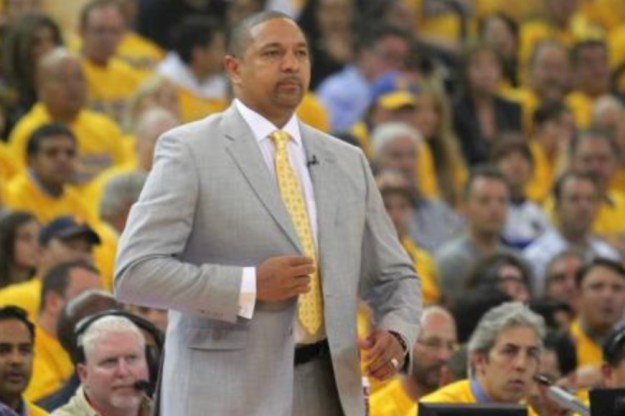
Mark Jackson, three-point forefather. Yes, Mark Jackson. (Photo: Ray Chavez)

Today at ESPN.com, you’ll find a good many words in two pieces on the three-point shot written by Myron Medcalf and yours truly, respectively.

It’s a good topic upon which to lavish a good many words. You can make a case that the rapid increase in three-point attempts is the central performance story in the sport of college basketball over the last five years.

Here, in thumbnail form, is one possible version of how that story’s played out thus far, and what may lay ahead. Consider what follows as a conjectural narration of the three-point revolution’s origins, spread, and limits, delivered in handy pocket size.

Origins
Somewhere in the front offices of the late-1960s-era American Basketball Association (ABA), there resided a pioneering thinker who had the idea of resurrecting a novelty dating from (we think) the early-1960s-era American Basketball League. It seems unlikely in retrospect that said thinker could have had any idea of exactly what it was being unleashed. Continue reading

Pace, favorites, and tournaments

retrieved

Virginia has unwittingly offered itself up as a near-perfect test case on the potential relationship between a slow tempo and very bad tournament performance. But, before we sift that rubble, a word of respect is in order for fans of a team that has somehow wandered into such an analytically convenient yet expectation-crushing artillery range.

Cavalier postseason futility is no Bill Self case, where the woke analytic point to be made is that the underlying perception is itself mistaken. Here, the perception is accurate and unavoidable.

No other team comes close in terms of quantifiable NCAA tournament misery, and the trail of statistical ugliness is easily explained. UVA keeps getting beautiful seeds, and then bowing out extraordinarily early. (The 2016 and 2017 tournaments being, in retrospect, exceptions of rare normalcy.) To gloss over that, much less to pretend otherwise, is to do traumatized Hoo fans a manifest disservice. Continue reading

Your bracket requires knowledge of shot volume

UNC

Generating a very high number of shot attempts is fun! (Photo: J.D. Lyon Jr.)

The story so far. Last year I cooked up a way of measuring how well teams combine taking care of the ball and getting second chances. I called it a shot volume index, North Carolina led the (major-conference) nation in said measure, and the Tar Heels won a national title. Boom! Analytic perfection!

Well, not really. UNC looked really good retroactively on the same measure in 2016, after all, and a fat lot of good that did them in the 40th minute of that year’s national championship game.

Speaking of the Heels, they are No. 1 again in the 2018 rankings, and this time they won going away.

Shot volume index (SVI)
Turnover percentage, offensive rebound percentage, and shot volume
Major-conference games only

                         TO%     OR%     SVI
1.  North Carolina      16.2    40.5    102.4
2.  West Virginia       16.9    36.4     99.7
3.  Florida             13.8    27.8     99.4

Year after year, the men in Chapel Hill put a nice floor under their offense, one that can come in very handy on bad shooting nights. Then again, you don’t have to be an insanely great offensive rebounding team to do so. Look at Mike White’s Florida Gators, slightly below-average on the offensive glass and generating a very high number of shots anyway. Continue reading

End the schedule obsession

Hess

Via David Hess.

The evaluative dead-end in which college basketball finds itself today has two sources. On the one hand, it’s a straightforward problem of political economy, method, and optics.

On the other hand, it’s a statistical issue that, rather remarkably, metastasized over the course of 40 years into an all-encompassing mode of entirely basketball-independent basketball perception. Ironically, that mode is engaged in mostly by those who fancy themselves as true basketball people above minutiae and pedantry like statistics.

The problem of political economy, as always when the NCAA’s involved, is maddeningly easy to solve in concept but difficult to make happen in reality. We keep critiquing the content of what this men’s basketball committee does, when in fact it is the very existence of and charge given to the committee that charts our path-dependent course. Once we’ve made the decision to let a group of eight or so people go from blank slate to a completely seeded and bracketed 68-team field, literally everything else is a footnote. Continue reading

Your viewer’s guide for Selection Sunday 2018

SDSU

(L.E. Baskow – AP photo)

The reason the mock brackets gathered together at bracketmatrix.com are so valuable collectively is that the people making those brackets are doing precisely what the committee does.

Unlike my good friends doing games on TV or talking about a given game from the studio, a person who goes to the trouble of building one entire bracket isn’t simply covering one game, pointing at a team, and saying, “They should be in.” Instead, they’re dealing with a finite number of spots, just like the committee. They have to make tough decisions regarding Arizona State versus Louisville, just like the committee. And they have exactly 36 at-large bids to hand out, just like the committee.

Then again, the reason why the cumulative consensus that results isn’t infallible is that even such a “bracket of brackets” is, in the end, just one bracket — and so too is the committee’s. Going 68-for-68 is entirely possible, but it entails luck as well as skill. Continue reading