Author Archives: johngasaway

Presenting the Easy Intrusive Coach Detector

What would the EMCD have to say about Coach Dale? (That's a rhetorical question. There was no three-point line back then.)

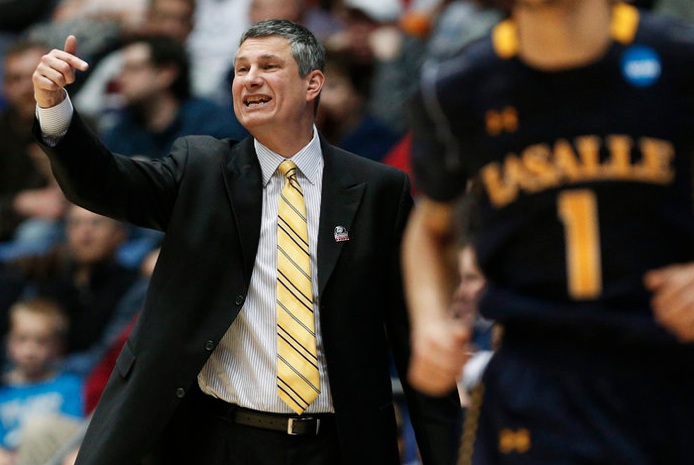
Five passes before every shot? Sounds intrusive, Coach.

If Mike Krzyzewski gets his way and college basketball really does name a commissioner to oversee the sport, I already have a credo picked out to inscribe above the Commish’s cool new office: “The Game is Coached Too Much.”

Take the three-point shot. Left to their own devices, players would shoot threes on occasion, but some coaches decree that their teams not do that. Depending on the team, that decree can either be a no-brainer or highly intrusive.

So, in the tradition of Drew Cannon’s Easy Bubble Solver, I’m pleased to unveil the Easy Intrusive Coach Detector, a fool-proof way to determine whether your head coach is carrying this whole authority thing to an extreme and actively harming the performance of his offense. It’s fast, simple, and effective.  Continue reading

A preface to the 15th Iowa Caucuses of hoops

The only thing more awkward than Maryland representing the conference it's leaving against the conference it's about to join is the ACC choosing the Terps over Clemson, Virginia Tech or Wake Forest.

The only thing more awkward than Maryland representing the conference it’s leaving against the conference it’s about to join is the ACC choosing the Terps to represent the league over Clemson, Virginia Tech or Wake Forest.

In the beginning the ACC dominated the Big Ten in the two leagues’  annual Challenge, winning the first 10 installments in the series (by razor-thin margins at first but soon rather handily — see below).

Then about the same time that people stopped laughing at the Big Ten’s fledgling new TV network, Jim Delany’s league stormed back and won three in a row. That’s where things still stand today — ACC 10, Big Ten 3 — because last year’s event ended in a draw. I still can’t believe that across the vast archipelago of impassioned fan sites no blog did a “[My Conference] BEATS [Other Conference] 6-6” headline, but apparently that really did not happen. I blame the poor historical instruction of our young people today. Somebody form a task force.  Continue reading

Minutes are everything for shot-blockers

Years of advanced hoops analysis have revealed a shocking truth. In order to block a shot you have to be in the game.

Years of advanced hoops analysis have revealed a shocking truth. In order to block a shot you have to be in the game.

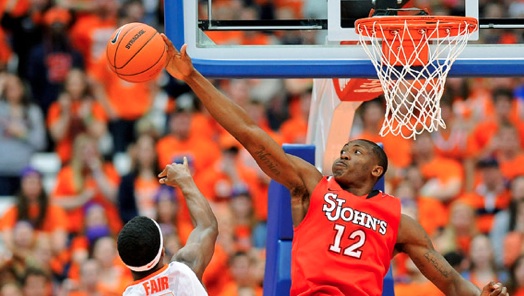
You don’t hear much about Chris Obekpa, and it’s easy to see why. For starters St. John’s hasn’t been very good lately. Steve Lavin’s team went 17-16 last year, and is off to a so-so 5-2 start this season. (Look fast. Right up until New Year’s Eve, St. John’s will continue to be the only team in the 161-year history of intercollegiate sports that has played 100 percent of its games inside the respective city limits of New York City and Sioux Falls, South Dakota.)

But if you do find yourself in the odd position of talking about St. John’s at some point, I’d recommend starting with Obekpa as opposed to usual suspects like D’Angelo Harrison or JaKarr Sampson. This team is again significantly better on defense than it is on offense, and I’ll nominate Obekpa as the largest single factor behind that good D. Not only does he block a high number of shots, he plays a goodly number of minutes as well.

I was mulling how a player whose home court is Madison Square Garden can possibly be under-hyped when I resolved to see if my confusion’s premise had any basis in performance. As a first step I turned to the rather unimaginative but commendably easy recourse of indexing block percentage by playing time.  Continue reading

Syracuse and the Huggins tree agree that shooting’s overrated

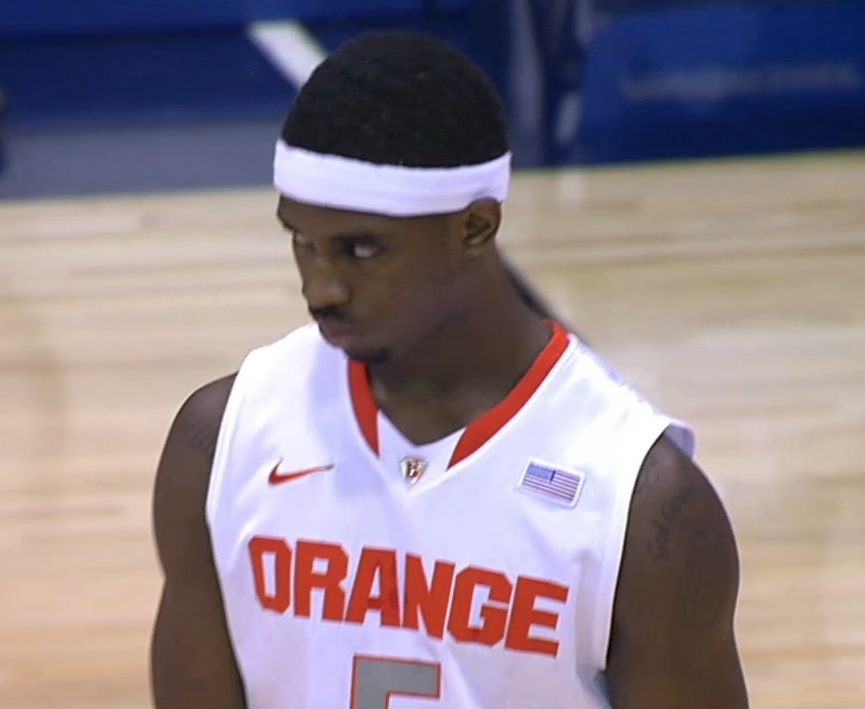
C.J. Fair glowers disdainfully at your traditional basketball metrics like "shooting."

C.J. Fair glowers disdainfully at your traditional basketball metrics like “shooting.”

Yesterday at Insider I wrote about Syracuse, and in passing I mentioned a curious feature of this team that’s already become apparent. Jim Boeheim’s men have proven they can win games while not shooting as well from the field as do the overwhelmed opponents (Cornell, Fordham, Colgate, and St. Francis NY) that are imported into the Carrier Dome. Since that post hit the interwebs, the Orange went out and extended this rather remarkable streak, defeating Minnesota in Maui 75-67 despite the fact that the Gophers (52.9 effective field goal percentage) were more accurate from the field than were Boeheim’s men (47.3).

Winning teams are outshot from the field every day of the week, of course, but what’s fun about Cuse is that they’re raising this to an art form.  Continue reading

How an ACC with nine so-so teams can still be the best conference ever

This could be the ACC's future: The Big East in 2009.

ACC, meet your future: The Big East in 2009.

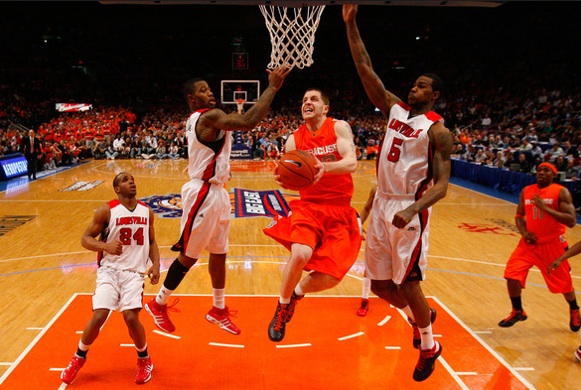
My unplanned multi-day ACC festival continues! Yesterday I pointed out that the 10 programs that constituted the “other” teams in the pre-expansion league — Boston College, Clemson, Florida State, Georgia Tech, Maryland, Miami, NC State, Virginia, Virginia Tech, and Wake Forest — haven’t been very good at basketball over the past eight years.

Today I want to flesh out the “Who cares?” objection to that line of critique. So:  Continue reading

The “rest of the ACC” has been weaker than commonly understood

ACC teams besides Duke and North Carolina used to do well in the NCAA tournament. But it's been a while.

ACC teams besides North Carolina and Duke used to do well in the NCAA tournament. But it’s been a while.

Every year we expect an ACC team besides North Carolina or Duke to finally break through, for lack of a better term, and certainly Miami seemed to fit that bill last year. The Hurricanes won the regular-season championship outright at 15-3 and took the ACC tournament title as well.

Maybe Jim Larranaga’s success in 2012-13 can provide a blueprint for the ACC’s non-Carolina and non-Duke programs. Certainly a blueprint is needed. That No. 2 seed the Canes got last year stands out in historical terms. Florida State received a No. 3 in 2012, but otherwise no ACC team not named “North Carolina” or “Duke” has secured anything higher than a No. 4 since Wake Forest was on the 2-line in the 2005 tournament.

And with the conference’s performance once again earning the wrong kind of headlines, this seems an appropriate moment to reflect on a rather weighty question:

What in the world happened to the rest of the ACC these last few years?  Continue reading

How I learned to stop worrying and love the new free throw rate

I think I see a trend.

I think I see a trend.

Depicted here in all its scintillating glory is Division I’s median free throw rate (FTA/FGA) from 2002-03 through last night, courtesy of Ken Pomeroy’s vault. As is plain from the upside-down 1929 line, the FT rate has been notably robust over the first 12 days of the 2013-14 season.

What this suggests for the season as a whole is still an open question. As Ken pointed out last week, turnovers have dropped more or less in lockstep with the jump in the free throw rate, meaning I could show you a really cool graph with the TO rate dipping about as dramatically as the FT rate has spiked. Maybe both developments will regress toward their respective means as the season unfurls, or maybe we’ve embarked on a new era of low-turnover high-free-throw ball. At this point it’s anyone’s guess.  Continue reading

Psychosomatic reactions and college basketball

You don't need a Ph.D. from Illinois like Dr. John Giannini to understand how folk wisdom influences perception.

You don’t have to have a Ph.D. from Illinois like Dr. John Giannini to wonder how folk wisdom influences perception.

People will say certain things during this college basketball season that are said every year. Certainly there really are some things that are true each year, but coaches, announcers, and writers don’t expend precious time saying “The baskets are 10 feet high this year,” or “made free throws are worth one point.” Instead the annual statements I refer to are phrased as considered judgments based on what’s been observed that particular season. “Parity,” for one, or “there are no great teams,” or possibly even “more blown calls than ever before.”

Still another considered judgment that recurs quite often is that we’re seeing a decline in the overall quality of play in college basketball. I suppose the interesting question is whether this can ever be true under normal circumstances. Obviously when the NFL uses replacement players during a strike, or when major league baseball tries to keep things going during a world war, there is likely to be a decline in the quality of play.

In the case of college basketball in particular, there are what appear to me to be conflicting attitudes toward defense. The underlying dynamic goes roughly like this….  Continue reading

Being the best conference ever is really hard to pull off

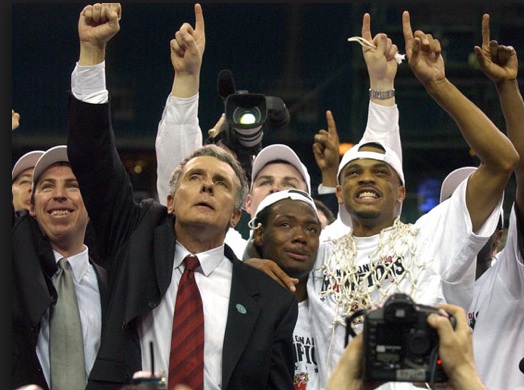
Some ACC guy in 2004 -- was this The Greatest Conference Ever?

Some ACC guy in 2004 — was this The Best Conference Ever?

Today I have a piece at Insider considering the new-look ACC’s claim to being “the best conference in the history of the game,” as Mike Krzyzewski memorably put it. Specifically I look at just how good the league can reasonably expect to be starting next season when Louisville arrives (and Maryland leaves for the Big Ten).

I’m not at liberty to divulge any conclusions I reached as a result of that particular effort, but as part of my daylong festival of Greatest Conferences, I thought I’d cover some of the other candidates for this particular title from years gone by.  Continue reading