Author Archives: johngasaway

Continuing coverage from the offensive rebound’s deathbed

Van

Offensive boards have disappeared at Vanderbilt. Will they ever come back?

It’s no secret that the offensive rebound is dying, both at the professional and collegiate levels. Barring a seismic turnaround, the offensive rebound rate in major-conference play this season will come in under 31 percent for the first time since I started doing things like tracking the offensive rebound rate in major-conference play.

This process has been in motion for years, and “inexorable” is probably not too strong a word to describe it. I’ll restate at the top what regular readers already know: I’m unpersuaded as to the wisdom of giving up on offensive rebounds. Be that as it may, it’s happening and, as the major-conference rate threatens to dip below 30 some season (very) soon, the disappearance of offensive boards is offering up some really interesting  vignettes. Continue reading

Tuesday Truths: Mott the Hoople edition

This “Simpsons” clip from three years ago coincidentally included a cameo from Alan Rickman along with the Bowie-authored “All the Young Dudes.” More recently Daniel Radcliffe’s deft tribute to Rickman ricocheted around social media, which made me remember that time when Radcliffe appeared on BBC Radio 1’s Innuendo Bingo….

If we can copy “The Office” and audition-based contestant reality shows from the Brits, surely we need to nick Innuendo Bingo as well. (The one with Hugh Jackman was also well done.)

Welcome to Tuesday Truths, where I look at how well 55 mid-majors are doing against their league opponents on a per-possession basis.

Major-conference Truths are at ESPN Insider.

A-10: Perceptual lags and Will Wade’s Rams
Through games of January 18, conference games only
Pace: possessions per 40 minutes
PPP: points per possession
EM: efficiency margin (PPP – Opp. PPP)

                          W-L   Pace    PPP   Opp. PPP    EM
1.  VCU                   5-0   70.3    1.14    0.91    +0.23
2.  Dayton                4-1   67.1    1.11    0.97    +0.14
3.  Rhode Island          3-2   62.6    1.17    1.04    +0.13
4.  Saint Joseph's        4-1   71.3    1.12    0.99    +0.13
5.  St. Bonaventure       4-1   70.4    1.19    1.08    +0.11
6.  George Washington     3-2   67.5    1.11    1.01    +0.10
7.  Richmond              2-3   69.3    1.14    1.10    +0.04
8.  Davidson              3-2   72.1    1.12    1.09    +0.03
9.  Duquesne              2-3   74.7    0.97    1.05    -0.08
10. La Salle              1-4   65.1    0.96    1.08    -0.12
11. George Mason          1-4   69.7    0.99    1.13    -0.14
12. UMass                 1-4   71.8    1.00    1.16    -0.16
13. Saint Louis           1-4   68.7    0.96    1.14    -0.18
14. Fordham               1-4   66.8    0.96    1.17    -0.21

AVG.                            69.1    1.07
KenPom rank: 8
% of games played: 28

Continue reading

Welcome to 2016’s egalitarian and accelerated showcase for veterans

JH

The nation’s leading scorer is Howard’s James Daniel, a seasoned junior who plays for a fast-paced team that isn’t great. How emblematic of him.

Today I’m officially removing the disclaimer “It’s early” from my 2015-16 lexicon. It’s not early anymore.

Most of the teams we spend our time talking about have now played 15 or so games, and even the conference seasons are at last well underway. We’ve now seen 20 percent of all the major-conference games we’re going to get in 2016, so forgive me if I feel like I have a pretty good — albeit still adjustable — understanding of where the season’s headed on January 13.

To my eyes these are the four factors (if you will) driving this unique season, in order of importance….

1. No great teams (hereafter NGT)
Kansas, Oklahoma, North Carolina, Michigan State, et al., are all fine teams that nevertheless would be ground into a fine neutral-floor powder by the Duke, Wisconsin, Kentucky, and Arizona teams we saw last season. Last year was unusually strong at the top. This year is unusually weak. I trust this isn’t merely Grandpa Simpson-variety carping on my part; ideally it is instead something I looked into and wondered about before the start of the season. More importantly a diagnosis of no great teams doesn’t have to be a dyspeptic lament. Continue reading

Tuesday Truths: “We can be heroes” edition

DB

“Just for one day.” Not a bad anthem for mid-majordom.

Today marks a first for Tuesday Truths. A branch office of the venerable franchise has been opened in Bristol, and per-possession Truths for the ACC, Big 12, Big East, Big Ten, Pac-12, SEC, and American await you over at ESPN Insider. There you’ll find the same trusty numbers and winningly phrased analysis you’ve come to demand hereabouts, only with a vastly superior layout. Make haste.

Welcome to Tuesday Truths, where I look at how well 55 mid-majors are doing against their league opponents on a per-possession basis.

Major-conference Truths are at ESPN Insider.

Learn how to coach and strategize the A-10 way 
Through games of January 11, conference games only
Pace: possessions per 40 minutes
PPP: points per possession Opp. PPP: opponent PPP
EM: efficiency margin (PPP – Opp. PPP)

                          W-L   Pace    PPP   Opp. PPP    EM
1.  VCU                   3-0   70.9    1.07    0.87    +0.20
2.  St. Bonaventure       3-0   70.7    1.23    1.04    +0.19
3.  Rhode Island          2-1   64.3    1.19    1.01    +0.18
4.  Dayton                2-1   66.8    1.08    0.91    +0.17
5.  George Washington     2-1   66.3    1.12    0.97    +0.15
6.  Saint Joseph's        2-1   71.5    1.08    1.05    +0.03
7.  Davidson              2-1   73.9    1.11    1.09    +0.02
8.  Richmond              1-2   67.8    1.14    1.16    -0.02
9.  La Salle              1-2   66.9    0.94    0.98    -0.04
10. Fordham               1-2   68.0    1.03    1.09    -0.06
11. UMass                 1-2   71.1    1.00    1.16    -0.16
12. Saint Louis           1-2   61.4    0.93    1.14    -0.21
13. Duquesne              0-3   71.7    0.87    1.09    -0.22
14. George Mason          0-3   67.6    0.89    1.13    -0.24

AVG.                            68.6    1.05
KenPom rank: 8
% of games played: 17

Continue reading

The new clock’s making conference games faster and therefore higher-scoring

KU.jpg

A triple-overtime game with 102 possessions and 215 total points? That’ll do. (Mike Gunnoe, Topeka Capital-Journal)

In the offseason the NCAA introduced a whole host of rule changes and/or “no, this time we really mean it” reemphases. Most prominent among the new measures was the 30-second shot clock, and coming into the season it was natural to think of the clock as purely a tempo-reform measure while pretty much everything else was either efficiency- or justice-related.

As always with such offseason discussions, the potential impact of the new rules and new clock were considered at length because it was hot outside and we had no games to talk about. Then, once the season started, we properly moved on to more pressing concerns such as who’s going to win the national title. As chance would have it I’m still interested in who’s going to win the national championship, but today I want to pause briefly to consider how the major conferences are faring in terms of tempo, efficiency, and scoring.

I realize that on January 6 it may seem rather early to look at the shot clock’s effect on conference play. Well, it is early. Still, 69 major-conference games have already been played, and that’s 10.2 percent of the eventual total right there. Think of it as the same number of games that, say, the Big 12 or Big East will have played in-conference by late February.  Continue reading

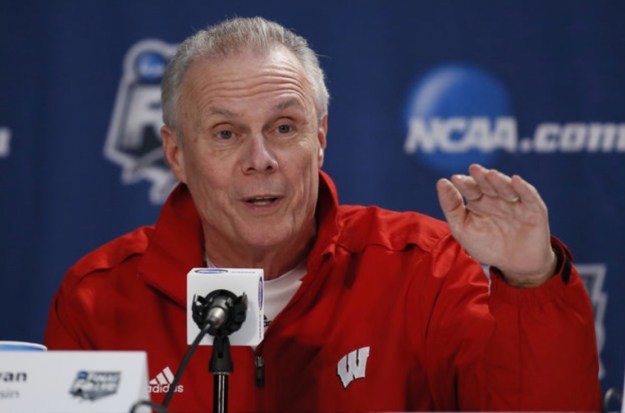
Why Bo Ryan was the most influential coach of his era

Ryan

Ryan addresses the media at the 2015 Final Four. (Reuters)

In the spring of 2001 when Pat Richter placed a call to Wisconsin Milwaukee head coach Bo Ryan, the Wisconsin athletic director had been through a challenging few months. Fresh off a surprising run to the 2000 Final Four as a No. 8 seed, the Badgers lost their coach when Dick Bennett decided to retire just two games into the 2000-01 season. Brad Soderberg coached the team the rest of the way that year, but it was widely assumed in basketball circles that the man that Richter — and the entire state of Wisconsin — really wanted for the job was Utah head coach Rick Majerus.

Only now, as Richter made his call to Ryan, the Utes’ coach had pulled his name from consideration for the post in Madison. The Badgers needed a Plan B immediately, and Richter had just one question for the man on the other end of the line:

“Bo, are you ready?”

“Pat, I’ve been ready.” Continue reading

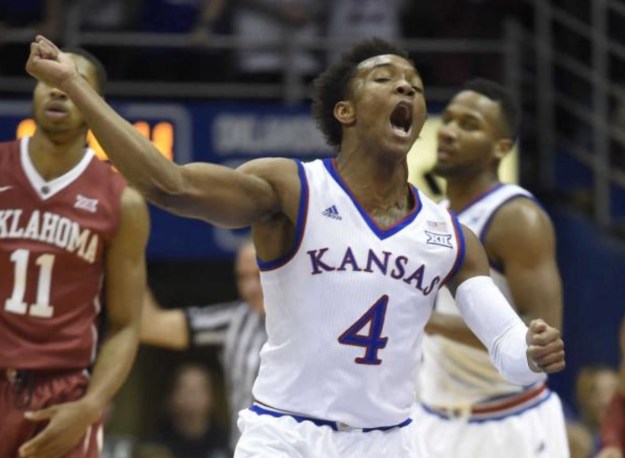
Elite freshmen, playing time, and Bill Self

Cheick

Cheick Diallo (right) before he was eligible. He often looks like this now that he’s eligible, too. (Rich Sugg, Kansas City Star)

After a protracted battle with the NCAA, Cheick Diallo became eligible for Kansas on November 25. What we all forgot to account for, however, is that Diallo actually has two hoops to jump through to play college ball. One was the organization in Indianapolis, and the other is an individual on the sidelines in Lawrence. Usually when a coach gets one of the best recruits in the country, he’s kind of anxious to, you know, have the freshman play basketball. But, as we saw this time a year ago with Kelly Oubre, Bill Self is comfortable being the exception to this rule.

I wanted to add a cherry on top of the excellent work already done on this topic by Jesse Newell, and the question I had for myself was a simple one. Exactly how weird is Self being? To see how aberrant KU’s coach really is, I scooped up every top-10 (RSCI) freshman from the past two seasons. Since I’m interested in actual in-game decisions as opposed to sheer player availability, I worked up figures for the percentage of “discretionary” minutes played.

Sometimes discretion and eligibility are the same thing. Diallo, for example, has been eligible for just three games and he’s played 41 of a possible 120 minutes. But I also wanted to account for things like Kansas choosing to keep Cliff Alexander on precautionary infractions ice at the end of 2014-15, Rashad Vaughn missing nine games due to injury, or even something as minute as Mike Krzyzewski resting a banged-up Jahlil Okafor against Clemson last season.  Continue reading

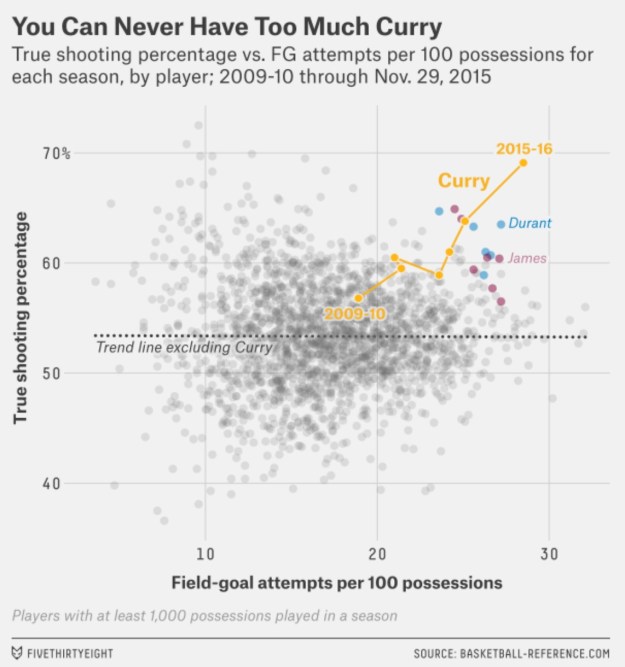
The college basketball implications of Stephen Curry

Curry

If it turns out the usage-efficiency tradeoff doesn’t apply to one player, what does that say about how the game should be played by every other player? (fivethirtyeight.com)

As an incorrigibly casual and contentedly sporadic NBA fan, I really enjoyed Benjamin Morris’s piece on what precisely Stephen Curry hath wrought in our game. Previously I had struggled to piece together a coherent awe from the stray random shouts I caught from trusted and unmistakably thunderstruck colleagues on Twitter. But after stumbling across Morris and his arresting visuals, I get it. A player who is (apparently) “virtually immune to burden” reorders the hoops universe.

So now what? As an incorrigibly dedicated and contentedly constant fan of the college game, I have some questions.

Should Curry change what college coaches do?
If nothing else Curry has erected a tower so that first-grade math can shine forth like a beacon and claim its due deference. Three is greater than two, and one possibility Curry raises is that, purely in the abstract sense, the first option for any basketball possession should be an open three-point attempt.  Continue reading

Three questions for the Iowa Caucus of hoops

RW

He looks uncertain. That makes two of us. (AP/Charlie Niebergall)

The Big Ten/ACC Challenge happens very early in the season — perhaps even too early — and its results are hungrily overanalyzed by information-starved pundits who’ve just emerged from a very long no-hard-news period and are thus eager to pontificate on any morsel of actual substance. That being said, the Challenge is also a genuinely compelling competitive spectacle and people do tend to remember who won.

In other words it’s uncannily similar to an Iowa Caucus. These are my questions for the 2015 incarnation…

Whatever happened to home-court advantage in this thing?
In the first nine years of this event the home team won 70 percent of the time. In the last seven years, however, that percentage has dropped all the way down to 55. This is an oddly low figure in light of the fact that in each of the two competing conferences over the past 10-plus years the home teams can be counted upon to win 64 (ACC) or 65 (Big Ten) percent of the time in league play. Continue reading

Quality, justice, and 2015-16’s brave new world

Under the new guidelines, verticality matters.

Under the new guidelines, verticality is supposed to matter the way it was supposed to matter under the old guidelines. This is a good thing.

You may not be exceedingly familiar with James Thompson IV, Ethan O’Day, or even the Convocation Center in Ypsilanti, Michigan, but the 2015-16 college basketball season will begin tomorrow morning at 11 Eastern when those two guys contest the opening tip in said arena on behalf of Eastern Michigan and Vermont, respectively. Perhaps this strikes you as a rather inauspicious manner in which to embark upon an endeavor that will culminate with all eyes on Houston next April. For my part I’m too happy to care. The season’s finally here.

In the seven months since the final horn sounded in Duke’s win over Wisconsin, the NCAA has instituted a number of changes and issued several directives aimed at improving the game. Yes, the shot clock’s been shortened from 35 seconds to 30, but if you’re unfamiliar with everything else that’s new and different the NCAA just posted a briskly efficient 14-minute video that summarizes the main points. I highly recommend giving it a click.

This is the part where I scratch my head over the NCAA acting like the nimblest of daring Silicon Valley start-ups when it comes to bettering the game while at the same time the organization does a searingly convincing imitation of a cadre of Bulgarian apparatchiks circa 1953 and continues to define “top-50” wins with a metric that’s off by 50 spots or more seven percent of the time. Go figure, the “bettering the game” part of said schizophrenia is highly laudable. NCAA, I salute you! Continue reading