Category Archives: florid historical references

Twos are dying

ML

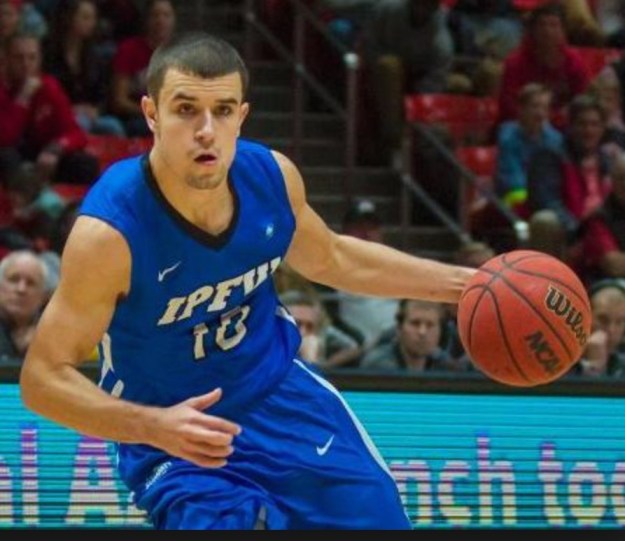
“Let’s dispel once and for all with this fiction that Buddy Hield is the only player who’s making about half his threes while attempting about eight of them a game. I’m Max Landis, and I approved this message. No, not that Max Landis.”

So far in 2015-16, attempts from inside the arc have comprised just 64.8 percent of all shots in Division I. True, 64.8 percent of anything is a fair share. Nevertheless, that figure does represent an all-time low. To quote a movie, at this rate twos will disappear entirely in another 27 years.

It is therefore fair to say that a three-point revolution is at hand. Being the helpful, proactive, and modest sort, I’ve prepared a brief précis to help you safely navigate this bold new era’s tumbrils and barricades. Enjoy.

There’s a reason it may seem like you’re not really seeing a revolution
Strictly speaking threes are at an all-time high across the breadth of D-I, but, as always when the subject is college basketball, this is somewhat misleading. No human being watches all of D-I, and the numbers that emerge from this vast unseen monolith are driven by a bulky majority of programs that even most professional college basketball writers never once glimpse during a given season. For example the most perimeter-oriented leagues in the nation are currently the SoCon, the Big South, and the MAAC. Conversely, the teams that more fans and writers do tend to watch are, rather ironically, the exceptions to the revolutionary rule.
Continue reading
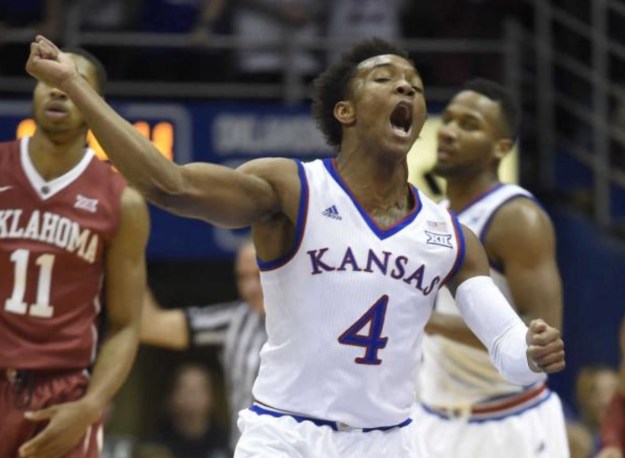
Buddy Hield’s season is impossible

BB

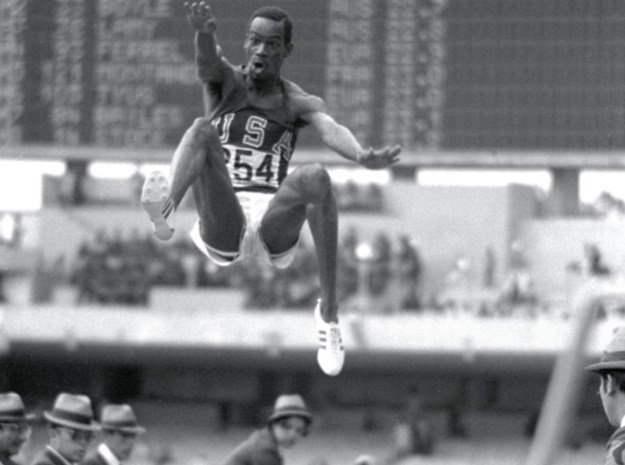
What we’re seeing is Beamon-esque.

This season I’ve adopted a new morning ritual. I check the previous evening’s scores, glance at the headlines, and then I devote a minute or two exclusively to Buddy Hield.

If by chance Oklahoma has played the previous evening, I’ll watch those highlights. Or if the Sooners are between games, I might find myself gazing upon Hield’s body of numerical work and trying, once again, to take the true measure of what I’m seeing….

It’s good to know my need to try to situate Hield within some kind of rational framework is a shared affliction. Last week I realized that Luke Winn, Kevin Pelton, and I were all simultaneously running Hield-triggered searches on 22 years’ worth of Division I basketball at sports-reference.com. Luke heralded Hield’s membership in the 50-50-90 club. Kevin wants to gently dissuade NBA general managers from thinking this remarkable Hield of Dreams thing can possibly continue at the next level. Continue reading

Why are there so many exceptionally challenged teams in 2016?

PR

“Highlights”?

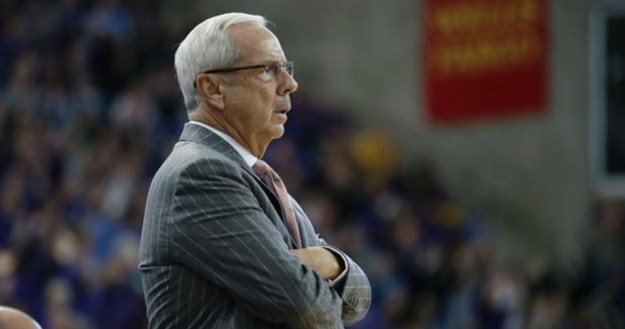
This week John Beilein was asked about his team’s next opponent, and he came up with a small masterpiece of backhanded complimenting.


Beilein’s brand of faint praise reminded me of how former Illinois coach Lou Henson used to respond in similar situations. When I was a kid my brother and I had a running joke involving Henson’s preferred verbal tic, “super ball club.” We’d take turns inserting the most absurd opponent imaginable and mimicking Henson’s flat New Mexican twang: “Well, Jim, Immaculate Heart of Mary is just a super ball club, and we’re going to have to play our best game to win.”

Still, Beilein’s ringing endorsement of his next opponent’s Division I status weirdly paralleled some thoughts I’ve had regarding exceptionally challenged teams. For starters I’ve often wondered how ECT’s happen at all. It seems like if you squint hard enough and keep things good and abstract, such teams should be all but impossible. Continue reading

The new clock’s making conference games faster and therefore higher-scoring

KU.jpg

A triple-overtime game with 102 possessions and 215 total points? That’ll do. (Mike Gunnoe, Topeka Capital-Journal)

In the offseason the NCAA introduced a whole host of rule changes and/or “no, this time we really mean it” reemphases. Most prominent among the new measures was the 30-second shot clock, and coming into the season it was natural to think of the clock as purely a tempo-reform measure while pretty much everything else was either efficiency- or justice-related.

As always with such offseason discussions, the potential impact of the new rules and new clock were considered at length because it was hot outside and we had no games to talk about. Then, once the season started, we properly moved on to more pressing concerns such as who’s going to win the national title. As chance would have it I’m still interested in who’s going to win the national championship, but today I want to pause briefly to consider how the major conferences are faring in terms of tempo, efficiency, and scoring.

I realize that on January 6 it may seem rather early to look at the shot clock’s effect on conference play. Well, it is early. Still, 69 major-conference games have already been played, and that’s 10.2 percent of the eventual total right there. Think of it as the same number of games that, say, the Big 12 or Big East will have played in-conference by late February.  Continue reading

Three questions for the Iowa Caucus of hoops

RW

He looks uncertain. That makes two of us. (AP/Charlie Niebergall)

The Big Ten/ACC Challenge happens very early in the season — perhaps even too early — and its results are hungrily overanalyzed by information-starved pundits who’ve just emerged from a very long no-hard-news period and are thus eager to pontificate on any morsel of actual substance. That being said, the Challenge is also a genuinely compelling competitive spectacle and people do tend to remember who won.

In other words it’s uncannily similar to an Iowa Caucus. These are my questions for the 2015 incarnation…

Whatever happened to home-court advantage in this thing?
In the first nine years of this event the home team won 70 percent of the time. In the last seven years, however, that percentage has dropped all the way down to 55. This is an oddly low figure in light of the fact that in each of the two competing conferences over the past 10-plus years the home teams can be counted upon to win 64 (ACC) or 65 (Big Ten) percent of the time in league play. Continue reading

The category 5 roster

A roster like this only comes along once every 2.25 seasons -- unless it's 2015, when there were two such rosters. (Robert Deutsch/USA Today)

A roster like this only comes along once every 1.8 seasons in Division I. Unless of course it’s 2015, when there were two such rosters. (Robert Deutsch/USA Today)

Last March at the Sloan Conference in Boston, I was told a near-perfect parable on the traditionally and deeply yet needlessly antagonistic relationship between the “talent” and “analytic” schools of basketball interpretation.

In the immediate aftermath of a dismal 2013-14 season, an NBA general manager ordered a top-to-bottom review of what had gone wrong with the team that year. By that time every front office was fully equipped with bright young minds who could apply the latest analytic tools and even brandish some proprietary and closely-held statistical methods of their own. But the GM had allotted just 48 hours for the task while also imposing a draconian two-page limit on the final report. As a result the analytics team worked in a frenzy to summarize every last data point, shot chart, and pick-and-roll efficiency in just a couple of pages.

At the end of the ordeal the exhausted head of the analytics group yanked the final draft from the printer and thrust the two-page encyclical into the waiting hands of his boss. Whereupon the GM took the report and, smiling genially and never so much as glancing down at the printout, wadded up the two pages while taking aim at the nearest waste basket. As the GM let fly with his shot, he uttered one word:

“Players.”

After a decade of watching college basketball in the one-and-done era, I’ve come to the conclusion that in one crucial respect the GM is exactly right. In fact the more I ponder the question the more I think I’ve become something of a talent essentialist in spite of myself.

I wonder whether there might be rare instances where we can remove college performance from the equation more or less entirely and just look at the roster of players. Forget efficiency or shooting accuracy. Tell me how many minutes the returning players recorded, how many possessions they used, and how highly the freshman class is rated, and in these very rare instances this may be all we need to know.

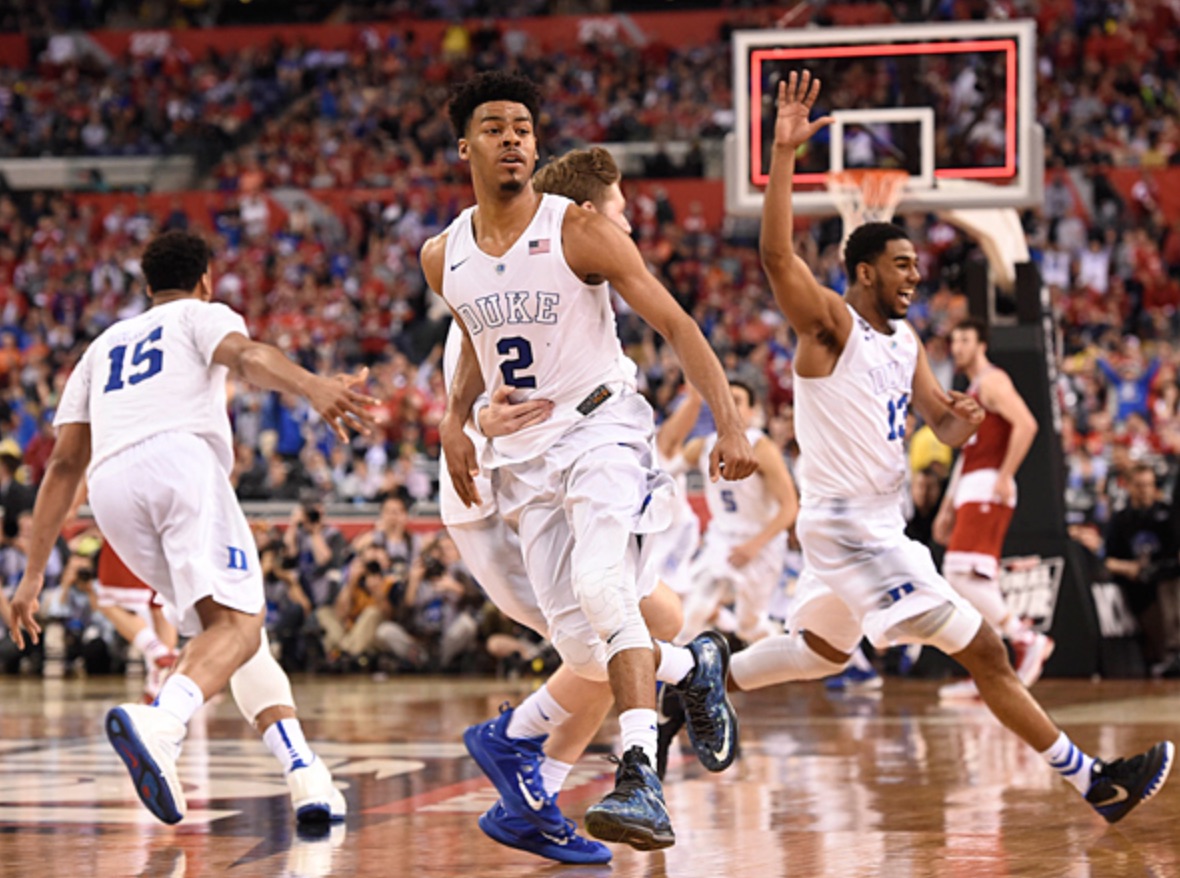
In such cases I think we may be able to just look at a college basketball roster before the season even starts and say that if precedent’s any guide this team has virtually a 100 percent likelihood of earning an NCAA tournament No. 1 seed, a 60 percent probability of reaching the Final Four, and a two-in-five shot at winning a national title. I’m going to call such instances category 5 rosters, and, though I (and others) didn’t know it ahead of time, it turns out that Duke’s in 2015 was one such roster.  Continue reading

One working definition of a major conference

Was this a major-conference game? Good question.

Can we do better than a Potter Stewart definition?

Last week I posted a piece at ESPN Insider where I pointed out that the new-look no-football Big East has recorded a pretty nice collective KenPom rating the past two seasons, while the newborn American — even with a national title in its pocket — has not. Little did I know that this piece would win the title for “largest response to anything I’ve ever written about college basketball in September.” Perhaps a further word is therefore in order. Just what is a major conference?

I’ll grant at the top that this might be an untenable dichotomy to begin with, and that maybe this whole “major vs. mid-major” thing is a doomed attempt to put static categorical toothpaste back into a more fluid and dynamic postmodern college hoops tube. It could be the case that old boundaries and vocabularies no longer serve our purposes all that well. Duly noted. Continue reading

How Walter Byers built, fought, lost, and wrote

Byers in 1986. (AP: Cliff Schiappa)

Byers in 1986. (AP: Cliff Schiappa)

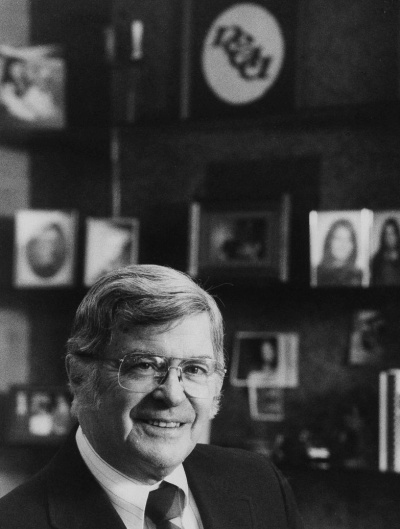
Longtime NCAA executive director Walter Byers passed away this week at the age of 93, and his New York Times obituary says that late in his career “he viewed the college sports landscape with increasing cynicism.” Granted I never spoke to the man — as near as I can tell no one did on the record after about 1997 — but I must say this strikes me as incorrect.

Anywhere that lawyers gather to contest the future form and very existence of the NCAA in 2015, there are two histories of college sports close at hand. (Literally.) Taylor Branch wrote one, of course, and Byers authored the other, in 1995.

Both histories were written in anger. Branch will tell you he’s angry that oligopolists are piously mouthing empty platitudes about amateurism while maintaining a cartel that allows them to profit off the sweat of young brows. Byers, conversely, wrote what on the surface is a far more conventional post-retirement jeremiad. At the age of 73 he yelled at a cloud, and did so at some length. Continue reading

The 30-second clock’s a long-overdue solution to a problem we may not have

The last time any adjustment was made to the shot clock, Glenn Robinson was the reigning player of the year. It's been a long time coming.

The last time an adjustment was made to the shot clock was in 1994, when Glenn Robinson was the reigning player of the year. It’s been a while.

Last week the NCAA’s rules committee exceeded my loftiest expectations. Not only did the group recommend the adoption of a 30-second shot clock, it also:

  • Eliminated one second-half timeout
  • Enlarged the restricted area under the basket
  • Made any bench timeout called in close proximity to a scheduled media stoppage the “media timeout” all by itself (no more “bench timeout, four seconds of action, media timeout” sequences)
  • Gave officials the authority to review potential shot-clock violations on made field goals throughout the game
  • Prohibited coaches from calling live-ball timeouts
  • Enabled refs to call personals on players who on replay are found to have faked fouls
  • Reduced the penalty for class B technical fouls (e.g., hanging on the rim) to just one free throw
  • Ended the prohibition on dunking in pregame warmups.

That sound you heard on Friday was Twitter laboring mightily to wield its surgically implanted torches and pitchforks in the face what by any reasonable measure was a rather disconcerting overabundance of wish fulfillment. (How the NCAA can broadcast so much common sense in the span of but a few minutes while also keeping the RPI hooked to life support into a fourth decade is surely a quandary worthy of our finest organizational anthropologists.)  Continue reading

Why we should occasionally be less impressed by undefeated records

If a team's still undefeated at this point in the season, they will almost invariably be ranked or very close to it. Is that a correct assessment? Good question.

If a team’s still undefeated at this point in the season, it will as a matter of custom be ranked or very close to it. Is that a correct assessment? Good question. (TCU)

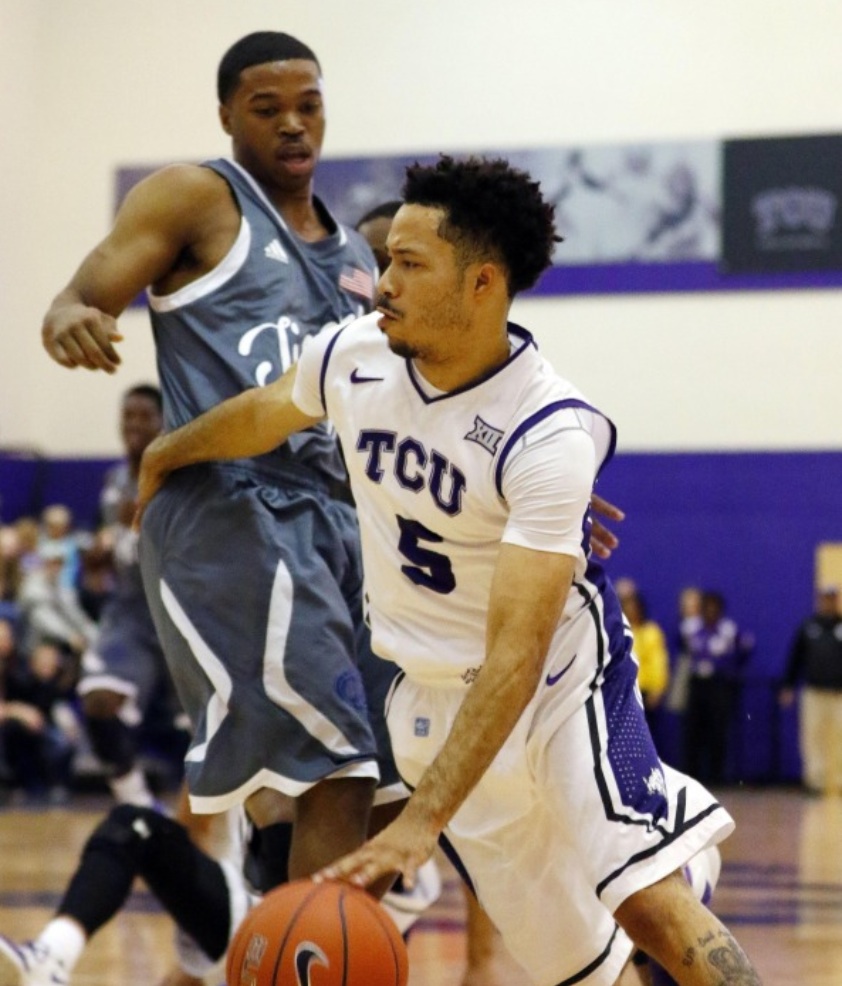
TCU and Colorado State have posted identical 13-0 records to start 2014-15, and I would venture to say that both the Horned Frogs and the Rams are indeed much better than we expected them to be in the preseason. Kyan Anderson, an unfailingly aggressive sub-six-foot lead guard, really is playing the way Chris Jones probably thinks that Chris Jones plays. CSU is winning games with zero (or multiple) point guards, a very high barrage factor (many offensive boards and few turnovers), and heaping helpings of clutchy clutchness and just wanting it more in close games. Trent Johnson and Larry Eustachy, take a bow.

I’m just not sure either team is really as mighty as what’s currently being shown in the polls: Colorado State is No. 24, and TCU’s No. 1 in the “others receiving votes” small type. There’s an evaluative bonus that comes from being undefeated, and I’m not interested in lobbying against it as much as I am in defining it more precisely. Indeed I myself have been known to bestow the evaluative bonus on this or that team on occasion. If anything I was perhaps too charitable in my pre-Stony Brook ranking of Washington.  Continue reading