Category Archives: hoops

Elite freshmen, playing time, and Bill Self

Cheick

Cheick Diallo (right) before he was eligible. He often looks like this now that he’s eligible, too. (Rich Sugg, Kansas City Star)

After a protracted battle with the NCAA, Cheick Diallo became eligible for Kansas on November 25. What we all forgot to account for, however, is that Diallo actually has two hoops to jump through to play college ball. One was the organization in Indianapolis, and the other is an individual on the sidelines in Lawrence. Usually when a coach gets one of the best recruits in the country, he’s kind of anxious to, you know, have the freshman play basketball. But, as we saw this time a year ago with Kelly Oubre, Bill Self is comfortable being the exception to this rule.

I wanted to add a cherry on top of the excellent work already done on this topic by Jesse Newell, and the question I had for myself was a simple one. Exactly how weird is Self being? To see how aberrant KU’s coach really is, I scooped up every top-10 (RSCI) freshman from the past two seasons. Since I’m interested in actual in-game decisions as opposed to sheer player availability, I worked up figures for the percentage of “discretionary” minutes played.

Sometimes discretion and eligibility are the same thing. Diallo, for example, has been eligible for just three games and he’s played 41 of a possible 120 minutes. But I also wanted to account for things like Kansas choosing to keep Cliff Alexander on precautionary infractions ice at the end of 2014-15, Rashad Vaughn missing nine games due to injury, or even something as minute as Mike Krzyzewski resting a banged-up Jahlil Okafor against Clemson last season.  Continue reading
The college basketball implications of Stephen Curry

Curry

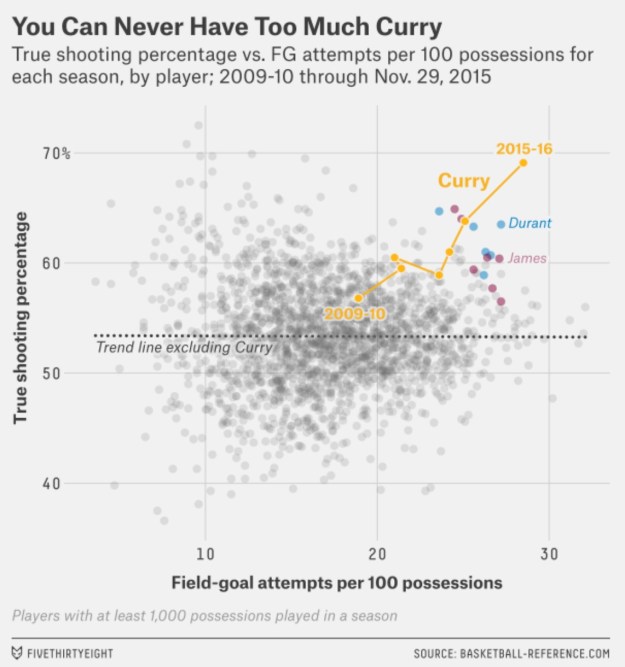
If it turns out the usage-efficiency tradeoff doesn’t apply to one player, what does that say about how the game should be played by every other player? (fivethirtyeight.com)

As an incorrigibly casual and contentedly sporadic NBA fan, I really enjoyed Benjamin Morris’s piece on what precisely Stephen Curry hath wrought in our game. Previously I had struggled to piece together a coherent awe from the stray random shouts I caught from trusted and unmistakably thunderstruck colleagues on Twitter. But after stumbling across Morris and his arresting visuals, I get it. A player who is (apparently) “virtually immune to burden” reorders the hoops universe.

So now what? As an incorrigibly dedicated and contentedly constant fan of the college game, I have some questions.

Should Curry change what college coaches do?
If nothing else Curry has erected a tower so that first-grade math can shine forth like a beacon and claim its due deference. Three is greater than two, and one possibility Curry raises is that, purely in the abstract sense, the first option for any basketball possession should be an open three-point attempt.  Continue reading

Three questions for the Iowa Caucus of hoops

RW

He looks uncertain. That makes two of us. (AP/Charlie Niebergall)

The Big Ten/ACC Challenge happens very early in the season — perhaps even too early — and its results are hungrily overanalyzed by information-starved pundits who’ve just emerged from a very long no-hard-news period and are thus eager to pontificate on any morsel of actual substance. That being said, the Challenge is also a genuinely compelling competitive spectacle and people do tend to remember who won.

In other words it’s uncannily similar to an Iowa Caucus. These are my questions for the 2015 incarnation…

Whatever happened to home-court advantage in this thing?
In the first nine years of this event the home team won 70 percent of the time. In the last seven years, however, that percentage has dropped all the way down to 55. This is an oddly low figure in light of the fact that in each of the two competing conferences over the past 10-plus years the home teams can be counted upon to win 64 (ACC) or 65 (Big Ten) percent of the time in league play. Continue reading

Quality, justice, and 2015-16’s brave new world

Under the new guidelines, verticality matters.

Under the new guidelines, verticality is supposed to matter the way it was supposed to matter under the old guidelines. This is a good thing.

You may not be exceedingly familiar with James Thompson IV, Ethan O’Day, or even the Convocation Center in Ypsilanti, Michigan, but the 2015-16 college basketball season will begin tomorrow morning at 11 Eastern when those two guys contest the opening tip in said arena on behalf of Eastern Michigan and Vermont, respectively. Perhaps this strikes you as a rather inauspicious manner in which to embark upon an endeavor that will culminate with all eyes on Houston next April. For my part I’m too happy to care. The season’s finally here.

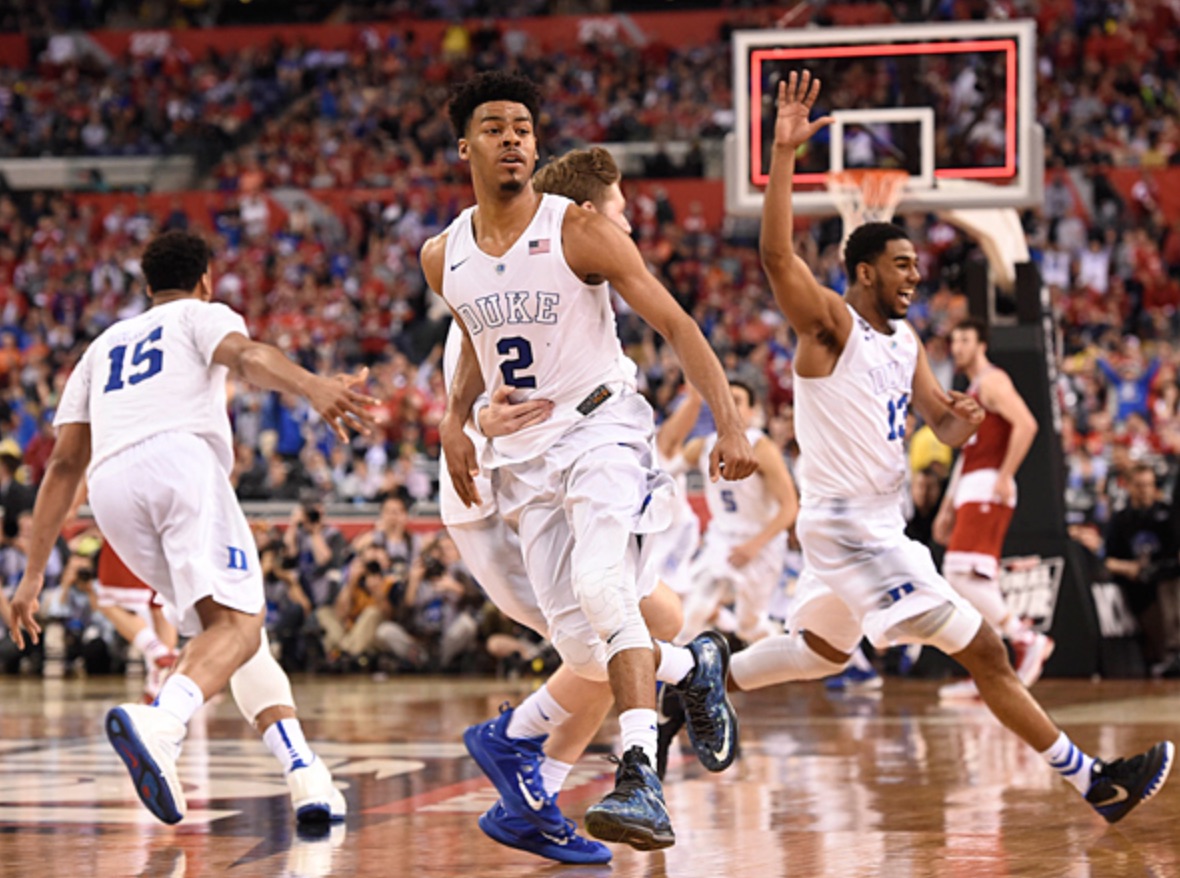
In the seven months since the final horn sounded in Duke’s win over Wisconsin, the NCAA has instituted a number of changes and issued several directives aimed at improving the game. Yes, the shot clock’s been shortened from 35 seconds to 30, but if you’re unfamiliar with everything else that’s new and different the NCAA just posted a briskly efficient 14-minute video that summarizes the main points. I highly recommend giving it a click.

This is the part where I scratch my head over the NCAA acting like the nimblest of daring Silicon Valley start-ups when it comes to bettering the game while at the same time the organization does a searingly convincing imitation of a cadre of Bulgarian apparatchiks circa 1953 and continues to define “top-50” wins with a metric that’s off by 50 spots or more seven percent of the time. Go figure, the “bettering the game” part of said schizophrenia is highly laudable. NCAA, I salute you! Continue reading

The category 5 roster

A roster like this only comes along once every 2.25 seasons -- unless it's 2015, when there were two such rosters. (Robert Deutsch/USA Today)

A roster like this only comes along once every 1.8 seasons in Division I. Unless of course it’s 2015, when there were two such rosters. (Robert Deutsch/USA Today)

Last March at the Sloan Conference in Boston, I was told a near-perfect parable on the traditionally and deeply yet needlessly antagonistic relationship between the “talent” and “analytic” schools of basketball interpretation.

In the immediate aftermath of a dismal 2013-14 season, an NBA general manager ordered a top-to-bottom review of what had gone wrong with the team that year. By that time every front office was fully equipped with bright young minds who could apply the latest analytic tools and even brandish some proprietary and closely-held statistical methods of their own. But the GM had allotted just 48 hours for the task while also imposing a draconian two-page limit on the final report. As a result the analytics team worked in a frenzy to summarize every last data point, shot chart, and pick-and-roll efficiency in just a couple of pages.

At the end of the ordeal the exhausted head of the analytics group yanked the final draft from the printer and thrust the two-page encyclical into the waiting hands of his boss. Whereupon the GM took the report and, smiling genially and never so much as glancing down at the printout, wadded up the two pages while taking aim at the nearest waste basket. As the GM let fly with his shot, he uttered one word:

“Players.”

After a decade of watching college basketball in the one-and-done era, I’ve come to the conclusion that in one crucial respect the GM is exactly right. In fact the more I ponder the question the more I think I’ve become something of a talent essentialist in spite of myself.

I wonder whether there might be rare instances where we can remove college performance from the equation more or less entirely and just look at the roster of players. Forget efficiency or shooting accuracy. Tell me how many minutes the returning players recorded, how many possessions they used, and how highly the freshman class is rated, and in these very rare instances this may be all we need to know.

In such cases I think we may be able to just look at a college basketball roster before the season even starts and say that if precedent’s any guide this team has virtually a 100 percent likelihood of earning an NCAA tournament No. 1 seed, a 60 percent probability of reaching the Final Four, and a two-in-five shot at winning a national title. I’m going to call such instances category 5 rosters, and, though I (and others) didn’t know it ahead of time, it turns out that Duke’s in 2015 was one such roster.  Continue reading

Alleged extreme cheating turns out to have zero measurable effect (a continuing series)

Former Louisville assistant Andre McGee. (UMKC photo)

Former Louisville director of basketball operations Andre McGee. (UMKC photo)

The Louisville basketball program stands accused of hiring an escort service to entertain Cardinal recruits and players between 2010 and 2014. According to a new book, “Breaking Cardinal Rules,” former Louisville director of basketball operations Andre McGee paid as much as $10,000 over a four-year period to provide escorts for recruits on campus visits, as well as for players staying in Billy Minardi Hall.

When I first learned of these allegations, my immediate reaction was that any cheating that took place apparently didn’t work all that well, or indeed at all. I’ll soon be sharing some data I’ve pulled together on recruiting versus results over the past decade, but in the wake of this particular episode I’ll go ahead and offer a teaser.

Rick Pitino, very much like Tom Izzo, has achieved a level of success on the court that easily surpasses any corresponding results he’s been able to show purely as a recruiter during the one-and-done era. The Cardinals have been a top-15 program nationally in terms of recruiting, certainly, but there’s another category entirely comprised of schools that form a remarkably absorbent oligopoly on the talent circuit.

It will not surprise you to learn that during the period of interest raised by this book those schools, going from bottom to top in terms of recruiting results, have been Kansas, Arizona, Duke, and Kentucky. Those four have been statistically different talent-wise the past few years and everyone else is in line outside, waiting and hoping to join that club. Continue reading

One working definition of a major conference

Was this a major-conference game? Good question.

Can we do better than a Potter Stewart definition?

Last week I posted a piece at ESPN Insider where I pointed out that the new-look no-football Big East has recorded a pretty nice collective KenPom rating the past two seasons, while the newborn American — even with a national title in its pocket — has not. Little did I know that this piece would win the title for “largest response to anything I’ve ever written about college basketball in September.” Perhaps a further word is therefore in order. Just what is a major conference?

I’ll grant at the top that this might be an untenable dichotomy to begin with, and that maybe this whole “major vs. mid-major” thing is a doomed attempt to put static categorical toothpaste back into a more fluid and dynamic postmodern college hoops tube. It could be the case that old boundaries and vocabularies no longer serve our purposes all that well. Duly noted. Continue reading

Your first look at the AP preseason top 25

There is no AP preseason top 25 yet, but here’s one guess at what it might look like when it arrives next month.

(This is not my top 25. This is a forecast of how my colleagues will vote in the AP top 25. I figured, why stop at 10?)

1.  North Carolina
2.  Maryland
3.  Kentucky
4.  Kansas
5.  Iowa State
6.  Virginia
7.  Duke
8.  Oklahoma
9.  Villanova
10. Wichita State
11. Gonzaga
12. Arizona
13. Michigan State
14. Indiana
15. California
16. Wisconsin
17. Baylor
18. Michigan
19. SMU
20. Utah
21. Georgetown
22. Notre Dame
23. Cincinnati
24. LSU
25. Butler

Others receiving votes: Louisville, Texas A&M, Vanderbilt, West Virginia, NC State,
Xavier, Purdue, Florida State, Miami, Oregon, Connecticut. 

Other things being equal, in any given preseason it should be easier to forecast Nos. 1 through 15 or so, than, say, 16 through 25. Anyway, we’ll see how I do.

Your first look at the AP preseason top 10

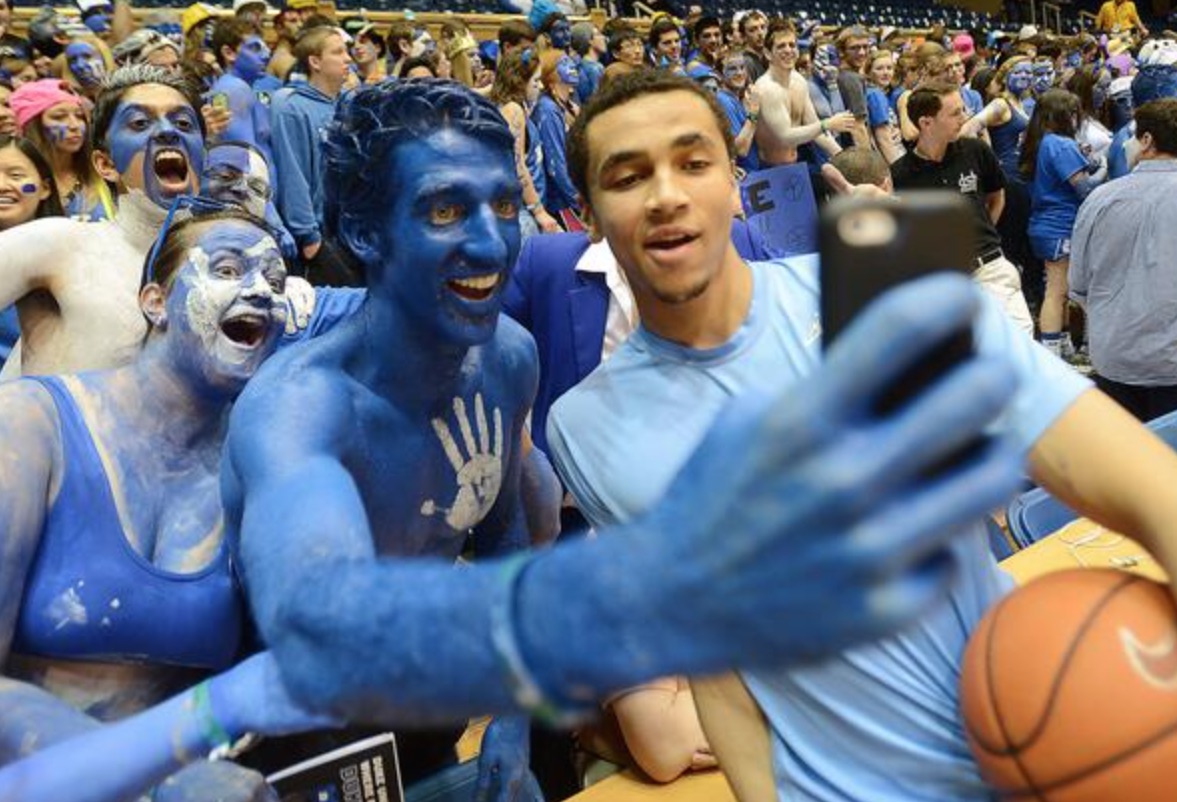
The Cameron Crazies magnanimously congratulate North Carolina's Marcus Paige on his team's upcoming No. 1 ranking.

The Cameron Crazies magnanimously congratulate North Carolina’s Marcus Paige on his team’s upcoming No. 1 ranking.

I suppose sticklers for quote-unquote accuracy will read my headline and object that that there is no AP preseason poll yet. True enough, but I feel like I have a pretty good handle on what we’ll see in a few weeks when the first rankings drop:

1.  North Carolina
2.  Maryland
3.  Kentucky
4.  Kansas
5.  Iowa State
6.  Virginia
7.  Duke
8.  Oklahoma
9.  Villanova
10. Wichita State

This is merely a prediction, mind you, not a ranking of my own top 10. Still, I’m feeling pretty confident about the membership (if not the exact sequence) of this group and particularly the top seven. In fact if someone other than these seven teams shows up in the AP’s first poll ranked between Nos. 1 and 7, I owe you all a beer.

Maybe I’ll do this every September — if nothing else it’s easily evaluated. I’ll dock myself one point for every spot I’m off the mark with a given team. A perfect score’s a zero.

In other news, Gonzaga, Arizona and Michigan State will head up the second 10.

So much for prognosticating. One question that occurs to me as I peer into the future of the AP poll is why North Carolina and Kansas are going to be seen as such wholly different quantities. After all, the Jayhawks posted a slightly better efficiency margin than did the Heels, and the guys in Lawrence did so in a slightly better league.

True, KU lost Kelly Oubre and the never-entirely-there Cliff Alexander, but UNC lost J.P. Tokoto — as  a result both 2015-16 rosters are essentially identical when it comes to experience (as measured in returning possession-minutes). Lastly Bill Self’s crop of freshmen is superior to Roy Williams’ bunch even assuming Cheick Diallo never gets his eligibility thing straightened out. And if Diallo does get on the floor at some point, KU and California will be essentially tied, by my lights, for the honor of claiming the nation’s No. 4-ranked freshman class behind Kentucky, Duke and LSU.

So why the discrepancy between Carolina and Kansas in the (yet to materialize but oh so accurately forecasted) rankings? Just curious.

A preface to shot-clock pessimism

I demand gotcha questions on where the candidates stand on the new shot clock. And I vote.

As hoops fans we demand that candidates take a stand on the new shot clock. And we vote.

I don’t know what will happen when the 30-second shot clock is introduced to the college game this November, and I’m prepared to wax fairly adamant and doctrinaire over my ignorance on this matter. The fact is no one knows what will happen, so the best we can do is engage in learned speculation.

Certainly I can be won over to speculating that this whole shot-clock thing is going to end rather badly. Why not? That is, after all, one of three possible outcomes. A year from now I suspect there will be a consensus view to the effect that the new shot clock has either been a success, a mixed blessing/non-event, or a failure. Other things being equal, “I have a bad feeling about this” has roughly a 33 percent chance of being correct. And a one-in-three probability qualifies as a strong likelihood in my book.

Nevertheless I’ve been struck by what’s been offered up in the way of trepidation on this question. Before I sign up for membership in the worried 33 percent, I confess I still have a couple questions that need answers.   Continue reading