Category Archives: hoops

Bigs, Bagley, and evaulative habit

Bagley

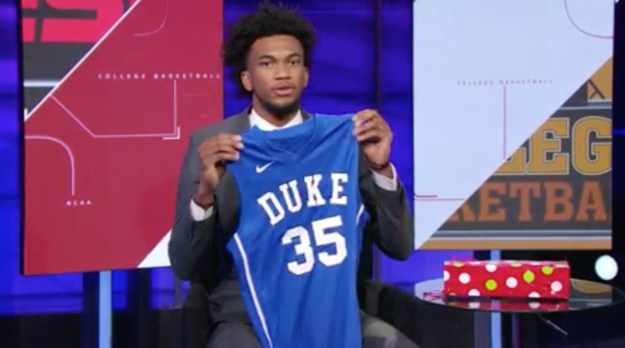
This week I re-ranked the top 25 players in college basketball on the occasion of Marvin Bagley III reclassifying and joining this year’s freshman class. I put Bagley at No. 1 because he’s been termed the best player to come out of high school since Anthony Davis. If Duke’s star does indeed have a Davis-level impact for the Blue Devils this season, I’ll come off looking like a genius in a vast hegemonic horde of parroting savants.

Whether that particular scenario pans out or not, I do wonder whether this Bagley moment itself may not function as a handy summation, one that can be called The (Evaluative) Trouble with Freshmen. On the one hand, the get-off-my-yard gene in all of us says that, at the very top of the rankings, freshmen are pretty much always overrated.

Markelle Fultz turned out to be as good as advertised, his team missed the tournament entirely, and his coach was fired. Ben Simmons turned out to be as good as advertised, his team missed the tournament entirely, and his coach was (eventually) fired.

Even Jahlil Okafor, who, whatever else you may think of him, was a first-team All-American as a freshman and was the leading scorer on a team that won a national title, is now being pointed at as some kind of museum exhibit for obsolete basketball artifacts and cautionary draft tales. Freshmen are always overrated. Continue reading
Even good math’s downstream from the big decisions

Bubas

(Photo: Tony Triolo, Getty)

Putting the haplessly erratic RPI out to pasture is long overdue, of course, but, since it hasn’t happened yet, the NCAA voicing a likelihood of doing so by 2018-19 is quite plainly an occasion for genuine, if watchful and conditional, celebration.

In 2012, fresh from the outstanding mock selection exercise that the NCAA runs annually, I speculated that the reason the knowledgeable, diligent, and inquisitive men and women in Indianapolis hadn’t already cast off the RPI’s deleterious cognitive shackles could only have been simple organizational inertia. Decry that inertia if you wish, but don’t wax superior about it. This, surely, is an affliction visited upon us all, varying only in its extent. (I will grant you this was one pretty extreme case.) Continue reading

There are just four major-conference teams missing from this list

nebrut

A picture of Northwestern used to go here.

This was a big year for previously unsuccessful NCAA tournament teams. Northwestern and South Carolina both won tournament games, marking 2017 as the ultimate in upward programmatic mobility.

The list of major-conference programs that have not won a game this century is now down to just four members: Nebraska, Oregon State, Rutgers, and TCU. That being said, we’ll give the Horned Frogs an asterisk on this one. Unlike the Cornhuskers, Beavers, and Scarlet Knights, the fightin’ toads weren’t members of a “power” conference for the entire time period in question.

Every national championship this century has been won by a team at No. 17 or higher on this list. The majority of Division I — 199 teams — is yet to win an NCAA tournament game this century. Continue reading

Four lessons from a hideous title game

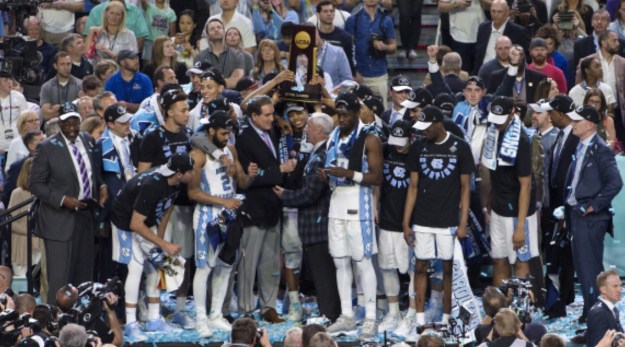
UNC

After a thorough statistical review I have determined that the 2017 NCAA tournament stood out most dramatically in terms of turned ankles. Speaking in an actuarial sense, we should be turned-ankle-free now through at least the 2023 brackets. We’re due.

Other conclusions to be drawn….

Hideous title games have to happen
An unsightly mess on the biggest evening of the college basketball year is unfortunate, but it will, unavoidably, occur. The 2011 game between Connecticut and Butler was even worse than what we saw last night. And, while this definitely falls under the heading of “How did you like the play otherwise, Mrs. Lincoln?” praise, North Carolina’s full six-game title run was if nothing else the fastest-paced such campaign by far that we’ve seen since this same program cruised to a much easier title in 2009. The Tar Heels averaged 74 possessions per 40 minutes in the tournament. (Villanova last year: 64.) UNC’s tournament run was a sprint that ended with fouls and missed shots exploding in every direction. Continue reading

There’s a hack for national-title game picks most years, but not for 2017

court

In each of the last 13 national championship games, the team with the better per-possession scoring margin in the five previous tournament games has won:

Tournament games only, through national semifinal
EM: efficiency margin
                          EM
2016  Villanova         +0.38
      North Carolina    +0.25
2015  Duke              +0.28
      Wisconsin         +0.12
2014  Connecticut       +0.12
      Kentucky          +0.06
2013  Louisville        +0.27
      Michigan          +0.20
2012  Kentucky          +0.17
      Kansas            +0.11
2011  Connecticut       +0.17
      Butler            +0.07
2010  Duke              +0.28
      Butler            +0.11
2009  North Carolina    +0.28
      Michigan State    +0.11
2008  Kansas            +0.24
      Memphis           +0.23
2007  Florida           +0.22
      Ohio State        +0.16
2006  Florida           +0.25
      UCLA              +0.19
2005  North Carolina    +0.21
      Illinois          +0.17
2004  Connecticut       +0.21
      Georgia Tech      +0.07         

There are three things you should know about this streak. Continue reading

The Gonzaga miracle before our eyes

Zags

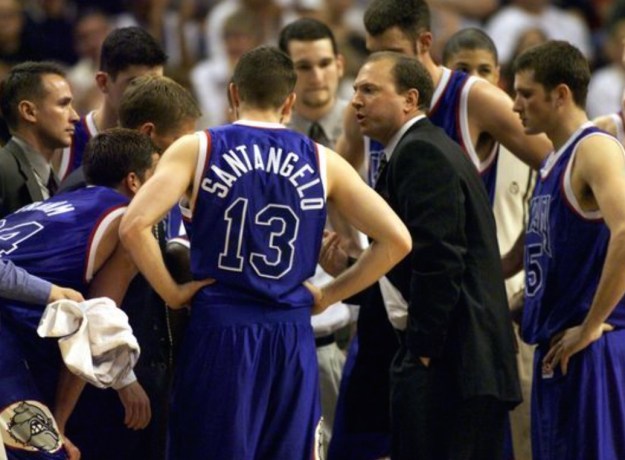
Mark Few (partially obscured), Matt Santangelo, and Dan Monson in the huddle, 1999.

Gonzaga as a program and Mark Few as a coach were written off for years as never being able to win the big one. Then when the Bulldogs and their coach finally did reach the Final Four, they were greeted with the same ho-hum reaction that North Carolina’s getting as a No. 1 seed while everyone (quite rightly) rubs their eyes in amazement at the presence of South Carolina.

That is entirely fitting, and possibly the highest compliment to be paid to a program that was once a mid-major. No one thinks of the Zags as a mid-major program any more. When Few lands a McDonald’s All-American like Zach Collins or schedules a neutral-floor game against Arizona at the Staples Center, no one bats an eye. Well, those are not the hallmarks of a mid-major. Continue reading

A letter to the preseason me

Martin

Who knew?

Dear October version of me,

You turned out to be wrong about a lot of things this season. Yes, on some other things, fine, your were  right. Still, the largest category of all takes in the weird and funky surprises of 2016-17.

Weird and funky surprises of 2016-17
In order of mayhem….

South Carolina made the Final Four. An offense that scored a mere 1,317 points in (well, what do you know?) 1,317 possessions in SEC play hummed along at 1.16 points per trip in the tournament. Sindarius Thornwell continued his SEC player of the year ways, and for the balance of the tournament P.J. Dozier was replaced with an NBA player who had undergone meticulous cosmetic surgery in order to look like the Gamecock sophomore (though even the doppelgänger continued to miss threes so as not to raise too much suspicion). On defense South Carolina forced its first four tournament opponents into giving the ball away on 24 percent of their possessions. You’re not supposed to be able to do that — panicky, error-prone guards should all be at home by late March — but Frank Martin’s men got it done. Continue reading

Carousel speed as social-media artifact

Martin

With job changes in 2008, 2011, 2014, and 2017, Cuonzo Martin is a one-man (cyclical) carousel. (kansascity.com)

It started with NC State. The Wolfpack let Mark Gottfried go way back in mid-February. Then came news of openings at Missouri, LSU, Illinois, Indiana, Washington, and, finally, Georgetown.

Cuonzo Martin took the job at Missouri, creating an opening at Cal, and Brad Underwood elected to take the helm at Illinois, leaving behind a vacant chair at Oklahoma State.

That makes nine major-conference head coaches who will be rookies in their positions next season. Naturally, that number could go higher still if one or more of the remaining openings (Indiana, Cal, Oklahoma State, Georgetown) were to be filled by a candidate who’s presently a major-conference coach somewhere else.

It feels like an unusually active carousel this season, and by “feels like” I refer not to any silly conventional wisdom out there in the world at large but to my own real-time reactions. The past 10 days it’s felt like I can’t write two paragraphs without my phone chirping at me about yet another coaching move.

Well, it turns out my real-time reactions are slightly misleading. This isn’t even close to the most active carousel season we’ve seen this century.  Continue reading

These are the teams that can generate shots

Va Tech

Virginia Tech ranked No. 74 out of 75 major-conference teams for shot volume, and the Hokies’ offense was above-average anyway. What is this voodoo that you do, Buzz Williams?

Basketball’s a contest to see who can put the ball in the basket the most times, and for whatever reason fans, media, and, especially, coaches (at least when they speak for public consumption) have always chosen to focus on whether a particular attempt is a make or a miss. We go into exceptional and occasionally tedious detail on the importance of creating one’s own shot, the finer points of pick-and-roll kabuki (particularly on D), proper defensive stance and hand position and such.

All of which is self-evidently important, but all of which also assumes implicitly that the number of times you get to attempt a shot is more or less constant across teams and games. That assumption doesn’t hold up.

In addition to in-play success or failure, the volume of plays is the other 50 percent of the matter that’s getting perhaps five or 10 percent of the words and attention. To redress this imbalance, I’ve been using a shot volume index this season to try to measure which teams generate the most shots. I’ve listed the final results on that metric for 75 major-conference teams below. Continue reading

A viewer’s guide to Selection Sunday

URI

Stanford Robinson, Jeff Dowtin and Hassan Martin straddle the ridge between 67 happy teams and 283 benighted programs who will blame the coach, refs, the committee, East Coast bias, or all of the above. Welcome to Selection Sunday.

There are three broad areas of suspense in play for Selection Sunday 2017. Two of these areas are inherent to the endeavor itself and therefore venerable. The third’s arisen just within the past few years as a result of the committee’s unstated and perhaps unconscious but nevertheless unmistakable moments of Cal Trask-like rage against the unbidden and unwelcome KenPom dad figure.

The three areas of suspense to watch are:

1. The No. 1 seeds
I’ve suggested from time to time that No. 1 seeds don’t really matter. Villanova did pretty well without one last year, and, anyway, the magic numero uno is purely an artifact of how many quote-unquote regions there are. If the committee someday decides we should have 72 teams and eight regions with nine teams each, are we really going to obsess over the cut line on the S-curve between team Nos. 8 and 9? That answer would be yes. Admit it. Continue reading