Category Archives: counting things

Peer performance pressure, and the limits of coaching theory

Feagin

Last season, this offense made its shots and took outstanding care of the ball. What could possibly have gone wrong?

Years ago, when rebound percentages were still seen as newfangled, the first question I was ever asked by a Division I coach was what the best target numbers are for both offensive and defensive rebound rates. I don’t remember my response, though I would guess I delivered, as requested (I was thrilled simply to have had my opinion solicited), two numbers spelling out what the team “should” be doing.

I now think that was a mistake. True, thanks to Dean Oliver, we know that the four factors in basketball are shooting, turnovers, rebounds, and free throws, and we rank offenses and defenses on each of those metrics.

But of late, however unconsciously, I find I no longer regard all of the factors as a must-watch sequence in and of itself. Instead, I’ve elevated shooting to a co-starring role above the title in this movie we call hoops.

Furthermore, I’ve collapsed turnovers and offensive rebounds into one quantity and elevated that into the other co-starring role, one I call shot volume. (In this two-factor amalgam, offensive rebounding is clearly the junior — or at least downstream — partner.) And, for better or worse, I now regard free throws as an occasionally dispositive but basically exogenous event, kind of like a power outage or visiting relatives.  Continue reading
Don’t fear the layoff

B1G

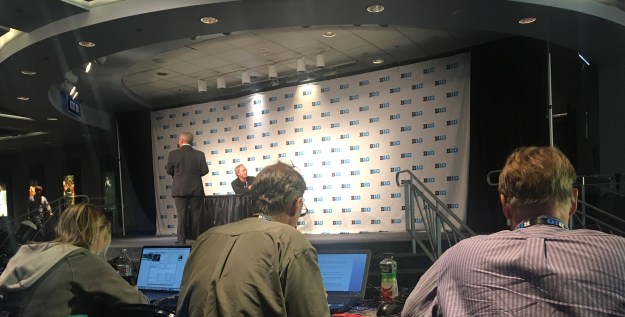
This week when I attended Big Ten media day in New York City (pictured!), there were several questions raised about the league playing its conference tournament in Madison Square Garden.

The move to the Garden will require the Big Ten to play its tournament a week earlier than what the league’s accustomed to doing, because, as always, the Big East has the World’s Greatest Arena booked for the following weekend leading into Selection Sunday. Consequently, the league’s coaches were asked repeatedly at media day whether this layoff will hurt the performance of their teams in the NCAA tournament.

Whether they were being sincere or not, the coaches said the right things. They said they were excited about playing the Big Ten tournament in the Garden, and that they’re not really worried about a layoff or about moving the whole conference schedule up a week.

What the coaches said, however, is at odds with a piece of hoops folk wisdom that holds that long layoffs before the tournament are to be feared. (To be sure, the other extreme is said to be bad too. No one wants to finish their conference tournament on Sunday afternoon and then open the round of 68 a few time zones away on Thursday at noon Eastern.) The folk wisdom has always interested me on a couple levels. Continue reading

There are still six major conferences

Shockers

A couple years ago, I ventured an opinion to the effect that there were, at that time, six major conferences. Now, with a new season almost upon us and Wichita State following in the footsteps of upwardly mobile predecessors like Creighton and Butler, it’s high time to take another look at the matter.

It turns out that, by my lights, there are still six major conferences. “Power 5” is a football term that should be banished from your basketball vocabulary. Say “major-conference basketball,” and people will know you’re referring to the ACC, Big 12, Big East, Big Ten, Pac-12, and SEC.

Naturally this is a characterization offered in advance of any changes that may be wrought in the American Athletic Conference’s profile this season due to the arrival of the Shockers. Maybe this question will require another look come March. If so, here’s how you’ll find me trying get my arms around the matter at that time….

For my part, I throw three separate yardsticks at the question of whether or not a given group of teams constitutes a “major” conference.

  1. KenPom AdjEM
  2. NCAA tournament seeds
  3. NCAA tournament wins

Continue reading

Coaching, leading, and Rick Pitino

Rick

Rick Pitino was a rarity even among the tiny group of elite coaches at the top of the college basketball pyramid. Let’s define that elite as active coaches who have either won multiple national titles or been to six or more Final Fours.

It’s a short list:

                   Titles     FFs
Mike Krzyzewski      5         12
Roy Williams         3          9
Rick Pitino          2          7
Tom Izzo             1          7
John Calipari        1          6

With the possible exception of Tom Izzo, the Louisville head coach appeared to rely less on recruiting top-20 talent than his fellow legends. He demonstrably relied on it less than John Calipari or Mike Krzyzewski, for example, but he also relied on it less than Bill Self or even a relative youngster like Sean Miller.

I had occasion to make this same point when the Louisville staff was found to be cheating on its recruiting by enlisting the assistance of strippers and escorts. That particular episode had zero measurable impact on recruiting. In point of fact, Louisville hasn’t signed an RSCI top-20 recruit since Samardo Samuels arrived on campus in the fall of 2008. Continue reading

Even good math’s downstream from the big decisions

Bubas

(Photo: Tony Triolo, Getty)

Putting the haplessly erratic RPI out to pasture is long overdue, of course, but, since it hasn’t happened yet, the NCAA voicing a likelihood of doing so by 2018-19 is quite plainly an occasion for genuine, if watchful and conditional, celebration.

In 2012, fresh from the outstanding mock selection exercise that the NCAA runs annually, I speculated that the reason the knowledgeable, diligent, and inquisitive men and women in Indianapolis hadn’t already cast off the RPI’s deleterious cognitive shackles could only have been simple organizational inertia. Decry that inertia if you wish, but don’t wax superior about it. This, surely, is an affliction visited upon us all, varying only in its extent. (I will grant you this was one pretty extreme case.) Continue reading

There are just four major-conference teams missing from this list

nebrut

A picture of Northwestern used to go here.

This was a big year for previously unsuccessful NCAA tournament teams. Northwestern and South Carolina both won tournament games, marking 2017 as the ultimate in upward programmatic mobility.

The list of major-conference programs that have not won a game this century is now down to just four members: Nebraska, Oregon State, Rutgers, and TCU. That being said, we’ll give the Horned Frogs an asterisk on this one. Unlike the Cornhuskers, Beavers, and Scarlet Knights, the fightin’ toads weren’t members of a “power” conference for the entire time period in question.

Every national championship this century has been won by a team at No. 17 or higher on this list. The majority of Division I — 199 teams — is yet to win an NCAA tournament game this century. Continue reading

There’s a hack for national-title game picks most years, but not for 2017

court

In each of the last 13 national championship games, the team with the better per-possession scoring margin in the five previous tournament games has won:

Tournament games only, through national semifinal
EM: efficiency margin
                          EM
2016  Villanova         +0.38
      North Carolina    +0.25
2015  Duke              +0.28
      Wisconsin         +0.12
2014  Connecticut       +0.12
      Kentucky          +0.06
2013  Louisville        +0.27
      Michigan          +0.20
2012  Kentucky          +0.17
      Kansas            +0.11
2011  Connecticut       +0.17
      Butler            +0.07
2010  Duke              +0.28
      Butler            +0.11
2009  North Carolina    +0.28
      Michigan State    +0.11
2008  Kansas            +0.24
      Memphis           +0.23
2007  Florida           +0.22
      Ohio State        +0.16
2006  Florida           +0.25
      UCLA              +0.19
2005  North Carolina    +0.21
      Illinois          +0.17
2004  Connecticut       +0.21
      Georgia Tech      +0.07         

There are three things you should know about this streak. Continue reading

A letter to the preseason me

Martin

Who knew?

Dear October version of me,

You turned out to be wrong about a lot of things this season. Yes, on some other things, fine, your were  right. Still, the largest category of all takes in the weird and funky surprises of 2016-17.

Weird and funky surprises of 2016-17
In order of mayhem….

South Carolina made the Final Four. An offense that scored a mere 1,317 points in (well, what do you know?) 1,317 possessions in SEC play hummed along at 1.16 points per trip in the tournament. Sindarius Thornwell continued his SEC player of the year ways, and for the balance of the tournament P.J. Dozier was replaced with an NBA player who had undergone meticulous cosmetic surgery in order to look like the Gamecock sophomore (though even the doppelgänger continued to miss threes so as not to raise too much suspicion). On defense South Carolina forced its first four tournament opponents into giving the ball away on 24 percent of their possessions. You’re not supposed to be able to do that — panicky, error-prone guards should all be at home by late March — but Frank Martin’s men got it done. Continue reading

These are the teams that can generate shots

Va Tech

Virginia Tech ranked No. 74 out of 75 major-conference teams for shot volume, and the Hokies’ offense was above-average anyway. What is this voodoo that you do, Buzz Williams?

Basketball’s a contest to see who can put the ball in the basket the most times, and for whatever reason fans, media, and, especially, coaches (at least when they speak for public consumption) have always chosen to focus on whether a particular attempt is a make or a miss. We go into exceptional and occasionally tedious detail on the importance of creating one’s own shot, the finer points of pick-and-roll kabuki (particularly on D), proper defensive stance and hand position and such.

All of which is self-evidently important, but all of which also assumes implicitly that the number of times you get to attempt a shot is more or less constant across teams and games. That assumption doesn’t hold up.

In addition to in-play success or failure, the volume of plays is the other 50 percent of the matter that’s getting perhaps five or 10 percent of the words and attention. To redress this imbalance, I’ve been using a shot volume index this season to try to measure which teams generate the most shots. I’ve listed the final results on that metric for 75 major-conference teams below. Continue reading

Tuesday Truths: Final reality

Welcome to this season’s final installment of Tuesday Truths, where I look at how well 120 teams in the nation’s top 10 conferences did against their league opponents on a per-possession basis.

A shot volume dynasty

bradley

UNC’s dominance on the offensive glass is made even more effective by the Tar Heels’ low turnover rate. (Jeffrey A. Camarati)

Through games of March 5, conference games only
Pace: possessions per 40 minutes
PPP: points per possession   Opp. PPP: opponent PPP
EM: efficiency margin (PPP – Opp. PPP)

ACC                       W-L   Pace    PPP   Opp. PPP    EM
1.  North Carolina       14-4   70.2    1.16    1.03    +0.13
2.  Louisville           12-6   67.9    1.13    1.01    +0.12
3.  Virginia             11-7   60.6    1.05    0.95    +0.10
4.  Florida State        12-6   71.1    1.12    1.03    +0.09
5.  Duke                 11-7   68.7    1.14    1.08    +0.06
6.  Notre Dame           12-6   67.9    1.10    1.05    +0.05
7.  Wake Forest           9-9   71.7    1.14    1.12    +0.02
8.  Syracuse             10-8   67.0    1.12    1.12    +0.01
9.  Miami                10-8   63.6    1.05    1.04    +0.01
10. Virginia Tech        10-8   67.7    1.10    1.14    -0.04
11. Clemson              6-12   66.8    1.09    1.14    -0.05
12. Georgia Tech         8-10   69.0    0.94    1.00    -0.06
13. Pitt                 4-14   64.7    1.02    1.14    -0.12
14. Boston College       2-16   71.6    1.00    1.15    -0.15
15. NC State             4-14   70.9    1.03    1.18    -0.15

AVG.                            68.0    1.08
Acceleration since 2015:        7.6%
KenPom rank: 2

In winning the 2017 ACC regular-season title outright, North Carolina came close but could not quite capture still another banner of sorts. This group was very nearly the best offensive rebounding team Roy Williams has ever had in Chapel Hill. Alas, the Tar Heels in 2008 rebounded 43.0 percent of their misses in ACC play, while this season Carolina posted a 42.1. Continue reading