Category Archives: counting things

The best games of tournament offense “ever”

Historically great tournament offense has a rich tradition stretching from 2003 to last Sunday. (AP/Mary Altaffer)

This past weekend in the round of 32, teams kept putting up ridiculously good numbers for offense. I would say as much in real time, and after two or three instances of this I was asked: Well, just how good are these performances, historically speaking?

Good question.

Here’s what I have for the top 25 games of NCAA tournament offense ever. As usual, “ever” is understood to encompass just the most recent 29 percent of tournaments as archived faithfully by my friend Ken.

Tough luck, old times! You should have tracked offensive boards and turnovers sooner and more frequently.

But before anyone asks: Villanova’s “Perfect Game” against Georgetown in 1985 comes in at 1.16 points per possession. Perfect shooting, yes, but turnovers were committed.

This is a very unofficial curation. Corrections and additions are welcome.

Still, it is likely that four of the best six tournament games on offense ever came from just two individual tournament runs. And one of those teams didn’t even reach the national title game. March Madness is beautiful, truly.

Continue reading
Bid thieves and March vocabulary

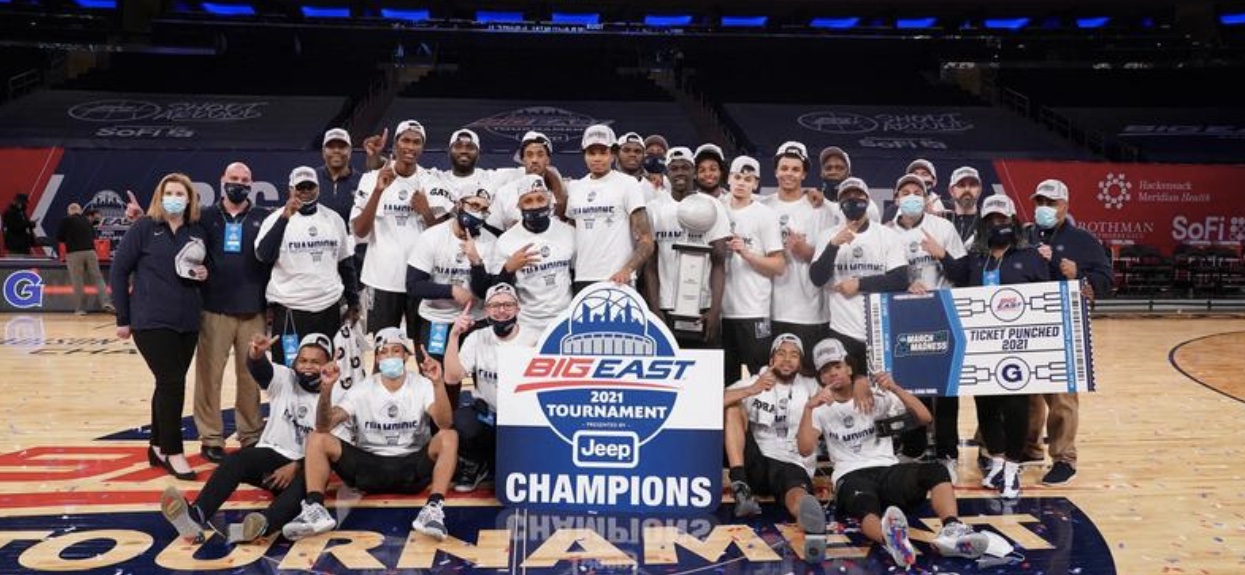
In 2021 Georgetown was a bid thief’s bid thief. (Georgetown Athletics)

Every March we’re awash in college basketball terms where bottom-up usage has filled a vacuum or triumphed over official top-down naming. “NCAA Division I Men’s Basketball Championship” is a mouthful. “March Madness” is perfect.

The NCAA trademark March Madness has a byzantine origin story. Even the lightest 2020s search shows this catchy bit of alliteration to be older than basketball itself. The term begins to produce more search hits in the 1920s and 1930s, when March madness could refer to gardening, the weather, or anything else happening that month. Actually, for a heartbeat it looked like March Madness might become the exclusive possession of English football.

Then Indiana newspapers covering high school hoops in the 1930s got busy. A poem celebrating the state high school tournament next door in Illinois limned “the March madness” and was published in 1939 by the Illinois High School Association.

Four decades later the IHSA commissioned March Madness, a history of the Illinois state tournament. From his chair at CBS Chicago in the 1970s, a young Brent Musburger picked up the term. Musburger took it with him to the mother ship when CBS began carrying the tournament in 1982. March Madness stuck. NCAA lawyers have been shooing away unauthorized users and uses ever since.

Continue reading

This is the golden age of shot volume

Scoring efficiency is up significantly in Division I men’s hoops in 2024 even as shooting accuracy remains more or less the same as it was last year. Teams are simply attempting more shots.

Giving credit for trends on the largest scale is challenging, but one version of events could venture to say the praise for our current high-scoring game might go to Kelvin Sampson and the NCAA, in that order.

Sampson is the guru of shot volume. This season the guru has landed in what is still, even with the presence of his Houston team, the lowest shot volume league of the six major conferences.

Broadly speaking, the Big 12 hasn’t traditionally done shot volume. More precisely, the league has perhaps hosted two schools of thought represented tidily by recent national champions. The Baylor school does say yes, please, to shot volume. The more influential paradigm, however, has been the Kansas school which has shown vividly you can win national titles, plural, without this volume stuff. This season the Jayhawks are pushing this to an extreme even by their own standards, cruising toward a No. 2 seed while ranking No. 67 out of 80 major-conference teams for shot volume.

Then there’s Sampson. When you watch a Houston game in 2024 the analyst will still say the Cougars’ best play call on offense is a missed shot. This remains a fair description as far as it goes, but tonight, for example, UH will host Cincinnati and based on Big 12 play the Cougars won’t even be the best offensive rebounding team in the building. Houston in 2024 carries the lowest whole-season rank for offensive rebound percentage of any post-pandemic UH team.

Continue reading

Reduce the number of timeouts

Anyone with the effrontery to suggest improvements for Division I men’s college basketball in 2024 should begin with the welcome elephant in the room. The game is flourishing. Arguably it’s never been better.

Scoring is up because efficiency has increased markedly. Back in the aughts when “points per possession” first started to be bandied about online, it was a notable occurrence to run across an offense clocking in at 1.07. Now the major conferences collectively score points at that rate in league play.

The change to the block/charge rule this season has been a spectacular success. Offensive fouls per game have declined from 3.7 in 2021-22 to 2.2 this year. Turnovers are down significantly across D-I. Scarcity in giveaways means abundance in points. Ours is truly a golden age of shot volume.

Many fans of the game clamored for reform on this front, often in anguished posts on social media. Then the NCAA stepped in, made the change, and suddenly the issue has subsided drastically. Now everyone can promptly set about finding other things to complain about, like for instance there being too many timeouts. Be that as it may, the new block/charge rule has been a triumph. Take a bow, NCAA.

Continue reading

Major conferences as evaluative labor-savers

We hardly knew ye. (Photo: Shelly Hanks)

Recently at ESPN.com I offered some forecasting on what shape college basketball may take next year when the term “power five” is, at last, accurate in basketball. In summary, the Big 12 might continue to swagger smugly around the top of the KenPom leader board, the ACC may again bring up the rear, and in between these poles the already fast-improving SEC could be strengthened further still by virtue of expansion alone.

Whenever pieces concerning the major conferences are posted, it is customary to field responses saying this or that additional league should also be regarded as meriting the label in question. Fair enough. Here is one working definition:

Over a five-year period the mean of a major conference’s performance will be equivalent to outscoring an average Division I opponent by at least 10 points over 100 possessions.

Scoring margin over 100 possessions is of course a nod to what’s shown as AdjEM (adjusted efficiency margin) at KenPom. Tracking this over five-year windows prevents one-season outliers from wagging the dog, and for that the ACC is thankful. Otherwise the unsightly +8.58 the league coughed up last year would have resulted in the ACC’s major-conference membership card being revoked.

Continue reading

The already and perhaps fleetingly historic UNC perimeter defense

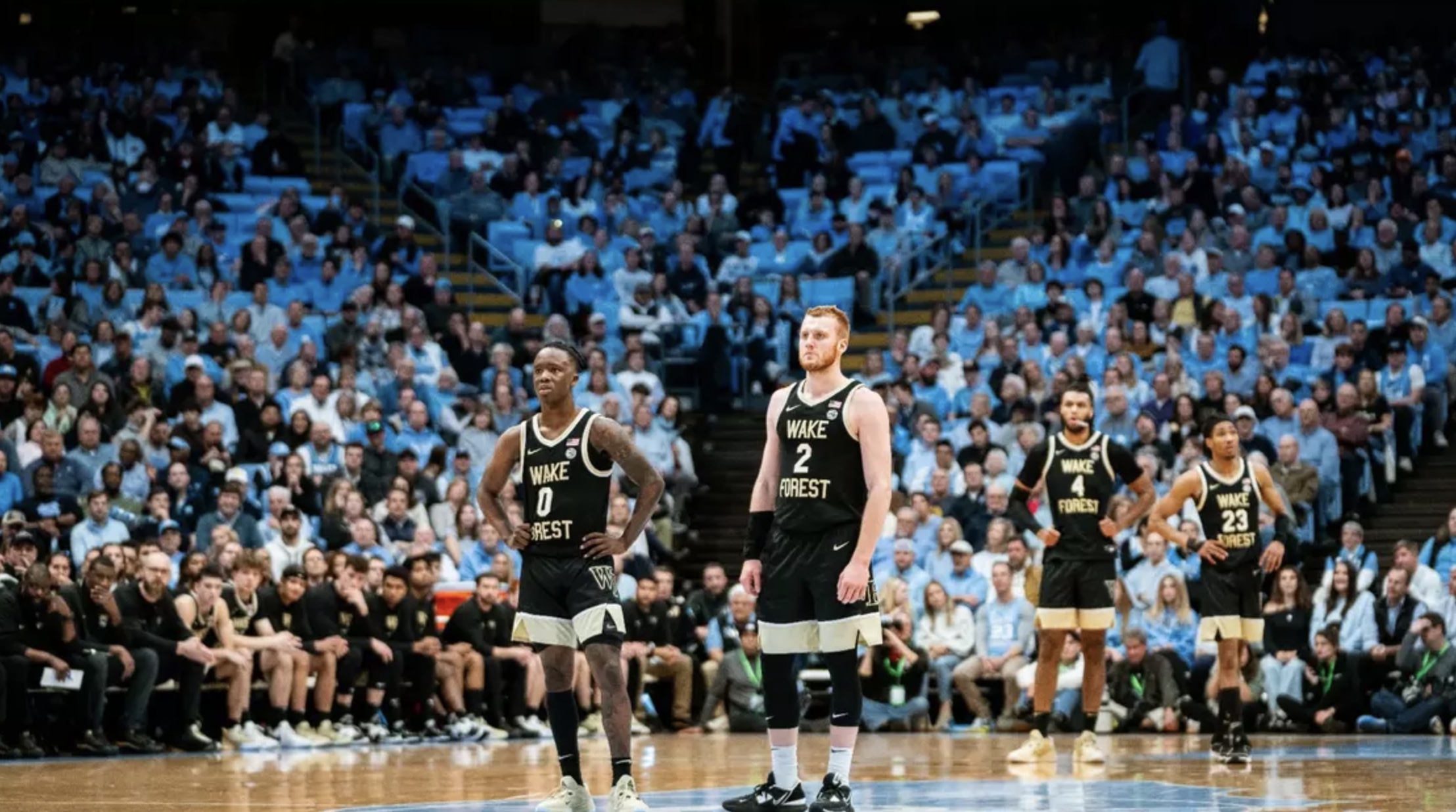
They appear saddened by their 15 percent shooting beyond the arc. (Photo: Seth Seebaugh)

Last night Wake Forest shot 3-of-20 on its threes in a 21-point loss at North Carolina. Both the final score and the opponent’s three-point haplessness are rapidly becoming par for the course with the Tar Heels.

UNC’s conference opponents have connected on just 22.5 percent of their threes. We haven’t even reached February, of course, and these numbers will shift over North Carolina’s remaining 12 conference games. Nevertheless, 570 possessions of basketball constitutes a fair sample size in its own right. At a minimum one might note that over that stretch the Tar Heels’ opponents were historically bad at making threes.

Just how extreme have UNC’s opponents been in their three-point misery, where is this coming from, and what happens now?

One answer to the first question would be “very.” The conference season is equally young for the entire ACC, yet to this point North Carolina’s three-point defense is nearly three standard deviations better than the conference mean.

Bear in mind Division I as a whole’s making a business-as-usual 33.6 percent of its threes this season. Actually the Tar Heels themselves have allowed opponents to shoot a rather more normal 28.5 percent from beyond the arc in all games. Non-conference opponents like Lehigh (13-of-33 on threes) or Kentucky (8-of-23) didn’t faint dead away at the sight of this defense.

Continue reading

On the size, strength, and selection of the field

Where have you gone, Harold Olsen?

Tonight the 2023 NCAA tournament will open with a matchup ranked No. 10 for KenPom Thrill Score on an evening when there are just 10 Division I men’s basketball games being played nationally. March Madness is tipping off with what projects to be the worst game in the country.

Partly this is what transpires (or at least what we expect to transpire) whenever a No. 16 seed’s in action. Actually, the Thrill Scores for Thursday’s 16-vs-1 games are even lower than what we have on tap tonight. But we’re happy to tolerate 16-vs-1 matchups when we have three other simultaneous games from which to choose. Conversely tonight’s opener has the Madness floor to itself.

The number 68 is to blame for this. The number is not especially compatible with a single-elimination format. We can and likely should advance automatic qualifiers straight past Dayton to the round of 64, as is often proposed. Then again the AQ leagues currently recording what are strictly speaking NCAA tournament wins in Dayton aren’t necessarily enamored of that proposal.

Nevertheless, assume for the sake of discussion that Dayton is retrofitted to host nothing but at-larges. Then we would be opening the 2023 NCAA tournament with Mississippi State vs. Pitt, tonight’s No. 1 game in the nation for Thrill Score. This nominal “best” game, however, has earned that distinction by a numerical hair over a virtually identical score posted by Yale vs. Vanderbilt in the NIT.

We can do better. The start of the NCAA tournament can be just as good as Thursday has always been. All we need is a better number than 68. Happily, most even numbers are better than 68.

Continue reading

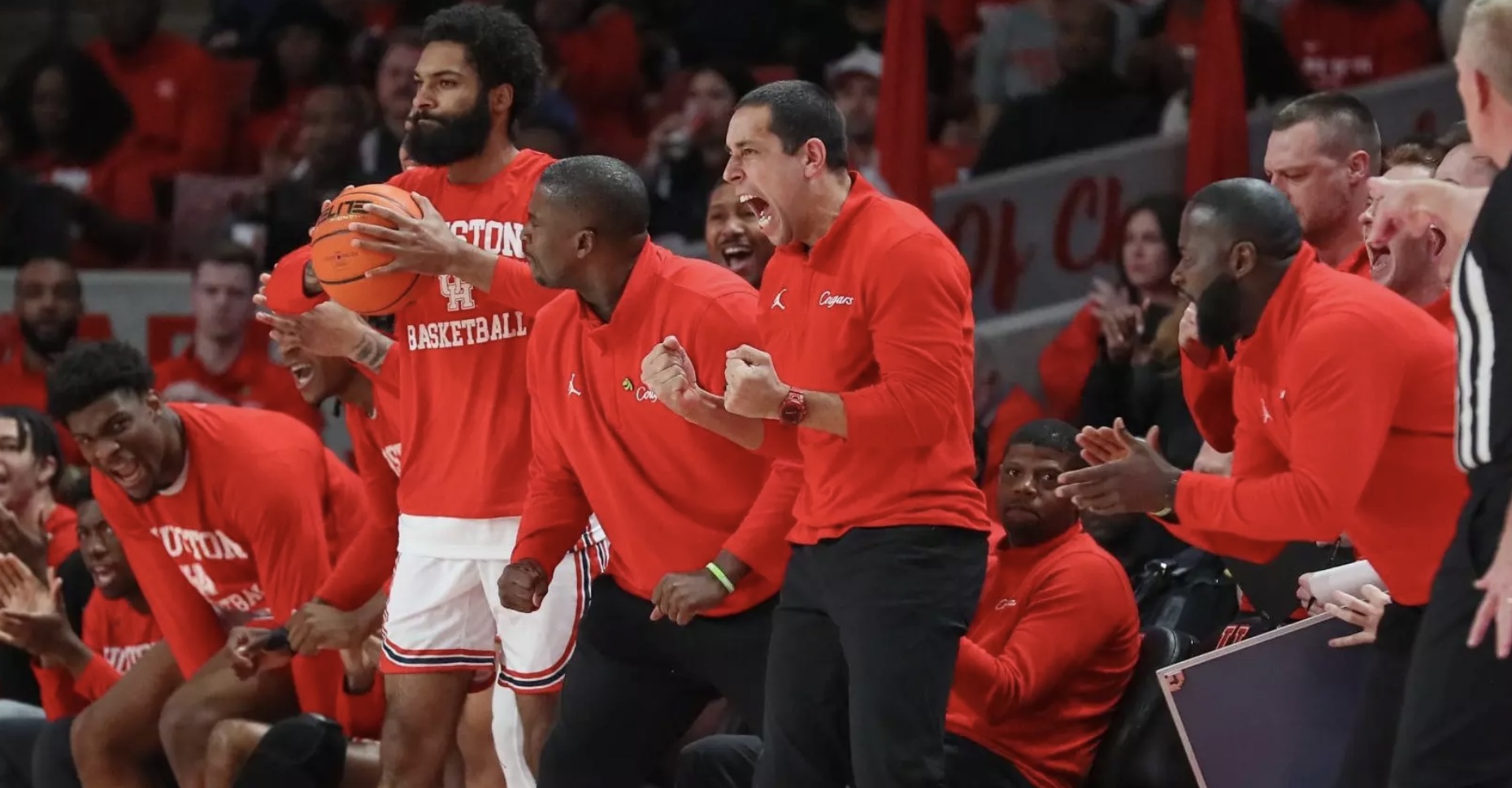
Houston’s historically mighty shot volume

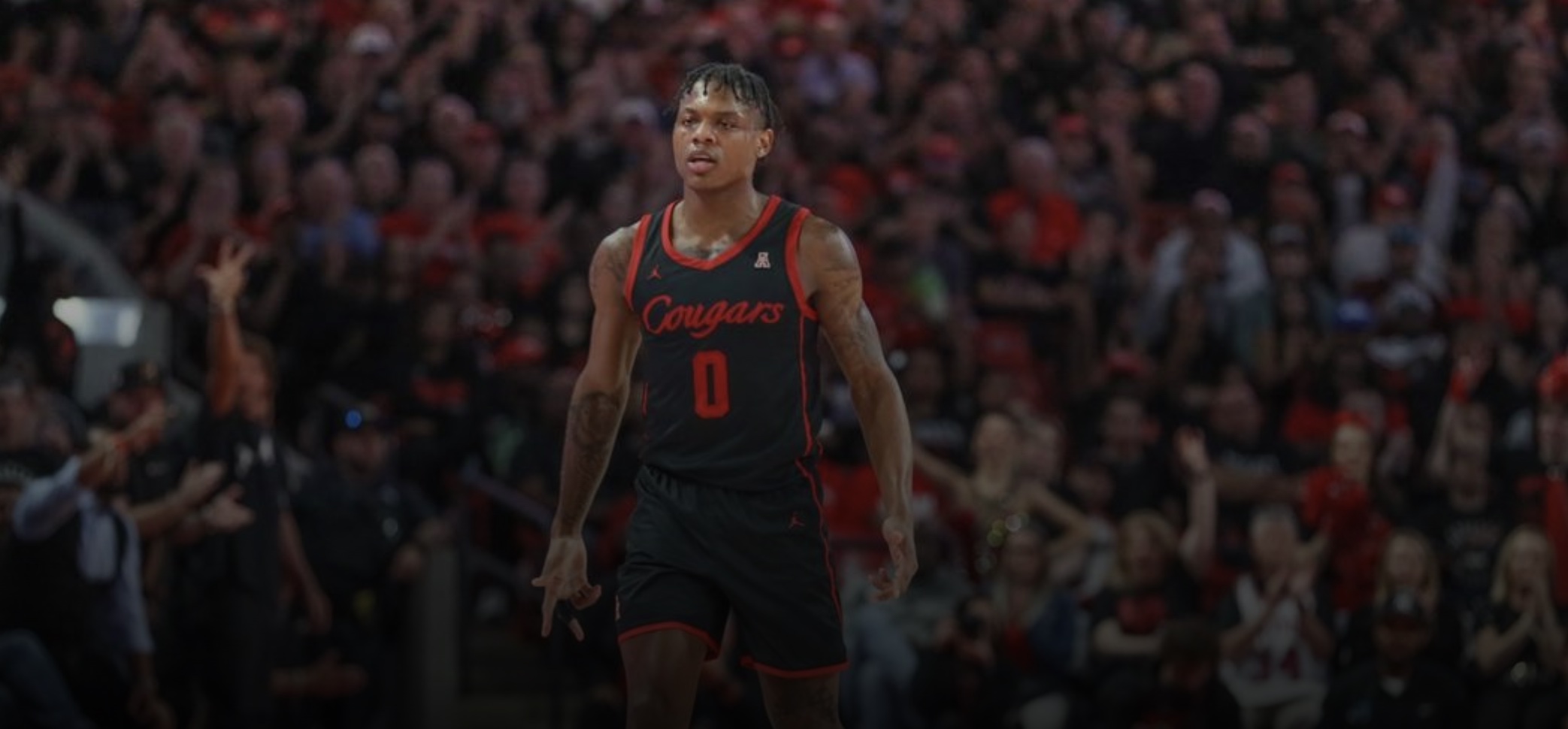
Marcus Sasser is afforded many opportunities to score. (uhcougars.com)

The No. 1 team in the AP poll is 27-2 and riding the nation’s sixth-longest active win streak. Said team also sits atop KenPom’s rankings and has done so continuously for the last 60 days. So what do we do as a college basketball commentariat? We sit around and talk about how there are no great teams this year. Forgive us. It’s what we do most years.

Houston may indeed turn out to be not great. As always, that will be for March and April to decide. What we can say without fear of contradiction in February, however, is that the Cougars are the greatest shot volume team we’ve seen in college basketball in the last five years.

Teams that take care of the ball and rebound their misses attempt a higher volume of shots than do opponents engaged in one or neither of these pursuits. To say as much feels unnecessary. It’s mere common sense, but for whatever reason we rarely watch games or discuss teams with this in mind. Happily, we can make helpful comparisons between numbers of attempts across varying tempos and free throw rates with our trusty shot volume index.

Named for Svi Mykhailiuk in the best traditions of PECOTA, SCHOENE, KUBIAK, and VUKOTA, a shot volume index can be thought of as the number of attempts a team would record from the field in 100 possessions of (rather implausibly) zero-free-throw basketball. This season Houston looks really good on this measure.

Continue reading

Expand the field

Sam Owens/Courier & Press

[NOTE: This was posted three hours before the NCAA Division I transformation committee published its recommendation to create larger championship fields.]

When expanding the NCAA tournament to 64 teams was first discussed seriously in 1981, NCAA men’s basketball committee chair Dave Gavitt made plain that he was opposed to the proposal. “I am personally very much against expansion,” he said that year. “I’m prepared to speak against it. I’m prepared to vote against it. Whether I have the prevailing opinion, I don’t know.”

Gavitt did not have the prevailing opinion. Two years later when it appeared increasingly likely that expansion would be approved, he sought to make the best of the situation. “I’m not anti-64,” Gavitt said. “But I am greatly concerned about what it will do to the quality of in-season play. It scares the hell out of me.” Nevertheless, the NCAA men’s basketball committee approved the 64-team field by an 8-to-1 vote on December 3, 1983. Gavitt’s was the lone vote in opposition.

The field expanded to 65 in 2001, but basically the tournament retained its essential structure for a quiet quarter of a century. Then expansion reared its head once again in the 2009-10 season, at least topically. Retired head coach Bob Knight made headlines that December not only by questioning the “integrity” of a certain unnamed head coach recently hired at Kentucky but also by coming out against all this talk he and everyone else was suddenly hearing about a 96-team bracket.

Continue reading

Your updated rankings for tournament wins in the modern era

(kuathletics.com)

We have now seen 37 “modern” NCAA tournaments played to completion. All but the first one in 1985 used a shot clock. All but the first two, in 1985 and 1986, featured a three-point line.

The expansion of the tournament to 64 teams in the 1980s also did away with byes, giving us a true measuring stick when teams accumulate tournament victories over the years. Yes, the NCAA muddied that up a bit by expanding past 64 teams starting in 2001, but we can adjust with a well-placed asterisk here and there.

Here are the teams with the most tournament victories since the field expanded in 1985 right through to Kansas winning the 2022 title.

NCAA tournament wins, 1985-2022

                         Wins
1.  Duke                 101    
2.  North Carolina        96 
3.  Kansas                92 (Congratulations!)
4.  Kentucky              83
5.  Michigan State        60
6.  Syracuse              57* 2018
7.  Arizona               56
8.  UConn                 55
9.  UCLA                  53* 2021
10. Michigan              51* 2016
11. Louisville            49
12. Florida               48
13. Villanova             47
14. Gonzaga               41
15. Oklahoma              37
16. Arkansas              36
    Wisconsin             36
18. Indiana               36* 2022
19. Ohio State            35
    Purdue                35

* Round of 68 wins

Note the gap between Kentucky and Michigan State. That top four’s been in a league of its own historically speaking.

Continue reading