
We tell ourselves NCAA tournament stories in order to love. March Madness is a treasure, surprises always occur, and each turn of events demands immediate explanation. We all have our narratives.
Here are some of my stories. I carry these with me serene in the knowledge they must be dashed by events someday….
Absolutely any team can lose one game, but only teams above a certain threshold can win six.
Not so much the mere presence of threes starting in the 1980s as their increasing prevalence since the teens has introduced new suspense in tournament outcomes.
Some seed lines are winning more games than previously and as a result old values for “expected” wins require an update (see below).
The champion’s always a team from the top 12 of the Week 6 AP poll and from the top six at KenPom on Selection Monday morning, etc., etc.
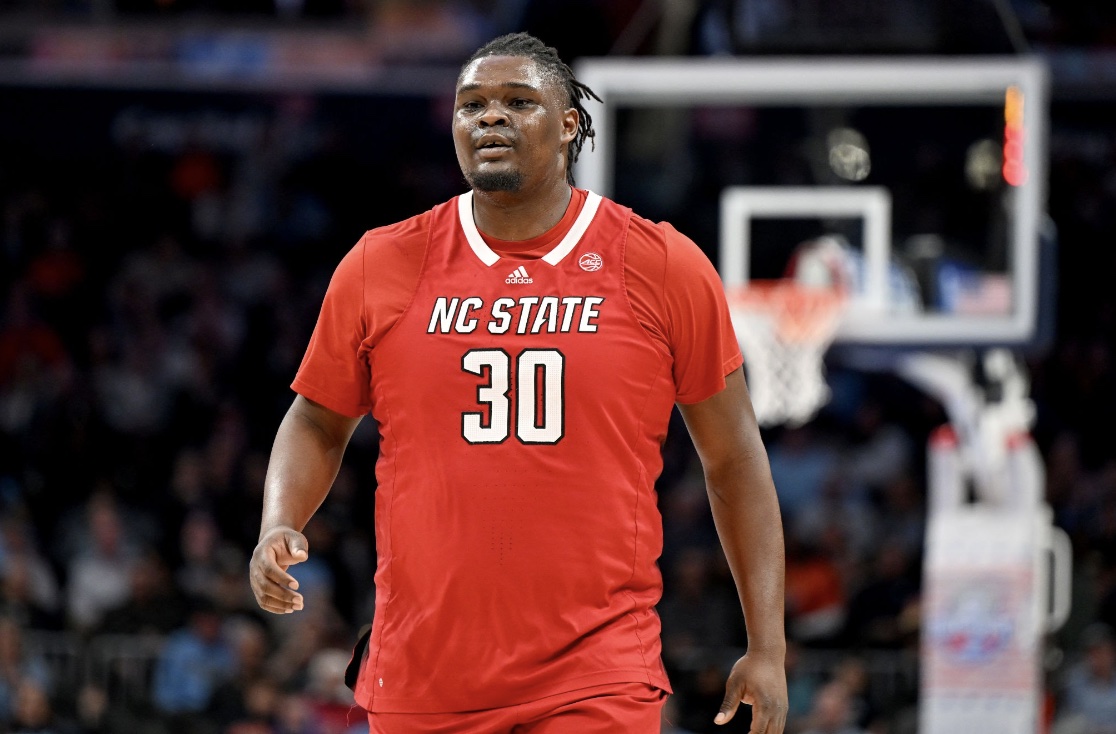
This last narrative of mine, of course, will absolutely be ground into a fine powder before long. Indeed, the narrative could crumble as soon as Monday night. Go to it, NC State or Alabama!
Until 2018, I strutted around smugly with charts and graphs insisting that someday a No. 16 seed would indeed beat a No. 1. (In the Before Times this was a hardy perennial in March Q&As.) Never in my wildest imagination did I believe the first such defeat would come by a margin of 20 points.
I suspect my beloved narratives are categorically doomed because building these backstories on sands of sudden death is itself a farcical endeavor of mine. The anodyne label for the tournament’s mode of propulsion is “single elimination,” but the NFL term feels more appropriate for the shock and trauma visited on 67 teams. To quote Mr. Whelliston from back in the day, it always ends in a loss.
It’s possible that, as viewers of so much everyday basketball dialectic from November to mid-March, we badly underrate the uniqueness of the sudden death zero-synthesis version of the sport. When a 1-in-10 event like an Oakland beating a Kentucky happens, it feels seismic in real time and everyone runs around screaming with their hands above their heads nationally for a day.
While our attention instantly moves on to the next upset, that previous event continues to reverberate downstream. By the time Final Four week arrives and we have 64 results pruned and redirected by the cumulative impact of multiple Oaklands, we set to work fitting an explanation to a bracket that’s sui generis and wouldn’t look this way if we played the tournament again 100 times.
Then again, the ACC seems to have triumphed over this variance and brought order to the chaos. Every year the league looks desultory all season long at KenPom only to romp untrammeled through the bracket in March. This year’s ACC teams, even with Virginia’s lopsided loss in the round of 68 included, have outkicked their coverage in terms of what laptops projected they would do on a game-by-game basis.
Just how strong has the ACC been in this bracket compared to what we’ve seen from other leagues of late? Here’s one possible answer with up-to-the-minute values for expected wins by seed. (“Up to the minute” meaning from 1985 through last Sunday night. It pained me that, in this day and age with our self-scouring plows and Otis elevator safety brakes, the top PASE search result is still a table from 2008. I went ahead and worked up the latest. I’ll share what I have after three more games.)
Best tournaments as conferences
Performance against seed expectation (PASE) since the pandemic
                     expected Ws  actual     PASE
1.  ACC        2022      4.98       13       +8.02
2.  Pac-12     2021      4.27       12       +7.73
3.  ACC        2024*     7.15       12       +4.85
4.  Big East   2023      7.44       12       +4.56

* In progress
Wins in and subsequent to round of 64 only
With three wins still to land somewhere, the ACC’s performing about as well as the Big East did last year. Still, even with a 2024 national title, the ACC won’t be able to catch the two post-pandemic GOATs.
Was there something about the Pac-12 in particular in 2021 that powered USC and Oregon State to the Elite Eight and UCLA to the 45th minute of a national semifinal against undefeated Gonzaga? Possibly. We just don’t know what it was, and neither does (did) the Pac-12.
As for the ACC in 2024, however, one potential wrinkle does suggest itself as a partial contributing factor. To be clear, this particular variable can speak only to this year and not at all to the league’s historically mighty PASE in 2022.
Still, it certainly hasn’t hurt matters in 2024 that the ACC’s tournament opponents haven’t been able to throw the ball in the ocean from a rowboat when it comes to threes.
Worst opponent 3FG%s by conference
NCAA tournament 2024
                        Opp 3FG%
1.  ACC                   27.98
2.  Big East              29.15
3.  Big Ten               29.64
4.  Mtn. West             33.16
5.  Big 12                33.33

Tournament as a whole     34.41

6.  SEC                   34.66
7.  Pac-12                35.42
Marquette’s 4-for-31 effort against NC State was an extreme case, but the Golden Eagles were far from the first team in this bracket to miss some threes against an ACC opponent. In fact, when NC State played Duke in the Elite Eight, the two teams combined for 8-of-33 shooting beyond the arc.
Conversely, it is past time for a really good conspiracy-theory narrative about how well NCAA tournament opponents shot threes year after year against the late lamented Pac-12. Last year tournament opponents shot 38 percent from beyond the arc against the league’s teams. You might recall this was the bracket where overall three-point shooting was so awful that everyone was blaming the ball.
A larger question does remain beyond the vicissitudes won, enjoyed, or endured by the likes of the Pac-12 and ACC, however. What do we mean exactly when we refer, as we all do, to tournament performance by conference? In its first year of existence, the American posted an excellent PASE of +4.68 thanks to UConn’s 2014 national title. No one was inclined to believe something inherent to the league itself drove that fact. The American that year was just a bunch of teams that found themselves scheduling games against each other from January to March.
Maybe in this one respect every league shares a bit in common with the American in 2014, particularly now with 12 Pac-12 teams scattering to the four winds. Throw in the possibility that conferences as we know them might be doomed anyway, and we may be repurposing cohesive brands and identities from the past to make sense of a highly variable present on the edge of a very different future.
One stylistic future that was certainly expected to arrive by now was the death of the two-point jumper. Here surely is a narrative that’s been with us for a while. As if on cue, Alabama has arrived at the national semifinals showing one immaculately clean rim-and-threes-only shot chart from its win over Clemson in the Elite Eight.
Nate Oats is doctrinaire about shooting from the highest value spots on the floor, and the success he’s achieved in Tuscaloosa has been spectacular. Of course, even Oats can’t enforce 100 percent conformity.
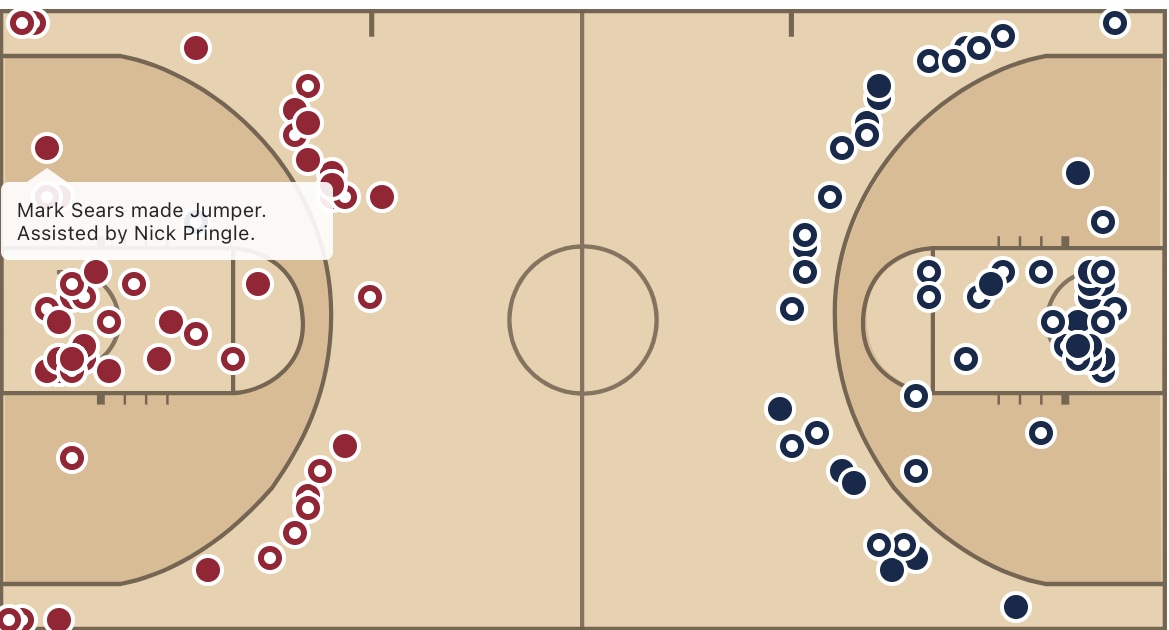
That’s Mark Sears against North Carolina in the Sweet 16, seeing Armando Bacot ensconced where the Alabama attempt “should” occur and concluding, “You know what, I’m good shooting this from here outside the paint.” It happens, even with the Crimson Tide. For their part the Tar Heels showed a similar if slightly less tidy shot chart. The sport is and has been moving in this direction and Oats is in the vanguard. (Though even Oats is looking up at Josh Schertz at hoop-math.com.)
At the same time, it’s true these things can be highly adverbial in addition to being, we think, causal. As if to remind us of this fact, Naismith’s game has seen fit to give us NC State’s DJ Burns. One good “essentials of basketball” hypothetical is what would or should happen, exactly, if Oats coached Burns. How does one enforce “threes and at the rim only” with the Roy Hobbs of March 2024, a guy who for the past two weeks has looked like the most sensational master of two-point jumpers since Maravich?
Two-point artistry
Burns and Edey in the tournament and all season
                  Tournament                     Season
                                      % of 2FGA           2FG%
                %Shots    2FG%       away from rim    away from rim
DJ Burns         28.6     67.4           59.3             46.6
Zach Edey        32.1     65.6           48.9             43.4

Data: Torvik/locally sourced
Naturally, “jumper” is an exceedingly poor description of what Burns is really doing. Play-by-play categories don’t include “backing down the defender and then flicking the shot over your shoulder with uncanny accuracy.” Burns thrives in the negative gravity created by his Haliburton-level passing. Defenses prefer on balance to give him the interior space he needs.
With Zach Edey, that same space comes courtesy of teammates who hit threes. What to do or not do with Edey in the paint, however, captures only one-third of the challenge faced by opposing defenses. Edey dominates by hitting twos, grabbing offensive boards, and getting to the line. Mitigating the harms done by the last of these threats, or at least trying to do so, perhaps stands out as the most promising option in a forbidding situation.
The case for trying not to foul Edey comes down to two separate likelihoods. If you’re fouling him at the rim, there’s an excellent chance you’re just handing him an and-one opportunity. Edey’s success rate at the rim this season (80.4 percent) is, amazingly, a hair higher than what all-time Two-Point Czar Zion Williamson himself recorded in 2019 (79.9). Williamson shot a much higher percentage than Edey on his twos overall, however, because he got to the rim so much more often. Which brings us to the second incentive for not fouling Edey.
As seen above, Purdue’s star attempts about half his shots away from the rim. (Granted, when you’re 7-4 you can be “away” from the rim and remain within easy reach of the offensive board.) He misses about 56 percent of these shots, so why foul him? He might miss. Get in position for a rebound. While you’re at it, keep a body on Trey Kaufman-Renn, who feasts in the synapse between Edey and the basket on these “away from the rim” attempts.
Alabama gets to the rim. Burns doesn’t need to go that far to rain twos down on you. Twos are just the beginning for Edey. And Donavan Clingan’s capable of removing the subject from the discussion entirely.
For all we know, UConn will revert to the “No. 1 at KenPom on offense” version of itself and play a high-scoring affair or two in Glendale the way it did against St. John’s in the Big East semifinals. Nevertheless, ever since that game against the Red Storm, Dan Hurley’s juggernaut has instead taken on that familiar UConn 2011 tournament look. Illinois is to 2024 what Butler was to 2011.
That’s mostly on Clingan. Purely in terms of rim defense, he’s crossed the line into Anthony Davis in 2012 territory and rendered fouls a moot point. Davis accomplished that because he was a generational talent who could block an extraordinary number of shots without fouling. Clingan’s done it because he’s an extraordinary talent who can block enough shots in the time allotted him at 3.4 fouls per 40 tournament minutes to see UConn through to its customary 30-point lead.
More stories to follow. Enjoy the last 120 or so minutes of 2024. It’s been a ride.

