
Monthly Archives: April 2024

Basketball’s most important factor feels eclipsed

Brynn Anderson/AP

During the men’s national championship game this week, TBS showed a graphic stating that UConn was shooting 48 percent and Purdue was connecting at a 46 percent rate. I winced as I always do when I see straight field goal percentages. Upon further reflection, however, my winces possess varying basketball connotations.

At this late date when an announcer still mentions rebound margin, for example, I wince on three separate yet uniformly unimpeachable grounds. Not only is the metric in question a perfect storm of statistical noise that can yield up-is-down, left-is-right results. Not only was there never a time when this was a useful statistic.

As if these reasons weren’t sufficient by themselves, there’s a perfectly good alternative that other announcers use all the time. This season I heard Bill Raftery, Jay Bilas, Dan Shulman and who knows how many others repeatedly and correctly offer variations on: Purdue rebounds almost 40 percent of its misses. Boom, you’re done. It’s easy!

Field goal percentage is different. It’s prohibitively noisy in the three-point era, of course, but the sport didn’t always have a three-point era. There was a time, 50 years ago in the NBA and 40 in the college game, when field goal percentage was a commendably sound stat. You can see why there was a desire to hang on to something similarly handy with the introduction of the three-point line.

Continue reading

Leaderboard for modern tournament wins

Tyler Schank/NCAA Photos via Getty

The men’s NCAA tournament field expanded to 64 teams in 1985 only after years of opposition. Then Villanova upset Georgetown in an iconic final and pretty much everyone loved the new format after all.

We call this the modern tournament era, which is perhaps a bit presumptuous. Even at this late date, there were more tournaments played before 1985 than have been contested since.

Still, “modern” makes descriptive sense. These brackets have shot clocks and three-point lines (starting in 1986 and 1987, respectively).

Expanding the field did away with byes, giving us a trusty measuring stick when teams accumulate tournament victories over the years. Yes, the NCAA muddied that up a bit by expanding past 64 teams starting in 2001, but we can adjust with a well-placed asterisk here and there.

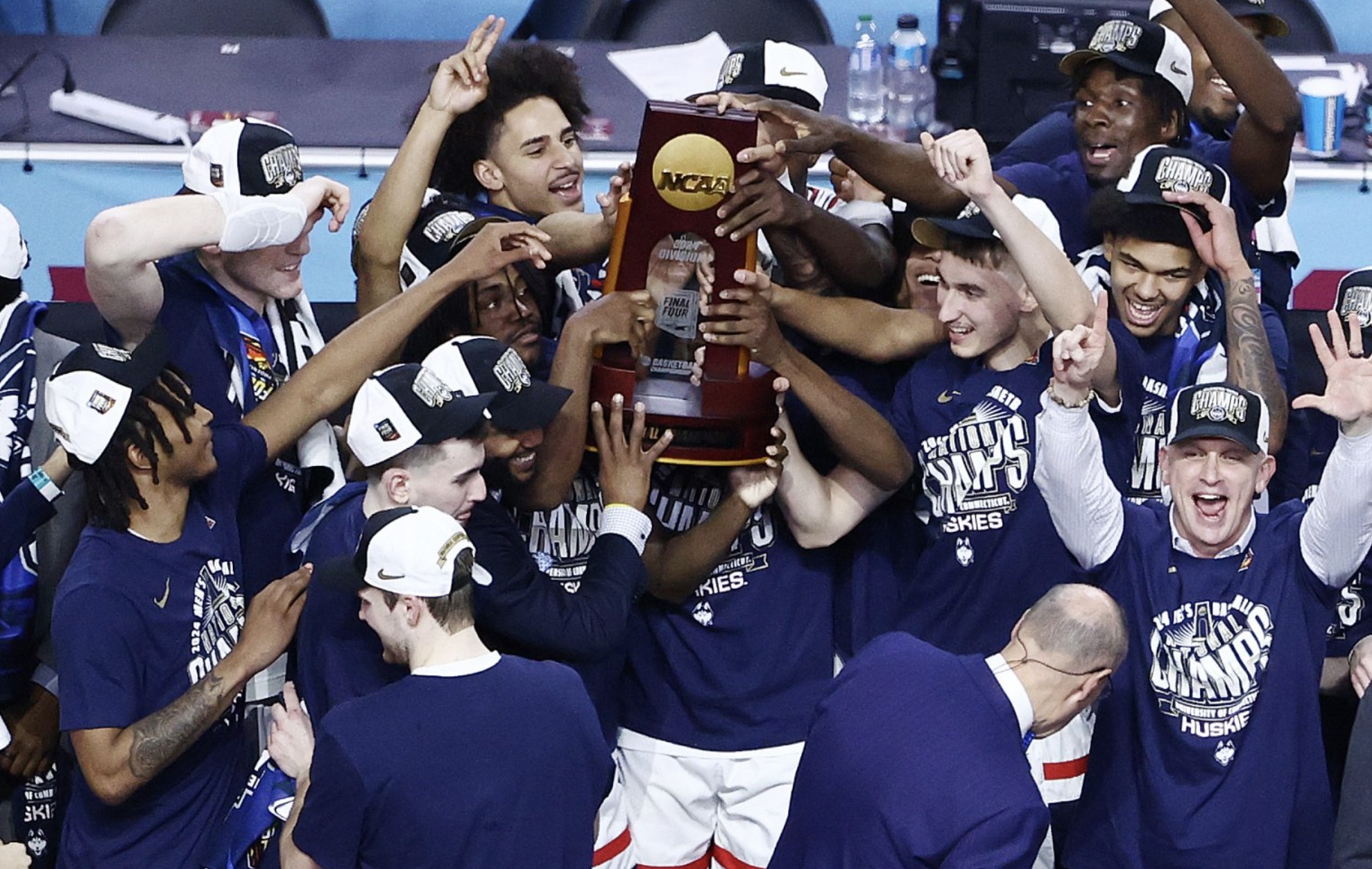
UConn is moving up fast on the leaderboard for modern-era tournament victories. Winning two titles in the span of about 390 days vaulted the Huskies past Michigan State, Arizona, and Syracuse.

Winningest NCAA tournament teams, 1985-2024

                         Wins
1.  Duke                 105    
2.  North Carolina        98 
3.  Kansas                94
4.  Kentucky              84
5.  UConn                 67
6.  Michigan State        63
7.  Arizona               58
8.  Syracuse              57* 2018
9.  UCLA                  55* 2021
10. Michigan              51* 2016
11. Louisville            49
12. Florida               48
13. Villanova             47
14. Gonzaga               46
15. Purdue                40
16. Arkansas              38
17. Oklahoma              37
    Indiana               37* 2022
19. Wisconsin             36
20. Ohio State            35
    Maryland              35

* Round of 68 wins
Continue reading

Performance against seed expectations

One measurement of performance in the NCAA tournament is wins above or below what every other team with the same seed has done. The difference between expected wins and your actual victories is performance against seed expectations (PASE).

Back in the day, PASE was shaping up to be a handy item. Then the field expanded to 68 teams, and assigning praise and blame became a bit less tidy with a few extra results knocking around.

The proposal here is to ignore the round of 68 entirely, both its wins and its losses. Take Virginia’s loss to Colorado State in the round of 68 this year. Don’t worry, Cavaliers. Never mind, ACC. For PASE purposes, we’ll simply count as though the Hoos missed the tournament entirely. Which they kind of played like they did. The Rams, conversely, do count as a No. 10 seed that won zero games in the 2024 tournament.

Based on tournament results from 1985 through 2024, here are the values for expected wins by seed starting from the round of 64. If you greet that first Thursday morning with one of the following numbers still listed as a live fact next to your name, this is what we expect of you….

seed    expected Ws       seed    expected Ws
1.  3.30 9. 0.62
2. 2.33 10. 0.60
3.  1.84 11. 0.67
4. 1.56 12. 0.51
5. 1.15 13. 0.26
6. 1.04 14. 0.15
7. 0.90 15. 0.10
8. 0.71 16. 0.01

Wins in and subsequent to round of 64 only
Continue reading

Sudden death and narratives

(Greg Fiume/Getty)

We tell ourselves NCAA tournament stories in order to love. March Madness is a treasure, surprises always occur, and each turn of events demands immediate explanation. We all have our narratives.

Here are some of my stories. I carry these with me serene in the knowledge they must be dashed by events someday….

Absolutely any team can lose one game, but only teams above a certain threshold can win six.

Not so much the mere presence of threes starting in the 1980s as their increasing prevalence since the teens has introduced new suspense in tournament outcomes.

Some seed lines are winning more games than previously and as a result old values for “expected” wins require an update (see below).

The champion’s always a team from the top 12 of the Week 6 AP poll and from the top six at KenPom on Selection Monday morning, etc., etc.

Continue reading