
Every March we’re awash in college basketball terms where bottom-up usage has filled a vacuum or triumphed over official top-down naming. “NCAA Division I Men’s Basketball Championship” is a mouthful. “March Madness” is perfect.
The NCAA trademark March Madness has a byzantine origin story. Even the lightest 2020s search shows this catchy bit of alliteration to be older than basketball itself. The term begins to produce more search hits in the 1920s and 1930s, when March madness could refer to gardening, the weather, or anything else happening that month. Actually, for a heartbeat it looked like March Madness might become the exclusive possession of English football.
Then Indiana newspapers covering high school hoops in the 1930s got busy. A poem celebrating the state high school tournament next door in Illinois limned “the March madness” and was published in 1939 by the Illinois High School Association.
Four decades later the IHSA commissioned March Madness, a history of the Illinois state tournament. From his chair at CBS Chicago in the 1970s, a young Brent Musburger picked up the term. Musburger took it with him to the mother ship when CBS began carrying the tournament in 1982. March Madness stuck. NCAA lawyers have been shooing away unauthorized users and uses ever since.
In this same spirit it’s remarkable that the bubble simply didn’t exist as a basketball noun until the late 1980s. Then it was adopted everywhere and all at once. Usage sweeps all before it.
Of all March terms, however, “bid thief” perhaps merits special if more selective acclaim. The label is short, vivid, and laudably accurate. Thievery is exactly what takes place when a bid’s taken off the board. In 2021 we should have thanked the Ivies for being bid donors.
Additionally, bid thieves and their perfectly rendered title possess an incongruous air of mystery. You either get a bid or you don’t, but we just don’t know in every instance which teams really were bid thieves and which ones were not.
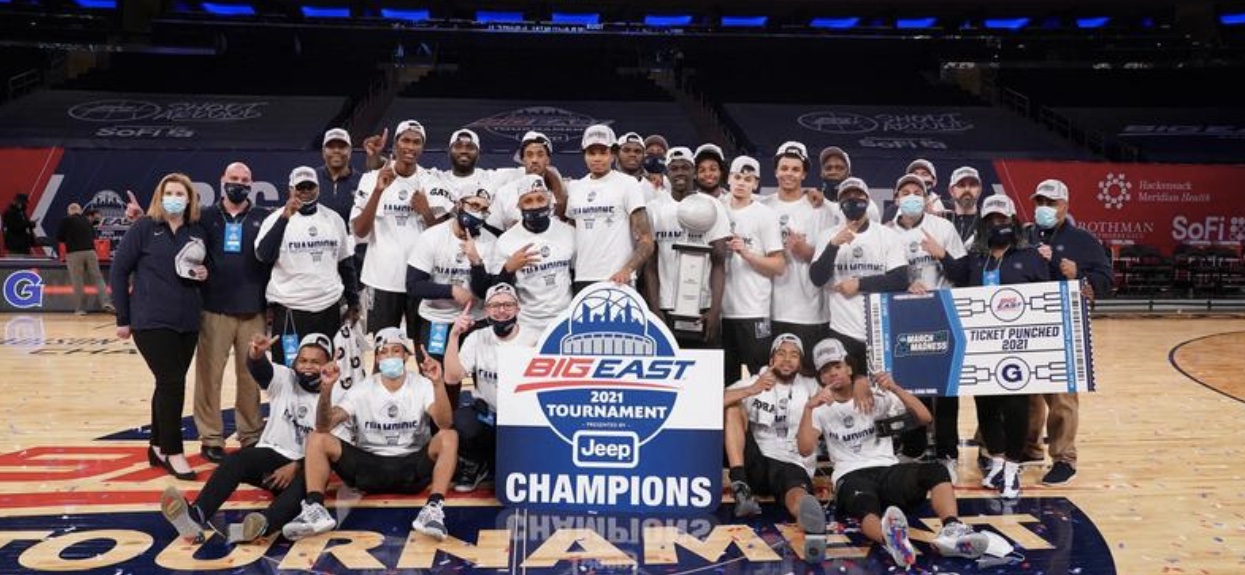
Here is one rough estimate. Outright Georgetown-in-2021-level bid thieves earn a 1.0 in this exercise. More nebulous judgment calls such as Virginia Tech in 2022 receive a 0.5.
Bid thieves since 2008
Automatic qualifiers that would not (1.0) or may not (0.5) have earned at-larges
                                         Thief?
1.  Richmond          2022   A-10         1.0
2.  Virginia Tech     2022   ACC          0.5
3.  Georgetown        2021   Big East     1.0
4.  Oregon State      2021   Pac-12       1.0
5.  Oregon            2019   Pac-12       1.0
6.  Saint Mary's      2019   WCC          1.0
7.  Saint Louis       2019   A-10         1.0
8.  Murray State      2019   OVC          0.5
9.  San Diego St.     2018   Mtn          1.0
10. Davidson          2018   A-10         1.0
11. Rhode Island      2017   A-10         0.5
12. Northern Iowa     2016   MVC          1.0
13. Wyoming           2015   Mtn          1.0
14. Providence        2014   Big East     0.5
15. W. Kentucky       2013   Sun Belt     1.0
16. Colorado          2012   Pac-12       1.0
17. St. Bonaventure   2012   A-10         1.0
18. Loyola MD         2012   MAAC         1.0
19. Richmond          2011   A-10         0.5
20. Memphis           2011   CUSA         1.0
21. Washington        2010   Pac-12       1.0
22. San Diego St.     2010   Mtn          0.5
23. Houston           2010   CUSA         1.0
24. Miss. State       2009   SEC          1.0
25. Temple            2009   A-10         0.5
26. Cleveland St.     2009   Horz         1.0
27. Georgia           2008   SEC          1.0
28. Temple            2008   A-10         0.5
29. San Diego         2008   WCC          1.0

                                         26.0
Bid thieves are rare. If there really have been 26 or so over the course of 476 conference tournaments since 2008, that’s a hit rate of less than six percent. Even if we look only at major conferences and the 10 other leagues that have produced thieves over that span, the chances of seeing one happen at a given tournament are still less than 11 percent. In this one respect, the Big 12 and Big Ten are equivalent to traditional one-bid conferences. All of the above have been bid-thief-free since 2008.
You may remember there were no bid thieves at all last year. That was good news for Nevada, the last team in the 2023 field of 68. Most years the Wolf Pack would have been bumped out of the bracket, just as Dayton was in 2022.
Tornadoes are also rare, of course, but we do tend to remember them. The Atlantic 10 is in effect the states of Oklahoma and Kansas for the tornado of thievery. The conference breeds the perfect conditions for bid thieves to form.
A bid thief requires the presence of an at-large team in the same conference. Thieves like Western Kentucky in 2013, Loyola MD in 2012, and Cleveland State in 2009 are storied legends in part because they went dancing alongside league rivals Middle Tennessee, Iona (a No. 14 seed at-large!), and Butler, respectively. Often when we say this or that mid-major conference last sent an at-large team into the bracket back in such and such a year, what we’re really citing is the presence of a second team that was a bid thief.
Over the years the A-10 has steadily manufactured at-large-worthy candidates, up to and including the six-bid Selection Sunday of 2014. Then again, the league hasn’t always minted these teams in the depth we see from, say, this season’s Mountain West.
Naturally, the presence of multiple at-large teams in a conference bracket doesn’t guarantee there won’t be a bid thief. Virginia Tech beat three at-large opponents including North Carolina and Duke in succession in the 2022 ACC tournament. Still, there’s a correlation. The more at-larges you have, the less likely you are to produce a thief.
This year’s Atlantic 10 is believed to have one at-large team. If Dayton doesn’t win the conference tournament, we could see an A-10 bid thief yet again in 2024.
 John Gasaway