
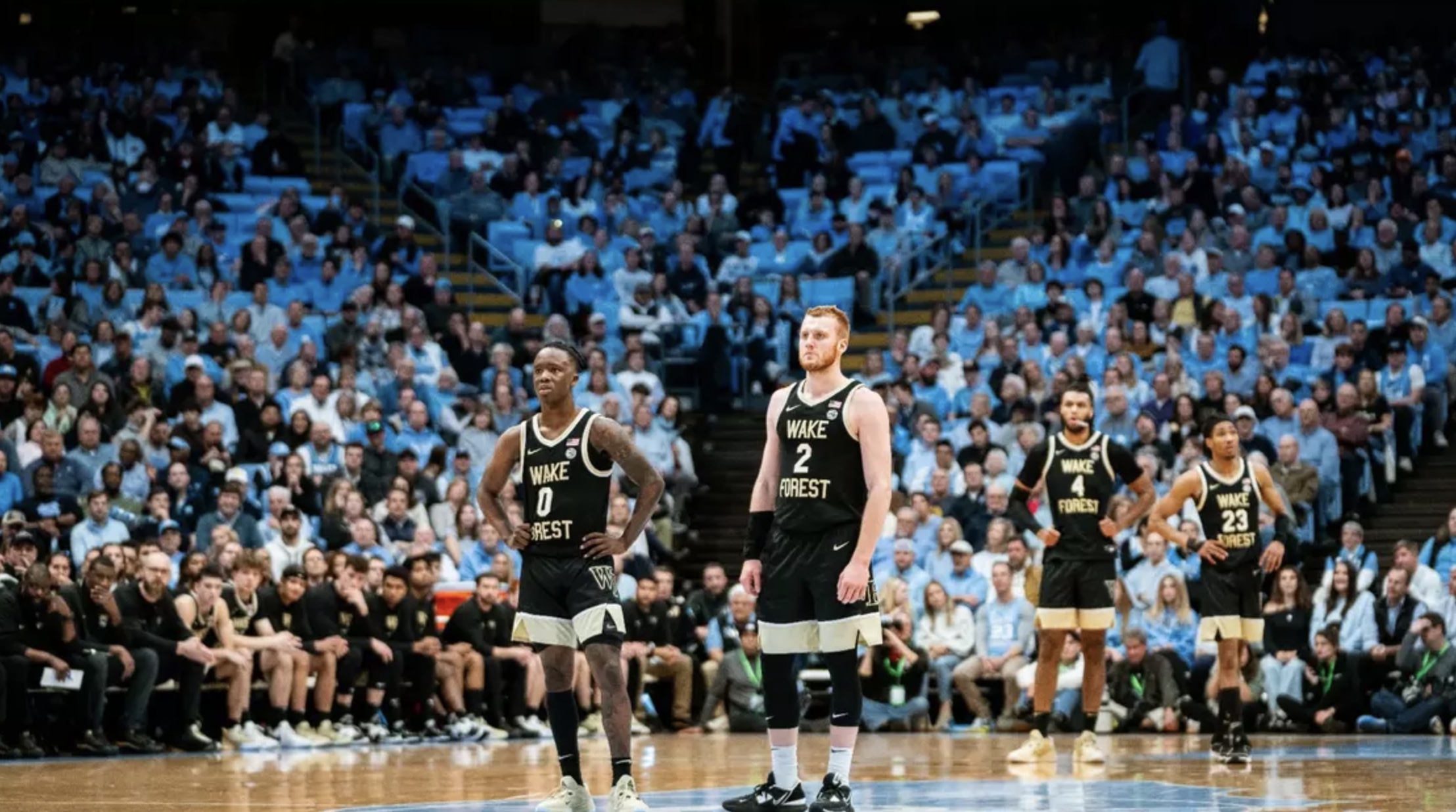
Last night Wake Forest shot 3-of-20 on its threes in a 21-point loss at North Carolina. Both the final score and the opponent’s three-point haplessness are rapidly becoming par for the course with the Tar Heels.
UNC’s conference opponents have connected on just 22.5 percent of their threes. We haven’t even reached February, of course, and these numbers will shift over North Carolina’s remaining 12 conference games. Nevertheless, 570 possessions of basketball constitutes a fair sample size in its own right. At a minimum one might note that over that stretch the Tar Heels’ opponents were historically bad at making threes.
Just how extreme have UNC’s opponents been in their three-point misery, where is this coming from, and what happens now?
One answer to the first question would be “very.” The conference season is equally young for the entire ACC, yet to this point North Carolina’s three-point defense is nearly three standard deviations better than the conference mean.
Bear in mind Division I as a whole’s making a business-as-usual 33.6 percent of its threes this season. Actually the Tar Heels themselves have allowed opponents to shoot a rather more normal 28.5 percent from beyond the arc in all games. Non-conference opponents like Lehigh (13-of-33 on threes) or Kentucky (8-of-23) didn’t faint dead away at the sight of this defense.
Even ACC foe Florida State posted a 12-of-28 effort on its threes in UNC’s first conference game. Since that time, however, ACC opponents have been extraordinarily bad from the perimeter, to wit: 26-of-141 (18.4 percent). So, yes, this run of bad three-point shooting has been extreme.
As to where this is coming from, get your Venn diagram ready. In one circle we say opponent three-point accuracy is largely though not entirely outside the control of the defense. In a separate yet overlapping circle we say hey, wait a minute, Kansas in 2022, Virginia in 2019 (with a different line), and, going way back, Duke in 2010 all appear on our leader board of quote-unquote lucky defenses in conference play. Some will study this circle and say post hoc ergo propter hoc. Others will persist in feeling that’s a pretty fair hit rate for nascent national title teams.
In a third and final circle we say teams under opponent-created stress from this or that direction can on occasion turn in awful three-point shooting performances. The opponent-created stress can take the form of, say, a weird zone D or perhaps simply having to face a nascent national champion that’s really good at basketball in ways somewhat or even entirely removed from perimeter defense. Back in the day my friend Ken labeled this circle the “Boeheim exception.” I subsequently offered “nuisance value” as my own unsolicited tag. Both terms are foreordained to go viral soon.
Which brings us at long last to what happens now. One of the most puzzling aspects of North Carolina’s picture in 2024 is the fact that the ACC is actually pretty good at making threes. Conversely in recent years we’ve grown accustomed to seeing this or that SEC program, for example, post a stellar number for three-point defense. Alabama memorably recorded an entire conference season in 2021 where it held opponents to 25.9 percent three-point shooting.
We take such occurrences in stride knowing full well that the SEC collectively in conference play just tends to be really, really bad at making threes. Since the current line was pushed out to FIBA conformity prior to 2019-20, the SEC has ranked Nos. 28, 22, 29, 32, and 30 out of 32 D-I conferences for three-point accuracy.
Not so this season’s ACC (No. 11). In part it is precisely this ability to make threes against every opponent except the Tar Heels that makes what we’re seeing from the ACC and UNC all the more unusual.
Best 3FG% defenses with the current line
Major-conference games only, 2020-24
                           Opp 3FG%  conf avg  difference
1.  North Carolina  2024*    22.5      35.0      -12.5
2.  Kansas State    2024*    25.8      33.2       -7.4
3.  Alabama         2021     25.9      33.4       -7.5
4.  Oklahoma        2024*    26.0      33.2       -7.2
5.  Alabama         2023     26.5      32.0       -5.5
6.  Auburn          2024*    26.7      32.0       -5.3
7.  Iowa            2024*    27.3      35.1       -7.8
8.  Kansas          2022     27.5      32.0       -4.5
9.  Baylor          2022     27.7      32.0       -4.3
    LSU             2024*    27.7      32.0       -4.3

* In progress, thru 22 January
The ACC’s relative perimeter prowess suggests that a potential rubber-band effect for North Carolina’s perimeter defense over the coming weeks could in fact have a bit of snap.
Or not, right? It’s the future. If the Heels do finish the season with a number for three-point defense that’s 12 or 13 percent better than the conference mean (to say nothing of an equally ridiculous seven or eight percent better than the league’s second-best perimeter D), it will be time to get busy theorizing the Hubert Davis Exception.
To this point, however, the trend has been that ridiculously successful whole-season perimeter defenses in conference play instead clock in at between four and eight percent better than their conference means. Even Duke’s notoriously Naismith-kissed year of perimeter D back in 2010 (ACC opponent 3FG%: 24.9, with a different and more forgiving line, no less) bowed to this same tendency (-7.9 percent).
The demon in the major-conference sky so far has been out there somewhere between minus-seven or -eight percent. If North Carolina does reset that to something more like minus-12 or -13 this year, it will be notable.
 John Gasaway