Category Archives: in many ways the work of a critic is easy

Elite freshmen, playing time, and Bill Self

Cheick

Cheick Diallo (right) before he was eligible. He often looks like this now that he’s eligible, too. (Rich Sugg, Kansas City Star)

After a protracted battle with the NCAA, Cheick Diallo became eligible for Kansas on November 25. What we all forgot to account for, however, is that Diallo actually has two hoops to jump through to play college ball. One was the organization in Indianapolis, and the other is an individual on the sidelines in Lawrence. Usually when a coach gets one of the best recruits in the country, he’s kind of anxious to, you know, have the freshman play basketball. But, as we saw this time a year ago with Kelly Oubre, Bill Self is comfortable being the exception to this rule.

I wanted to add a cherry on top of the excellent work already done on this topic by Jesse Newell, and the question I had for myself was a simple one. Exactly how weird is Self being? To see how aberrant KU’s coach really is, I scooped up every top-10 (RSCI) freshman from the past two seasons. Since I’m interested in actual in-game decisions as opposed to sheer player availability, I worked up figures for the percentage of “discretionary” minutes played.

Sometimes discretion and eligibility are the same thing. Diallo, for example, has been eligible for just three games and he’s played 41 of a possible 120 minutes. But I also wanted to account for things like Kansas choosing to keep Cliff Alexander on precautionary infractions ice at the end of 2014-15, Rashad Vaughn missing nine games due to injury, or even something as minute as Mike Krzyzewski resting a banged-up Jahlil Okafor against Clemson last season.  Continue reading
The college basketball implications of Stephen Curry

Curry

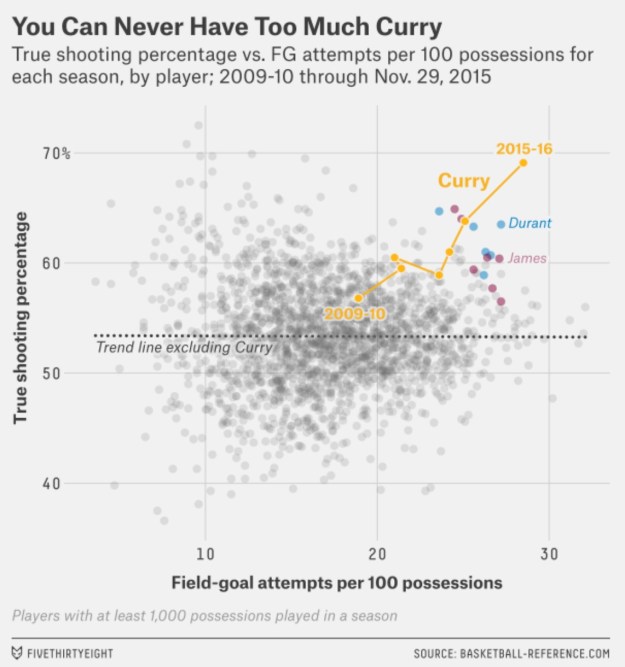
If it turns out the usage-efficiency tradeoff doesn’t apply to one player, what does that say about how the game should be played by every other player? (fivethirtyeight.com)

As an incorrigibly casual and contentedly sporadic NBA fan, I really enjoyed Benjamin Morris’s piece on what precisely Stephen Curry hath wrought in our game. Previously I had struggled to piece together a coherent awe from the stray random shouts I caught from trusted and unmistakably thunderstruck colleagues on Twitter. But after stumbling across Morris and his arresting visuals, I get it. A player who is (apparently) “virtually immune to burden” reorders the hoops universe.

So now what? As an incorrigibly dedicated and contentedly constant fan of the college game, I have some questions.

Should Curry change what college coaches do?
If nothing else Curry has erected a tower so that first-grade math can shine forth like a beacon and claim its due deference. Three is greater than two, and one possibility Curry raises is that, purely in the abstract sense, the first option for any basketball possession should be an open three-point attempt.  Continue reading

Three questions for the Iowa Caucus of hoops

RW

He looks uncertain. That makes two of us. (AP/Charlie Niebergall)

The Big Ten/ACC Challenge happens very early in the season — perhaps even too early — and its results are hungrily overanalyzed by information-starved pundits who’ve just emerged from a very long no-hard-news period and are thus eager to pontificate on any morsel of actual substance. That being said, the Challenge is also a genuinely compelling competitive spectacle and people do tend to remember who won.

In other words it’s uncannily similar to an Iowa Caucus. These are my questions for the 2015 incarnation…

Whatever happened to home-court advantage in this thing?
In the first nine years of this event the home team won 70 percent of the time. In the last seven years, however, that percentage has dropped all the way down to 55. This is an oddly low figure in light of the fact that in each of the two competing conferences over the past 10-plus years the home teams can be counted upon to win 64 (ACC) or 65 (Big Ten) percent of the time in league play. Continue reading

Quality, justice, and 2015-16’s brave new world

Under the new guidelines, verticality matters.

Under the new guidelines, verticality is supposed to matter the way it was supposed to matter under the old guidelines. This is a good thing.

You may not be exceedingly familiar with James Thompson IV, Ethan O’Day, or even the Convocation Center in Ypsilanti, Michigan, but the 2015-16 college basketball season will begin tomorrow morning at 11 Eastern when those two guys contest the opening tip in said arena on behalf of Eastern Michigan and Vermont, respectively. Perhaps this strikes you as a rather inauspicious manner in which to embark upon an endeavor that will culminate with all eyes on Houston next April. For my part I’m too happy to care. The season’s finally here.

In the seven months since the final horn sounded in Duke’s win over Wisconsin, the NCAA has instituted a number of changes and issued several directives aimed at improving the game. Yes, the shot clock’s been shortened from 35 seconds to 30, but if you’re unfamiliar with everything else that’s new and different the NCAA just posted a briskly efficient 14-minute video that summarizes the main points. I highly recommend giving it a click.

This is the part where I scratch my head over the NCAA acting like the nimblest of daring Silicon Valley start-ups when it comes to bettering the game while at the same time the organization does a searingly convincing imitation of a cadre of Bulgarian apparatchiks circa 1953 and continues to define “top-50” wins with a metric that’s off by 50 spots or more seven percent of the time. Go figure, the “bettering the game” part of said schizophrenia is highly laudable. NCAA, I salute you! Continue reading

One working definition of a major conference

Was this a major-conference game? Good question.

Can we do better than a Potter Stewart definition?

Last week I posted a piece at ESPN Insider where I pointed out that the new-look no-football Big East has recorded a pretty nice collective KenPom rating the past two seasons, while the newborn American — even with a national title in its pocket — has not. Little did I know that this piece would win the title for “largest response to anything I’ve ever written about college basketball in September.” Perhaps a further word is therefore in order. Just what is a major conference?

I’ll grant at the top that this might be an untenable dichotomy to begin with, and that maybe this whole “major vs. mid-major” thing is a doomed attempt to put static categorical toothpaste back into a more fluid and dynamic postmodern college hoops tube. It could be the case that old boundaries and vocabularies no longer serve our purposes all that well. Duly noted. Continue reading

A preface to shot-clock pessimism

I demand gotcha questions on where the candidates stand on the new shot clock. And I vote.

As hoops fans we demand that candidates take a stand on the new shot clock. And we vote.

I don’t know what will happen when the 30-second shot clock is introduced to the college game this November, and I’m prepared to wax fairly adamant and doctrinaire over my ignorance on this matter. The fact is no one knows what will happen, so the best we can do is engage in learned speculation.

Certainly I can be won over to speculating that this whole shot-clock thing is going to end rather badly. Why not? That is, after all, one of three possible outcomes. A year from now I suspect there will be a consensus view to the effect that the new shot clock has either been a success, a mixed blessing/non-event, or a failure. Other things being equal, “I have a bad feeling about this” has roughly a 33 percent chance of being correct. And a one-in-three probability qualifies as a strong likelihood in my book.

Nevertheless I’ve been struck by what’s been offered up in the way of trepidation on this question. Before I sign up for membership in the worried 33 percent, I confess I still have a couple questions that need answers.   Continue reading

How Walter Byers built, fought, lost, and wrote

Byers in 1986. (AP: Cliff Schiappa)

Byers in 1986. (AP: Cliff Schiappa)

Longtime NCAA executive director Walter Byers passed away this week at the age of 93, and his New York Times obituary says that late in his career “he viewed the college sports landscape with increasing cynicism.” Granted I never spoke to the man — as near as I can tell no one did on the record after about 1997 — but I must say this strikes me as incorrect.

Anywhere that lawyers gather to contest the future form and very existence of the NCAA in 2015, there are two histories of college sports close at hand. (Literally.) Taylor Branch wrote one, of course, and Byers authored the other, in 1995.

Both histories were written in anger. Branch will tell you he’s angry that oligopolists are piously mouthing empty platitudes about amateurism while maintaining a cartel that allows them to profit off the sweat of young brows. Byers, conversely, wrote what on the surface is a far more conventional post-retirement jeremiad. At the age of 73 he yelled at a cloud, and did so at some length. Continue reading

The 30-second clock’s a long-overdue solution to a problem we may not have

The last time any adjustment was made to the shot clock, Glenn Robinson was the reigning player of the year. It's been a long time coming.

The last time an adjustment was made to the shot clock was in 1994, when Glenn Robinson was the reigning player of the year. It’s been a while.

Last week the NCAA’s rules committee exceeded my loftiest expectations. Not only did the group recommend the adoption of a 30-second shot clock, it also:

  • Eliminated one second-half timeout
  • Enlarged the restricted area under the basket
  • Made any bench timeout called in close proximity to a scheduled media stoppage the “media timeout” all by itself (no more “bench timeout, four seconds of action, media timeout” sequences)
  • Gave officials the authority to review potential shot-clock violations on made field goals throughout the game
  • Prohibited coaches from calling live-ball timeouts
  • Enabled refs to call personals on players who on replay are found to have faked fouls
  • Reduced the penalty for class B technical fouls (e.g., hanging on the rim) to just one free throw
  • Ended the prohibition on dunking in pregame warmups.

That sound you heard on Friday was Twitter laboring mightily to wield its surgically implanted torches and pitchforks in the face what by any reasonable measure was a rather disconcerting overabundance of wish fulfillment. (How the NCAA can broadcast so much common sense in the span of but a few minutes while also keeping the RPI hooked to life support into a fourth decade is surely a quandary worthy of our finest organizational anthropologists.)  Continue reading

Leaving early can be more rational than you think

Olivier Hanlan is a major-conference player leaving school after his junior season. That may not turn out well. Leaving after his senior season may not have either.

Olivier Hanlan is a major-conference player leaving school after his junior season. That may not turn out well. Leaving after his senior season may not have either. (USA Today)

Each spring when a national champion is crowned, we who follow college basketball reliably turn our collective endeavors toward scolding every non-lottery-track player that announces his intention to leave school early. Comments like “Is there a third round now?” and “Get your passport ready” pop up regularly on Twitter each April.

Basically if I’m a basketball writer and you’re an underclassman who’s not projected to go in the lottery, I’m supposed to tell you to stay in school. The instinct behind that piece of advice is reflexive and genuine. It is also largely unexamined and — in one specific, admittedly qualified and most certainly narrow sense — incorrect.

Continue reading

The four structural hazards of any coaching search

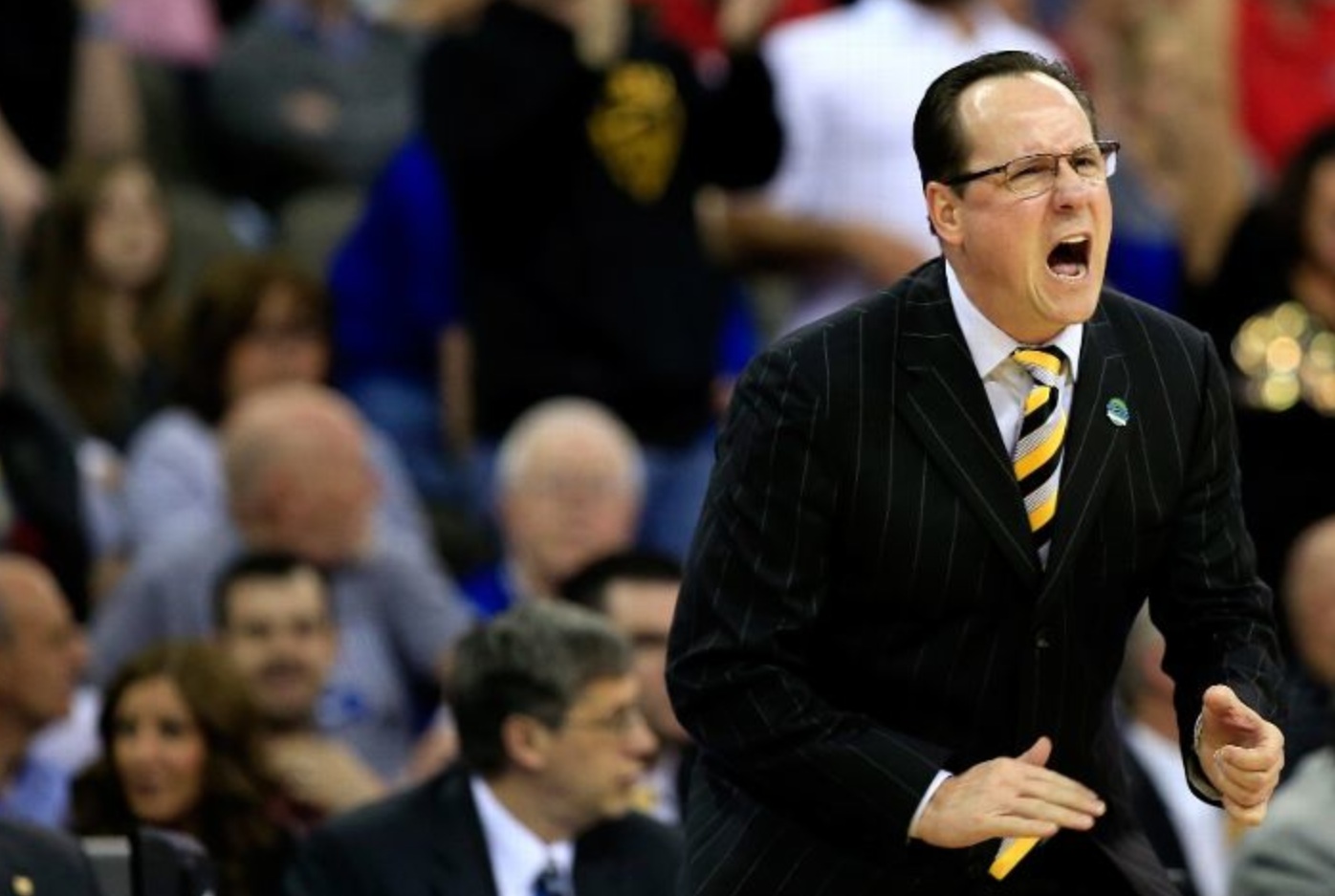
This March the hot young coach generating all the buzz is 52.

This March the hot young coach generating all the buzz is 52. (Getty/Jamie Squire)

The coaching carousel is turning rather slowly this March, with major-conference openings currently available at Alabama, Arizona State and DePaul and nowhere else. Perhaps there’s another shoe or even two that will drop on this front, but for now the salient characteristic of this season’s job market is not only the small number of openings but also the fact that none of these vacancies were created by voluntary coach exits. To really get the carousel going you need a series of guys jumping by choice to greener pastures.

Still, even in a slow year for hirings we will likely see all the traditional characteristics that make hiring a college basketball coach a uniquely challenging endeavor. To my eye these are the four structural hazards in any coaching search:

Tournament warp
Great coaches tend to do well in the NCAA tournament, eventually, but not every team that does well in the NCAA tournament necessarily has a great coach. Not to mention “doing well” in the tournament is by custom defined as making the Sweet 16, but most of the coaches who make the second weekend in any given year aren’t looking to change jobs. Continue reading