Author Archives: johngasaway

The ACC slams on the brakes

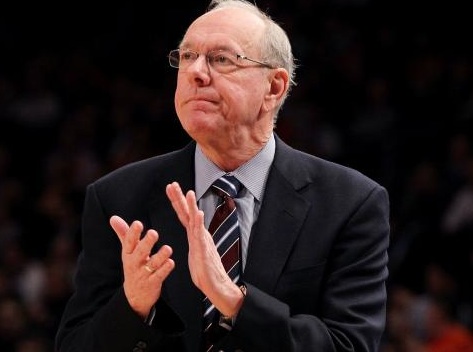
Syracuse is first in the ACC in defense, efficiency margin, offensive rebounding, and opponent turnover percentage. And last in pace.

Syracuse is first in the ACC in efficiency margin, defense, offensive rebound percentage, and opponent turnover percentage. And last in pace.

Tomorrow afternoon Miami will host Syracuse, and, as it happens, in terms of pace the Hurricanes and the Orange rank No. 126 and 127, respectively, out of the 127 teams I track on a per-possession basis during conference play. Ken Pomeroy’s laptop is well aware of this state of affairs and has spit out what would otherwise be a rather startling 54-possession forecast for the contest in Coral Gables.

That sounds about right. Duke paid a visit to BankUnited Center just the other night, after all, and Mike Krzyzewski and company were treated to a 57-possession gameContinue reading

Fine, defensive rebounding does matter

bitterbeerface

The Alabama student section is clearly excited about what the Tide and Arkansas can teach us about defensive rebounding.

This week while researching a piece on Arizona for Insider, I happened to notice that a) the Wildcats aren’t very good at defensive rebounding, and b) it hasn’t seemed to matter very much. Sean Miller’s team has far and away the best defense in the Pac-12, and possibly even the best D in the country.

This odd juxtaposition of facts led me to fling something reckless out on Twitter (it’s true!):

If only I’d held my fire, so to speak. Soon I was on to different questions entirely, or so I thought, when I came across this:  Continue reading

Tuesday Truths: “We’re Back” Edition

Welcome to the season’s first installment of Tuesday Truths, where I look at how well 127 teams in the nation’s top 11 conferences are doing against their league opponents on a per-possession basis. For a tidy little homily on why this stuff is so very awesome, go here.

American: Cincinnati has a very good defense
Through games of January 20, conference games only
Pace: possessions per 40 minutes
PPP: points per possession   Opp. PPP: opponent PPP
EM: efficiency margin (PPP – Opp. PPP)

                      W-L   Pace    PPP   Opp. PPP    EM
1.  Louisville        5-1   71.1    1.12    0.92    +0.20
2.  Cincinnati        6-0   64.0    1.03    0.87    +0.16
3.  SMU               3-2   65.3    0.99    0.92    +0.07
4.  Connecticut       2-3   65.7    1.12    1.09    +0.03
5.  Memphis           3-2   69.3    1.06    1.04    +0.02
6.  Houston           3-2   67.0    0.99    1.00    -0.01
7.  Rutgers           2-3   70.7    0.96    1.05    -0.09
8.  Temple            0-5   68.9    1.00    1.10    -0.10
9.  S. Florida        1-4   67.8    0.95    1.07    -0.12
10. UCF               1-4   68.8    0.94    1.14    -0.20

AVG.                        67.9    1.01

Over the years Cincinnati has cultivated a reputation for excellent defense, but this season’s Bearcats are giving indications that they might be the best such team we’ve yet seen in Mick Cronin’s tenure. And even if UC doesn’t finish the season looking as good on D as they do here — and with a remaining schedule that includes two games each against Connecticut and Louisville, they likely will not — I still offer all coaches reading this the example of the Bearcats’ first six games for further study. Over that stretch Cincinnati protected the rim, pushed opponents inside the three-point line, forced turnovers, and stayed out of foul trouble. That’ll do. Continue reading

Coming soon: Tuesday Truths for a realigned world

Pearl, the world's only tempo-free dog, eagerly awaits the return of Tuesday Truths.

Pearl, the world’s only tempo-free dog, eagerly awaits the return of Tuesday Truths.

Next week on a day that I trust needs no further specification here, Tuesday Truths will spring to life for a seventh season. In the peripatetic feature’s latest incarnation, the Truths will track every possession in conference play for the American, ACC, Big 12, Big East, Big Ten, Pac-12, SEC, A-10, Missouri Valley, Mountain West, and West Coast. If a Final Four team arises from outside of that group, you’ll have to say you saw it all coming thanks to some non-Truths source. My apologies in advance.  Continue reading

Perception and Josh Pastner

JP

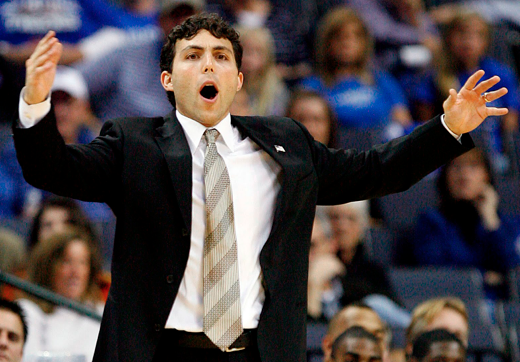
Today at Insider I’ve written about Memphis and why I think the Tigers will be a force to be reckoned with in this year’s American race. And by “force to be reckoned with,” I mean “about as good as if not better than any other team that we think will still be in the league next season.”

Having zeroed in on this season’s team, I want to take a step back and consider Josh Pastner’s career and specifically what his example may be able to tell us about how college basketball is customarily narrated. (Something like a person facing backward on a train and describing the terrain as it goes by with feigned “I knew this was coming” omniscience. But I’m getting ahead of myself.)  Continue reading

Mark Emmert is exactly right

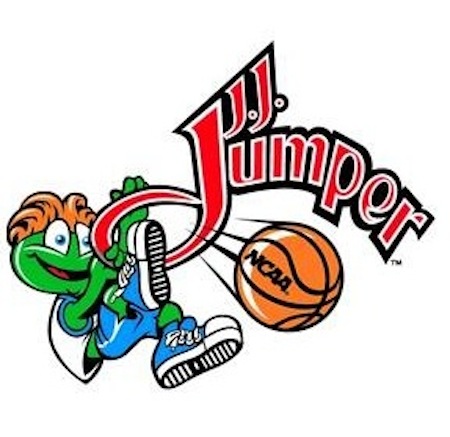
Official NCAA mascot J.J. Jumper is actually less efficient in his scoring than Trey Triples or Attila at the Rim.

Official NCAA mascot J.J. Jumper, a markedly less efficient scorer than Trey Triples or Relentless Rim-Attacks. (NCAA)

Speaking at the IMG Intercollegiate Athletics Forum in New York yesterday, NCAA president Mark Emmert answered a question about the criticism that’s been directed his way by my ESPN colleague Jay Bilas. “I don’t like the ad hominem attacks,” Emmert said, to which Jay immediately responded: “They’re not attacks. The criticism is fair, and right on.”

As Jay himself is wont to say, reasonable people can differ on the precise point at which substantive criticism becomes an exercise in ad hominem polemic. For Emmert, that point was apparently reached earlier this year when Jay called the NCAA’s head man “an absentee president.” Personally I think that’s self-evidently an assessment of performance rather than a prejudicial slander — pallid grounds for a duel, if you ask me.  Continue reading

There are, for now, seven major conferences

James H. Smart helped start the Big Ten, possibly because he was tired of Purdue being called a mid-major.

James H. Smart helped start the Big Ten, possibly because he was tired of Purdue being called a mid-major.

Yesterday at Insider I ranked my top five mid-majors, and in response I heard back from some readers who felt that the hardiest of hoops perennials — what’s a mid-major? — perhaps merits rehashing in this era of wanton realignment. Fair enough. What’s a mid-major?

A mid-major is a team from any conference except the ACC, American, Big 12, Big East, Big Ten, Pac-12, or SEC.  Continue reading

Saluting the nation’s most masochistic fans

Which program is the polar opposite of these guys?

Which program is the polar opposite of these guys?

One thing I’ve always respected highly is the ability to faithfully support a team that’s consistently terrible. Today I want to salute the fans of the worst major-conference program in the nation.

Not merely the worst team at this moment, mind you. I’m after something more enduring, the program that can make the best case that it is nothing less than ontologically hapless.  Continue reading

You say Marshall Henderson, I say Andy Kennedy

Turns out the SEC has seen a quick trigger finger before.

The SEC’s seen a quick trigger finger before.

Marshall Henderson attempted 23 threes in 36 minutes in Mississippi’s 115-105 overtime loss to Oregon yesterday. Henderson fared quite well against the Ducks, sinking 10 of those attempts and scoring 39 points, but it was not quite enough for the Rebels to win at home against a top-15 opponent.  Continue reading

Placebo effects and new coaches

Not every hire can work out this well. (He probably promised a faster pace.)

Not every hire can work out this well. He probably promised a faster pace.

All new-coach hires are alike; each coaching departure is unhappy in its own way.

For example at Missouri the past couple years, Frank Haith’s been turning things around:

Haith was an instant positive energy on the sidelines and on the practice court. Practices were higher intensity and more structured. Film sessions became analytic. The strength and conditioning program went from a team perspective under [Mike] Anderson to an individualized approach under Haith.

Haith replaced Mike Anderson, who was hired by Arkansas in 2011. When he arrived in Fayetteville, Anderson promptly started turning things aroundContinue reading