
On the evening of March 15, 2011, Alex Garcia-Mendoza drained a three for Little Rock with 18:47 remaining in the first half of the Trojans’ First Four game against UNC Asheville in Dayton. It was the first three-pointer in the opening game of the 2011 NCAA tournament.
Garcia-Mendoza’s trey marks a convenient boundary line. The field had just expanded to 68 teams that year. As of this writing we are three games shy of having played 15 full brackets in this current configuration.
In the 68-team era NCAA tournament teams have made nearly 13,000 threes on about 38,000 attempts. The 15-tournament figure for accuracy from behind the arc thus stands at 33.6 percent, but keep in mind the line was moved back prior to the tipoff of the 2021 bracket. A more accurate rendering of March Madness accuracy might note instead that with the current line teams are 4,816-of-14,557 (33.1 percent) across the last five tournaments.
Recurring 2020s-era exposés on bad three-point shooting in the tournament and on any potential culpability of the ball itself are therefore eminently understandable if not historically predetermined. Such pieces give voice to the disillusion and bafflement of we oldsters who proudly carry sentient memories of the 2010s.
We old-timers recall a pre-pandemic idyll when Twitter was “Twitter,” coaches wore suits instead of officially licensed pajamas, and teams made 34 percent of their tournament threes. Alas, that statistical gravity is now centered at 33 percent. Today’s variable but still tethered all-day, all-round, or all-bracket highs for accuracy won’t be as high as we (correctly!) remember them being in the Before Times. The lows will be lower.
There is however one Madness tradition that spans the decades with becoming seamlessness. Whether the arc has been closer to or somewhat more distant from the goal, teams reaching the Final Four have without fail shown a really good collective figure for three-point FG percentage defense.
Such is the case once again in 2025.
The NCAA tournament can be a three-point defense lottery
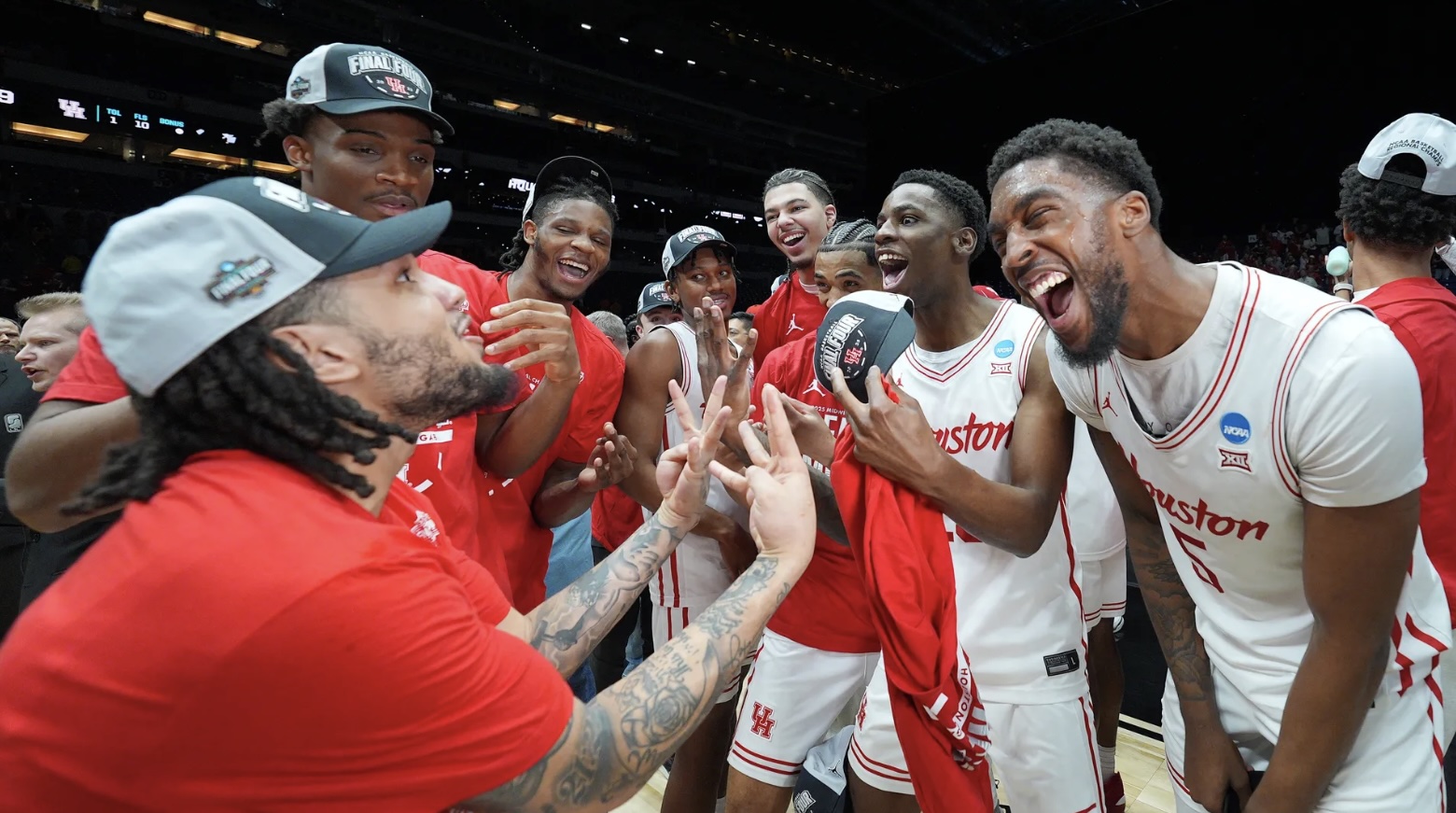
Tournament opponent 3FG%s for 2025 Final Four
                            Opp. 3FGM    Opp. 3FGA      %
Auburn            2025          30           92       32.6
Duke              2025          33          110       30.0
Florida           2025          26           89       29.2
Houston           2025          24          100       24.0

Total                          113          391       28.9
Houston’s four opponents collectively made fewer threes in 160 minutes than Alabama drained in 40 against BYU. Nevertheless, a collective 28.9 percent figure from all Final Four opponents is actually the best three-point accuracy we’ve seen from a combined grouping of 16 vanquished foes since 2021. (When of course it was 17 vanquished foes. Well done, UCLA.)
Over the course of 15 tournaments since the field expanded Final Four teams have reliably had a wind at their back equivalent to about a five percent dip in opponent three-point accuracy. Naturally there are exceptions for individual national semifinalists. Wisconsin in 2015 and Virginia in 2019 in particular stand out as examples where opponents fairly went nuts from beyond the arc to the tune of 50 percent on very low volume and 39 percent on extremely high Carsen Edwards-fueled volume, respectively.
At the other extreme we’ve seen just how bad opponent three-point shooting can be over a sample size as small as four games.
Good fortune at the best time
Worst pre-Final Four tournament opponent 3FG%s for national semifinalists, 2011-25
                            Opp. 3FGM    Opp. 3FGA      %
Syracuse          2013          14           91       15.4
San Diego State   2023          16           94       17.0
Kentucky          2015          12           59       20.3
Villanova         2022          17           80       21.3
VCU               2011          23          100       23.0
Texas Tech        2019          22           94       23.4
Look at that plucky UK team from 2015, a bunch of scrappy overachievers who needed every break they could get to eke out a miracle Final Four run. No, as is the case on occasion with the wealthy and actual lotteries, sometimes it’s the mightiest teams that receive Naismith’s whimsical blessing in the form of historically atrocious three-point shooting by opponents. Go figure.
As three-point attempt rates rise one might expect opponent accuracy from beyond the arc to play an increasingly large role in March Madness outcomes. That’s sound as far as it goes, and indeed in terms of perimeter orientation in the tournament we are now (40.8 percent of attempts) back to where we were in 2019 (40.9) before the line was moved back. However, one qualifier is perhaps in order before we fret about future tournaments becoming more like a roulette wheel.
Another way of saying that three-point attempt rates are rising is to remark that the number of two-point tries outside the paint is falling. The relative weights of “jumpers” on the one hand and “paint attempts/layups/dunks” on the other may remain more or less steady over time even as three-point attempt rates continue to climb. What could be happening is not so much that threes are taking over the game as that long twos are continuing their slow decline toward obsolescence.
This telling of the story would seem to be supported by the best tournament two-point shooting we’ve seen in eight years. In the first 64 games of the 2025 tournament, teams have converted a robust 51.1 percent of their attempts inside the arc. As a result those expected point values per attempt that Nate Oats is always rattling on about have actually been in rather serene equilibrium on either side of the arc in this bracket.
The tournament can be a three-point defense lottery and it has always been thus. What’s changing is that with each passing year teams continue to improve at getting the puppies organized behind the line before launching that long jumper with a 1-in-3 chance of success.
 John Gasaway